Loading…
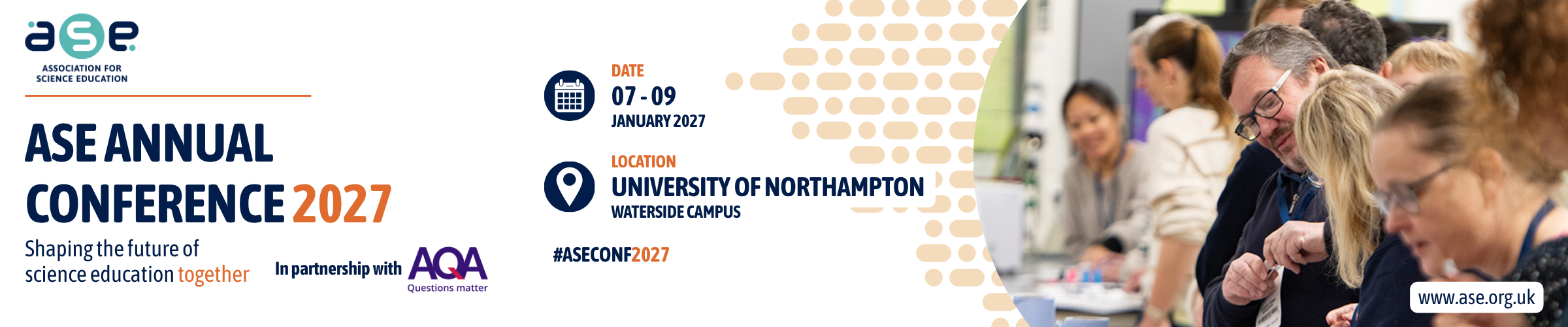
The ASE is delighted to be hosting its’ 2027 Annual Conference at the University of Northampton from 7th to 9th January.


Venue: LH124 (Learning Hub Level 1) clear filter
arrow_back View All Dates
Saturday, January 9
 

08:45 GMT

Making primary physics matter
Saturday January 9, 2027 08:45 - 09:40 GMT
Physics in primary classrooms can sometimes feel difficult to teach confidently. Children often arrive with strong existing ideas about forces, light, sound or electricity, while practical activities can easily become focused on “doing” rather than understanding. This workshop explores simple, evidence-informed approaches that help teachers make physics teaching clearer, more purposeful and more accessible for all learners.

Using a range of classroom examples, participants will explore how to start with children’s thinking, make practical work more meaningful and develop pupils’ ability to talk and reason about physics. The session will examine approaches such as prediction questions, purposeful practical design, diagnostic discussion strategies, explicit vocabulary teaching and structured classroom talk.

The workshop focuses on small changes that can have a big impact on pupil understanding without requiring specialist equipment or advanced subject knowledge. Participants will leave with practical routines, questioning techniques and adaptable strategies that can be used immediately within primary science lessons.
This session is particularly suitable for primary teachers, science leaders and teachers who may feel less confident teaching physics but want to strengthen pupils’ conceptual understanding and engagement.

As a result of attending, participants will be able to:
> use strategies to elicit and respond to pupils’ existing physics ideas and misconceptions
> adapt practical activities so that the physics learning is explicit and purposeful
> structure classroom talk to support reasoning, explanation and participation
> teach and reinforce key physics vocabulary more effectively
> apply evidence-informed approaches to improve pupil understanding in primary physics lessons
> identify at least one practical change they will implement in their own classroom practice immediately

Background: This workshop draws on my work supporting primary science and physics teaching through classroom practice, teacher development and subject-specific CPD. Over time, I have become increasingly interested in the small pedagogical shifts that can make a significant difference to children’s understanding of physics concepts.
The session is informed by evidence and guidance from organisations including the Education Endowment Foundation, the Institute of Physics and the Ogden Trust, alongside research into purposeful practical work, oracy and misconceptions in primary science. It also reflects extensive work with teachers who often feel less confident teaching physics than other areas of science.

The approaches shared have been developed through trialling and refining strategies that help teachers move beyond “busy practicals” towards lessons where children think, talk and reason more effectively about the physics taking place.
Speakers
AP

Amanda Poole

Teaching and Learning Coach, Primary Partnerships, Ogden Trust
Amanda Poole is a specialist in primary science education and Chartered Science Teacher. As a physicist, she began her career as a secondary advanced skills teacher in Coventry and after holding a range of senior leadership roles in secondary education she moved into the field of... Read More →
Saturday January 9, 2027 08:45 - 09:40 GMT
LH124 (Learning Hub Level 1)
  Primary

09:55 GMT

(OUP) The magic of storytelling in the diverse physics curriculum
Saturday January 9, 2027 09:55 - 10:50 GMT
Storytelling has always been a powerful way to share knowledge, shape understanding, and engage curiosity — but its role in the physics classroom is often overlooked. In this session, we will explore how narratives can transform the way students experience physics, making it more engaging, memorable, and authentically inclusive.

The session begins by unpacking the concept of a curriculum narrative — a structured and sequenced thread that connects key ideas across lessons and units. Participants will examine how narrative techniques can help learners perceive the curriculum not as a collection of isolated facts but as a cohesive and compelling story. Using classic narrative structures, we will discuss how educators can build meaningful arcs around topics such as forces, radioactivity, or energy, framing physics as a human story of curiosity, bravery, collaboration, and discovery.

It’s important to acknowledge the risks and challenges of storytelling in physics education: as such, the session will encourage us to consider how to balance narrative elements with rigorous concept delivery, avoid reinforcing stereotypes, and design lessons that make key ideas explicit and secure.

The session will be highly practical and interactive, with opportunities to:

- Explore a range of narrative themes relevant to physics teaching, such as awe and wonder, bravery in discovery, collaboration, and resilience
- Map existing units onto a narrative structure and develop creative approaches to embedding stories into everyday practice
- Discover new and inclusive sources for narratives, including students’ own cultural contexts, contemporary STEM careers, and “what if” scenarios that spark curiosity.

By the end of the session, attendees will:

- Understand the principles and benefits of curriculum narrative design in physics
- Be equipped with actionable strategies for incorporating storytelling into lessons and schemes of work
- Gain insights into how stories can challenge outdated stereotypes and foster a more inclusive physics curriculum that resonates with every learner.

Participants engage with themes such as awe and wonder, bravery in discovery and collaboration and resilience within a discussion of how these can shape teaching within a curriculum mapping task including embeddings storytelling into lessons, explanations and sequences of learning.

Participants will leave with:
a clearer understanding of the implications of generative AI for science education;
practical classroom strategies for developing critical AI literacy through science;
approaches for helping students evaluate scientific claims and information critically;
increased confidence in discussing AI, accuracy, misinformation and scientific communication within KS3 science contexts;
ideas for embedding AI literacy within existing science curricula and pedagogical approaches.
Speakers
avatar for Jonathan Lansley-Gordon

Jonathan Lansley-Gordon

Co-Founder, Blackett Lab family

Sponsors
avatar for Oxford University Press

Oxford University Press

As part of one of the world’s great universities, we’re driven by a love of learning and a deep conviction that education is a universal good.

For us, every child deserves to be taught by brilliantly professional teachers, working in close partnership with engaged parents, using the best and most inspiring learning resources, technology, and teaching methods. To that end, we work with the brightest, most creative educational... Read More →

Saturday January 9, 2027 09:55 - 10:50 GMT
LH124 (Learning Hub Level 1)

11:15 GMT

Teaching primary science outdoors
Saturday January 9, 2027 11:15 - 12:10 GMT
This practical workshop will support teachers in taking their primary science lessons outdoors.  

• To consider which lesson objectives should be taught outdoors, and which lesson objectives could be taught outdoors
• To plan purposeful practical activities
• To explore opportunities for assessment and recording outdoors

Helen Spring CSciTeach is a Primary Science and Outdoor Learning Consultant. With a wealth of experience as a teacher and science subject leader, Helen specialises in primary science and outdoor learning. She is the author of the book, 'Teaching Primary Science Outdoors'. Helen's expertise lies in supporting primary science subject leaders and teachers, assisting them in enhancing the quality of their teaching and learning.

This practical workshop will support teachers in taking their primary science lessons outdoors. We will explore which lessons should be taught outdoors, and which lessons could be taught outdoors. We will spend time looking at how to plan for effective outdoor science lessons, where children make progress, and where teachers have the opportunity to assess that progress.

Participants will be able to reflect on their own science teaching, and to plan further opportunities for taking their science lessons outdoors.  
Speakers
avatar for Helen Spring CSciTeach

Helen Spring CSciTeach

Primary Science and Outdoor Learning Consultant, Spring Learning
I am a Primary Science and Outdoor Learning Consultant for Spring Learning and a Primary Consultant for CLEAPSS, as well as the author of 'Teaching Primary Science Outdoors'.  I am the co-chair of the ASE's Primary Science Committee, a Primary Science Quality Mark hub leader and... Read More →
Saturday January 9, 2027 11:15 - 12:10 GMT
LH124 (Learning Hub Level 1)

12:25 GMT

Talking and thinking at Science on Stage: using simple stimuli and strategies to build a culture of rich scientific talk
Saturday January 9, 2027 12:25 - 13:20 GMT
 Are your students working in groups but not truly thinking together?

In this session, we will explore how strategies such as purposeful oracy games can transform the quality of talk and argumentation in your science classroom. You will be introduced to a simple, repeatable structure that moves students beyond mere prediction to explaining their reasoning, observing with purpose, and reconciling their ideas with evidence. Rather than seeing/dialogue/  as an "extra," you will learn how to weave it into the fabric of your lessons, creating rich, productive environments where good talk becomes a habit.

We will discuss the small, manageable changes you can make to your everyday practice; from a short starter activity to a more extended investigation, that can have a transformative impact on student thinking, engagement, and scientific literacy.

We will also provide practical examples and a framework for designing these sequences, so they are easy to implement and highly effective.
Speakers
avatar for Peter Munroe

Peter Munroe

Head of Chemistry, Uckfield College

avatar for Alex Black

Alex Black

Council Member, Lets Think Forum
Saturday January 9, 2027 12:25 - 13:20 GMT
LH124 (Learning Hub Level 1)

13:35 GMT

What if the next climate solution is in your classroom? Project Earth - empowering young people to build a better world.
Saturday January 9, 2027 13:35 - 14:30 GMT
Young people have extraordinary ideas for tackling climate change and biodiversity loss. Too often, those ideas never get beyond the classroom.  Project Earth is changing that.

This talk explores how teachers can help young people move from learning science to using science to solve real problems — connecting their ideas with experts, opportunities and the support to take them further.

Don't just teach young people about the future. Give them the tools to help shape it.

Young people have extraordinary potential. Project Earth helps turn it into impact — now..

Speakers
avatar for Becky Parker MBE

Becky Parker MBE

Director (Project Earth) / Physics Teacher / Visiting Professor (School of Physics and Astronomy), Queen Mary University of London
Saturday January 9, 2027 13:35 - 14:30 GMT
LH124 (Learning Hub Level 1)

15:55 GMT

A framework for fostering scientific argumentation: Enhanced (CASE)
Saturday January 9, 2027 15:55 - 16:50 GMT
Participants will experience a series of short science-learning episodes designed to model how prediction and the five CASE pillars can foster effective scientific argumentation. Through carefully structured dialogic activities, participants will discuss scientific contexts, make and justify predictions, evaluate competing explanations and reflect on the pedagogical moves that support productive classroom talk.

The session will briefly introduce the theoretical foundations of CASE and the role of prediction in generating cognitive conflict and conceptual engagement. Participants will then work collaboratively through classroom examples that demonstrate how prediction tasks can stimulate reasoning, evidence-based discussion and metacognitive reflection.

Throughout the session, participants will analyse how teacher questioning, social interaction and task design contribute to an environment where scientific argumentation can flourish. Time will also be provided for reflection and action planning so participants can consider how these approaches could transfer to their own contexts.

Background:  Scientific argumentation is increasingly regaining recognition as central to high-quality science education, yet many classrooms still struggle to move beyond short-answer recall or teacher-led questioning. This workshop explores how prediction, when deliberately integrated within the CASE framework, can help create conditions in which students are more willing to articulate, defend and reconsider their thinking.
The conditions that researchers such as Osborne, Kuhn and Erduran have insisted are necessary for successful argumentation will be explored in relation to the CASE pedagogy.

The way that eliciting predictions and explanations creates a classroom culture for dialogic teaching to flourish will be demonstrated throughout the presentation. The presenter has developed and refined approaches that combine the established CASE pillars with explicit prediction routines to encourage deeper reasoning and richer pupil talk. The session is informed by research into cognitive conflict, social construction of understanding and the role of exploratory discussion in science education.
Speakers
avatar for Alex Black

Alex Black

Council Member, Lets Think Forum
avatar for Natasha Serret

Natasha Serret

Associate Professor of Science Education, Nottingham Trent University
I started my professional career as a classroom teacher and science lead in a London primary school. I was and remain passionate about classroom learning that promotes a scientific mindset alongside the development of an understanding of key scientific concepts.  This professional... Read More →
Saturday January 9, 2027 15:55 - 16:50 GMT
LH124 (Learning Hub Level 1)
 

Share Modal

Share this link via

Or copy link

Filter sessions
Apply filters to sessions.
Filtered by Date -