Loading…
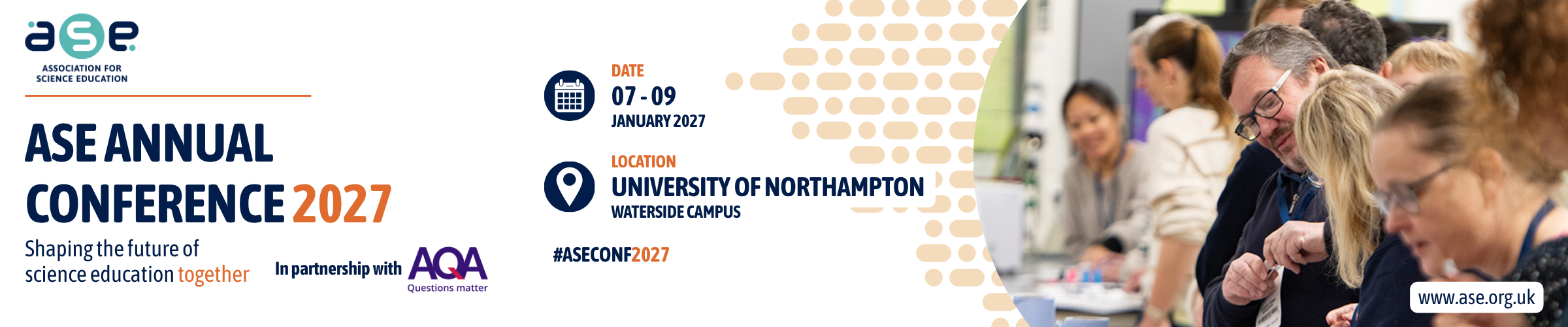
The ASE is delighted to be hosting its’ 2027 Annual Conference at the University of Northampton from 7th to 9th January.


Venue: LH113 (Learning Hub Level 1) clear filter
arrow_back View All Dates
Saturday, January 9
 

08:45 GMT

Energise your science teaching: enquiry, sustainability and real-world contexts
Saturday January 9, 2027 08:45 - 09:40 GMT
How can we teach primary science in ways that are both rigorous and genuinely meaningful?

This interactive session explores how cross-curricular topics such as energy, climate, and sustainability can be taught through enquiry-driven, real-world contexts. Grounded in the primary science curriculum, it demonstrates how linking to geographical understanding—such as rocks and soils, water systems, habitats, environments, and human impact—can strengthen, rather than dilute, disciplinary knowledge.

Participants will take part in a practical renewable energy investigation, modelling how pupils can ask questions, test ideas, and interpret results. The session also introduces free, adaptable resources and shows how they can be used to support substantive and disciplinary knowledge and skills.

We will also explore how initiatives like the Great Science Share for Schools and Practical Action projects can provide purpose and audience for pupil learning, raising engagement and science capital.
You will leave with clear, classroom-ready approaches that combine strong science pedagogy with meaningful context—without increasing workload.

By the end of the session, participants will:
• Explore enquiry-based science lessons using real-world energy and sustainability contexts
• Apply strategies to support pupils in asking questions, investigating, and communicating findings
• Integrate opportunities for purposeful talk to strengthen scientific reasoning
• Be ready to implement at least one practical, evidence-informed strategy in their classroom

Background: This session draws on classroom practice and cross-curricular curriculum development, with a focus on improving how pupils engage with complex scientific ideas such as energy and climate. My work has been shaped by integrating science and geography to provide meaningful, real-world contexts that support both conceptual understanding and pupil motivation.

I have collated, developed and trialled classroom approaches where pupils ask their own questions, investigate renewable energy systems, and communicate their findings—leading to improved engagement, confidence, and scientific reasoning.
Speakers
avatar for Jo Montgomery CSciTeach

Jo Montgomery CSciTeach

Primary Science Education Consultant, Dr Jo Science Solutions
RSC Excellence in Primary Education Prize 2024. With both a teaching and science background, Dr. Jo Montgomery has more than 20 years’ experience working with children and schools to support science education from Early Years to university. Passionate about encouraging curiosity... Read More →

Saturday January 9, 2027 08:45 - 09:40 GMT
LH113 (Learning Hub Level 1)

11:15 GMT

Using research on children's misconceptions to develop primary science
Saturday January 9, 2027 11:15 - 12:10 GMT
This session explores why evidence-based approaches are essential for creating high-quality primary science lessons that are effective and meaningful for all learners.

It introduces research-informed approaches such as Best Evidence Science Teaching (BEST) for primary-aged children, demonstrating how evidence can be translated into practical strategies to diagnose misconceptions, sequence learning and use formative assessment to build secure scientific understanding.

The session also introduces BEST Bites, new CPD modules designed to support teachers in developing learners’ understanding of key scientific ideas and easing transition from primary to secondary science.
Speakers
avatar for Nicky Waller

Nicky Waller

Advisory Teacher for Primary Science, University of York

Saturday January 9, 2027 11:15 - 12:10 GMT
LH113 (Learning Hub Level 1)
  Primary

12:25 GMT

Decolonising primary science: examples, research and next steps
Saturday January 9, 2027 12:25 - 13:20 GMT
The aim of this session is to support teachers in applying a decolonial lens to their primary science teaching practice. It will encourage participants to explore parallel ways of knowing and to acknowledge how colonial legacies continue to shape our current education systems. We will demonstrate how to link historical and indigenous epistemologies to Western understanding and applications of science and suggest how these ideas can be taught concurrently.  

Concrete classroom and whole‑school examples of this approach will be shared, alongside discussion of their impact on children’s attitudes, beliefs and engagement with science. In addition, the session will disseminate evidence from our research into the use of generative artificial intelligence in identifying and producing resources to support teaching through a decolonial lens.

We will start with an introduction for the need to decolonise the primary science curriculum and an overview of what this entails, and discuss tried and tested classroom and whole‑school examples. We will also include a review of research into how GenAI can be used to source specific materials for this approach and offer delegates an opportunity to trial GenAI prompts to source materials, ending with a brief Q&A.

Speakers
DO

Danielle Oudomvilay

Classroom Teacher and Science Subject Lead, Bevington Primary School

avatar for Alex Sinclair

Alex Sinclair

Associate Professor; Primary Science Course Lead; Ex Co-Chair of ASE (23/24), St Mary's University, Twickenham
I am Associate Professor and Primary Science Lead for the Initial Teacher Education programmes at St Mary’s University, Twickenham. As a member of the Primary Science Curriculum Advisory Group (PCAG) I was involved in producing the Framework for a Future Primary Science Curriculum... Read More →
Saturday January 9, 2027 12:25 - 13:20 GMT
LH113 (Learning Hub Level 1)

14:45 GMT

Using story probes to link primary science and literacy
Saturday January 9, 2027 14:45 - 15:40 GMT
This session draws on decades of research on formative assessment (including Paul Black and Dylan Wiliam’s work) focused on uncovering and using students’ ideas as the foundation for instruction. The approach has evolved through classroom practice that combines research on conceptual understanding, disciplinary literacy, and productive science discussion. Story probes were developed combine the engagement of narrative with the instructional power of formative assessment.

Stories naturally engage learners, spark curiosity, and invite discussion. In this interactive session, participants will explore how story probes can be used to connect science learning, literacy practices, and formative assessment. Through carefully crafted story scenarios, students encounter characters expressing different ideas about a scientific phenomenon or concept. These scenarios encourage learners to analyse characters’ perspectives, and share their own ideas in a low-risk and engaging context.

Participants will experience how story probes can be used to uncover children’s thinking about science while supporting close reading strategies by interpreting meaning from text. Attention will be given to how teachers can listen for children's ideas, use those ideas to inform instruction, and create classrooms where thinking, questioning, and sensemaking are valued. Participants will leave with practical strategies for developing and integrating story probes into science instruction in ways that strengthen both conceptual understanding and literacy skills. They will also be provided with a link to access and download sample story probes.

These story probes are based on extensive formative assessment research and practice from both the UK and the US. Page Keeley’s probes in the Uncovering Student Ideas series published in the U.S. are used extensively in schools throughout the U.S.; and, in collaboration with Ed Walsh, have been adapted by Millgate for a UK audience.

As a result of attending this session, participants will be able to:
1) Facilitate close reading and productive science talk around science scenarios.
2) Use a story scenario to identify and interpret students’ ideas revealed through story-based discussions
3) Apply formative assessment strategies that use student thinking to inform instruction.
4) Adapt or create story scenarios that integrate science content with literacy practices

Speakers
avatar for Page Keeley

Page Keeley

Past President/NSTA Press Author, National Science Teaching Association
Page Keeley is an American science education consultant and author of over 25 books linking research to practice, including several award-winning books in the Uncovering Student Ideas in Science formative assessment series. She is a co-author, with Ed Walsh, of the UK publication, Understanding Children's Ideas in Science. She works with school districts, universities, and organizations throughout the U.S. and internationally to build capacity for understanding student thinking through assessment... Read More →
avatar for Ed Walsh

Ed Walsh

Science Education Consultant, Ed Walsh Consulting
An author and CPD presenter, I was a teacher for 20 years, 12 of them as team leader.  I then worked as a consultant, supporting teachers and science teams, training teachers and developing curriculum materials.  I am now a Series Editor for Collins, CPD Trainer for AQA and Development... Read More →
Saturday January 9, 2027 14:45 - 15:40 GMT
LH113 (Learning Hub Level 1)
  Primary

15:55 GMT

Dialogic teaching -a new CPD resource for primary science
Saturday January 9, 2027 15:55 - 16:50 GMT
Join ASE and our partner, University of York Science Education Group, for the launch of our Dialogic Teaching in Primary Schools MOOC.

This resource is supported by the Templeton World Charity Foundation as part of ASE’s Sustaining the Impact of Big Questions in Classrooms in Science Education initiative
Speakers
avatar for Marianne Cutler

Marianne Cutler

Director of Curriculum Innovation, Association for Science Education
avatar for Peter Fairhurst

Peter Fairhurst

Research Fellow, University of York Science Education Group
I am a research fellow at the University of York where, in addition to empirical research, the focus of my work is the translation of research-evidence into classroom resources that support students' learning of science through the development of teachers' research-informed pract... Read More →
Saturday January 9, 2027 15:55 - 16:50 GMT
LH113 (Learning Hub Level 1)
 

Share Modal

Share this link via

Or copy link

Filter sessions
Apply filters to sessions.
Filtered by Date -