Loading…
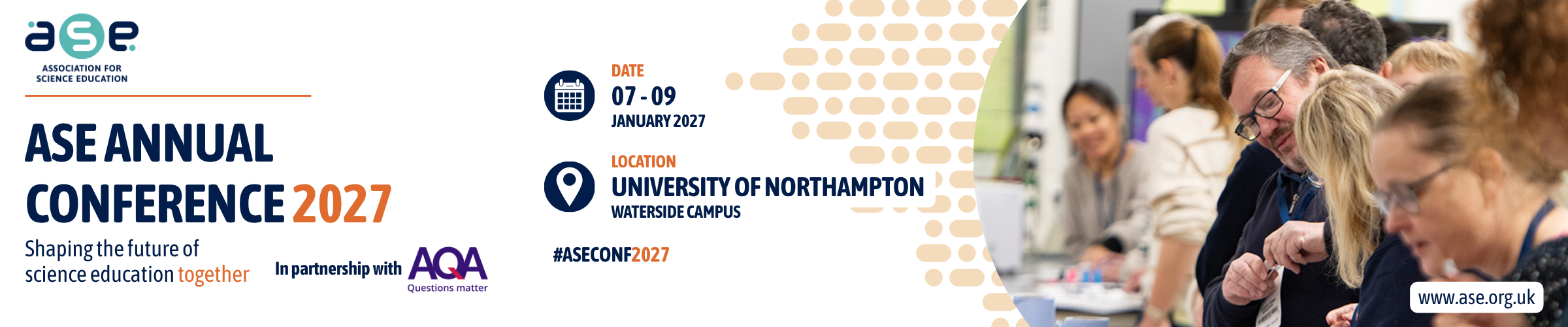
The ASE is delighted to be hosting its’ 2027 Annual Conference at the University of Northampton from 7th to 9th January.


Company: Inclusion and Diversity including SEND clear filter
arrow_back View All Dates
Saturday, January 9
 

09:55 GMT

(OUP) The magic of storytelling in the diverse physics curriculum
Saturday January 9, 2027 09:55 - 10:50 GMT
Storytelling has always been a powerful way to share knowledge, shape understanding, and engage curiosity — but its role in the physics classroom is often overlooked. In this session, we will explore how narratives can transform the way students experience physics, making it more engaging, memorable, and authentically inclusive.

The session begins by unpacking the concept of a curriculum narrative — a structured and sequenced thread that connects key ideas across lessons and units. Participants will examine how narrative techniques can help learners perceive the curriculum not as a collection of isolated facts but as a cohesive and compelling story. Using classic narrative structures, we will discuss how educators can build meaningful arcs around topics such as forces, radioactivity, or energy, framing physics as a human story of curiosity, bravery, collaboration, and discovery.

It’s important to acknowledge the risks and challenges of storytelling in physics education: as such, the session will encourage us to consider how to balance narrative elements with rigorous concept delivery, avoid reinforcing stereotypes, and design lessons that make key ideas explicit and secure.

The session will be highly practical and interactive, with opportunities to:

- Explore a range of narrative themes relevant to physics teaching, such as awe and wonder, bravery in discovery, collaboration, and resilience
- Map existing units onto a narrative structure and develop creative approaches to embedding stories into everyday practice
- Discover new and inclusive sources for narratives, including students’ own cultural contexts, contemporary STEM careers, and “what if” scenarios that spark curiosity.

By the end of the session, attendees will:

- Understand the principles and benefits of curriculum narrative design in physics
- Be equipped with actionable strategies for incorporating storytelling into lessons and schemes of work
- Gain insights into how stories can challenge outdated stereotypes and foster a more inclusive physics curriculum that resonates with every learner.

Participants engage with themes such as awe and wonder, bravery in discovery and collaboration and resilience within a discussion of how these can shape teaching within a curriculum mapping task including embeddings storytelling into lessons, explanations and sequences of learning.

Participants will leave with:
a clearer understanding of the implications of generative AI for science education;
practical classroom strategies for developing critical AI literacy through science;
approaches for helping students evaluate scientific claims and information critically;
increased confidence in discussing AI, accuracy, misinformation and scientific communication within KS3 science contexts;
ideas for embedding AI literacy within existing science curricula and pedagogical approaches.
Speakers
avatar for Jonathan Lansley-Gordon

Jonathan Lansley-Gordon

Co-Founder, Blackett Lab family

Sponsors
avatar for Oxford University Press

Oxford University Press

As part of one of the world’s great universities, we’re driven by a love of learning and a deep conviction that education is a universal good.

For us, every child deserves to be taught by brilliantly professional teachers, working in close partnership with engaged parents, using the best and most inspiring learning resources, technology, and teaching methods. To that end, we work with the brightest, most creative educational... Read More →

Saturday January 9, 2027 09:55 - 10:50 GMT
LH124 (Learning Hub Level 1)

09:55 GMT

Improving primary science teaching in areas of high deprivation & challenge
Saturday January 9, 2027 09:55 - 10:50 GMT
This session will present the design, implementation, and findings of a three year research and improvement project focused on raising the quality of science teaching and learning in high deprivation settings.

We worked with 32 primary schools to explore what improves science teaching — and what holds it back. You’ll hear how schools used science audits, teacher surveys, targeted CPD, and network meetings to build teacher confidence and strengthen classroom practice. We’ll share what changed, what teachers valued most, and how high-quality CPD helped schools understand their challenges and make improvements.

We’ll also discuss the real world barriers schools face — including high subject leader turnover — and what helped them keep making progress.

Participants will gain:
• Evidence of impact, including clear improvements in teacher confidence, positive shifts in science teaching practice and excellent participant feedback on CPD quality
• Insights into systemic challenges, particularly:
- High turnover of science subject leaders and its effect on continuity
- Practical strategies for supporting science subject leaders in high deprivation contexts
- An approach for using deprivation related data to understand school needs and tailor support
- Recommendations for sustaining improvement, even in schools with leadership instability

Background: Primary science teaching provision gaps in England remain strongly linked to socioeconomic deprivation. Schools serving communities with high levels of disadvantage often face additional barriers: limited departmental stability, fewer opportunities for sustained professional development and sometimes significant behavioural challenges.

This project worked with 32 schools across three ‘priority’ areas in the south-east of England (Edmonton, Medway and the North Thames Estuary) to understand their specific needs and to trial targeted support. The initiative combined school level diagnostic audits, teacher surveys, structured CPD, mentoring and ongoing collaboration through network meetings. The aim was to build capacity, strengthen subject leadership, and improve the quality of science teaching in a way that is responsive to each school’s context.

CPD and support was delivered across schools by Kulvinder Johal, Primary Science Mentor for the Primary Science Teaching Trust. Content was created by drawing on years of experience working in the classroom, backed up by research and findings on good primary science teaching in the sector.
Speakers
avatar for Kulvinder Johal

Kulvinder Johal

Regional Mentor for London and the S.E., Primary Science Teaching Trust
@kulvinderj
SF

Sophie Franklin

Impact & Research Director, Primary Science Teaching Trust

Saturday January 9, 2027 09:55 - 10:50 GMT
LH125 (Learning Hub Level 1)

10:50 GMT

Chair Chat
Saturday January 9, 2027 10:50 - 11:15 GMT
Our dedicated Chair Trio invite you to drop-in to the “Chair-Chat” sessions on one of the days of Annual Conference 2027. The Chair is a vital role to the ASE, and the elected Chair provides an authoritative voice for the thousands of members that the ASE supports, along with those working within the wider science education community. Those elected remain part of our Chair Trio for 3 years.

Got a question? Ever wondered about what goes on behind the scenes? Ever thought about getting involved in Committee activities? Are you wanting to know more about Professional Registration or writing an article in one of the ASE journals? First time attending our flagship Conference?

If this is your first ASE Conference, then please come along and say Hello.

We look forward to hearing your questions and will endeavour to answer them or point you in a selection of possible right directions!
Speakers
avatar for David Allen

David Allen

Associate Professor Learning and Teaching / Outgoing Chair of the ASE 25/26, University of Hertfordshire & Creative Primary Science Education Consultancy
I worked in primary schools for over twenty years as a classteacher, senior leader and Deputy Headteacher. I taught across Key stages 1, 2 and 3 in UK and in Spain. During this time I developed a passion for science, art and design, improvised drama, assessment for learning, creativity... Read More →
avatar for Claire Seeley (MA CSciTeach)

Claire Seeley (MA CSciTeach)

Primary Science Education Consultant / Co-Chair of the ASE
Claire Seeley has been a teacher for over thirty years in a wide variety of contexts including both inner city and rural schools England. Claire is also a Primary Science Consultant, providing both continuing professional development and initial teacher training.  She has a passion... Read More →
EP

Emily Perry

Professor of Education, Manchester Metropolitan University
avatar for Natasha Serret

Natasha Serret

Associate Professor of Science Education, Nottingham Trent University
I started my professional career as a classroom teacher and science lead in a London primary school. I was and remain passionate about classroom learning that promotes a scientific mindset alongside the development of an understanding of key scientific concepts.  This professional... Read More →
Saturday January 9, 2027 10:50 - 11:15 GMT
Leathersellers Hide (Learning Hub Level 4)

11:15 GMT

Place-based STEM education: Heritage, careers and curriculum
Saturday January 9, 2027 11:15 - 12:10 GMT
This session will begin with an introduction to the Operation Spitfire 4 Schools project as a case study of place-based learning. The curriculum aims to increase engagement with STEM careers and increase civic pride within Stoke-On-Trent and Staffordshire. Each lesson is linked to a career in the past within Stoke-On-Trent and Staffordshire and a career opportunity that exists now within Stoke-On-Trent and Staffordshire.

The government white papers: Every Child Achieving and Thriving and the Post 16 Education and Skills reforms focus heavily on streamlining careers pathways. The work of the Futures Forum in Stoke-On-Trent will be shared with participants which streamlines careers into distinct careers pathways. WMBACC - myFUTURE | Supporting Skills, Careers & Progression . Participants will have time to consider the careers pathways available in their local area.

Participants will be given time to research a STEM career in the past and the future in their local area using the Neon Futures resource from Engineering UK and to reflect on how these might be linked to a lesson in their science curriculum.

Reflection and Questions. Participants will share how they have mapped a career in the past and the future to a lesson in their science curriculum.

Participants will have a framework that they will be able to use to map local STEM careers in their local area from both the past and the future to their existing STEM curriculum. They will have an example of a STEM career from the past and the future in their local area to share with their colleagues that maps to a lesson they teach.

Background: We know that the UK is facing a shortfall of over 173,000 engineering and technology workers, costing the economy around £1.5 billion each year. As demand rises in advanced manufacturing, clean energy, and defence, these shortages in engineering and design risk undermining critical infrastructure and the UK’s global competitiveness. Locally, Staffordshire faces a pressing need for 2,600 new skilled engineers every year for the next decade, to support both replacement needs and economic growth in priority sectors such as advanced manufacturing. Yet, the STEM pipeline is challenged by low interest and awareness - particularly among girls, young people from under-resourced (lower socio-economic) communities, and those from minoritised communities. Operation Spitfire 4 Schools was set up to directly address these challenges. Through a curriculum rooted in local heritage but designed to inspire future opportunity, OS4S provides early-stage engagement at KS2 and KS3, precisely the stage identified in Louise Archer's 2026 ASE key note speech as critical to challenging stereotypes and broadening aspirations.
Speakers
avatar for Emma McNeil

Emma McNeil

Curriculum Development Officer, Operation Spitfire 4 Schools
Emma McNeil is a Primary School Teacher, STEM specialist and heads up the education program for Operation Spitfire 4 Schools. She has developed the OS4S curriculum whilst working in a post at The Potteries Museum & Art Gallery which is funded by Operation Spitfire. Previously she... Read More →
JM

Jo Malone

Senior Advisor, Operation Spitfire 4 Schools
Saturday January 9, 2027 11:15 - 12:10 GMT
LH323 (Learning Hub Level 3)

12:25 GMT

Decolonising primary science: examples, research and next steps
Saturday January 9, 2027 12:25 - 13:20 GMT
The aim of this session is to support teachers in applying a decolonial lens to their primary science teaching practice. It will encourage participants to explore parallel ways of knowing and to acknowledge how colonial legacies continue to shape our current education systems. We will demonstrate how to link historical and indigenous epistemologies to Western understanding and applications of science and suggest how these ideas can be taught concurrently.  

Concrete classroom and whole‑school examples of this approach will be shared, alongside discussion of their impact on children’s attitudes, beliefs and engagement with science. In addition, the session will disseminate evidence from our research into the use of generative artificial intelligence in identifying and producing resources to support teaching through a decolonial lens.

We will start with an introduction for the need to decolonise the primary science curriculum and an overview of what this entails, and discuss tried and tested classroom and whole‑school examples. We will also include a review of research into how GenAI can be used to source specific materials for this approach and offer delegates an opportunity to trial GenAI prompts to source materials, ending with a brief Q&A.

Speakers
DO

Danielle Oudomvilay

Classroom Teacher and Science Subject Lead, Bevington Primary School

avatar for Alex Sinclair

Alex Sinclair

Associate Professor; Primary Science Course Lead; Ex Co-Chair of ASE (23/24), St Mary's University, Twickenham
I am Associate Professor and Primary Science Lead for the Initial Teacher Education programmes at St Mary’s University, Twickenham. As a member of the Primary Science Curriculum Advisory Group (PCAG) I was involved in producing the Framework for a Future Primary Science Curriculum... Read More →
Saturday January 9, 2027 12:25 - 13:20 GMT
LH113 (Learning Hub Level 1)

13:35 GMT

Decolonising the science curriculum; using science to challenge racism
Saturday January 9, 2027 13:35 - 14:30 GMT
The session will give science educators across all phases insight into how science has been used in the past to promote racism, how it can now be used to undermine racism and how to include in curriculum topics the contributions of several black scientists.  It will therefore support the aim of the curriculum and assessment review to empower teachers to illustrate the Science curriculum with inclusive examples of individuals working in and contributing to science.  

I have taken this approach because as a science teacher of 20 years I know that black British children often face more barriers to engage with their school education than their peers, that they can sometimes think that science is not for them and my experience is that racism is still an issue in many schools. I therefore to wanted to make a contribution towards changing this big issue as a science educator. I now work at the Faraday Institute for Science and Religion, a Cambridge based research and educational institute, where we have found that integrating ways of knowing from science with those that consider worldviews, philosophy and ethics helps approach big questions, like racism, in a more holistic manner enabling a more effective response.

Using this approach, I developed this presentation which explores the nature of science, considering the elements of both data collection and theory formation and how, for scientists, being aware of one's own world view is important as it may influence theory formation. This was sadly the case for some leading scientists in the past whose scientific work supported a racial hierarchy which still influences thought today. The presentation will suggest ways we can use science to start to redress this by drawing on findings from the human genome project which undermine a genetic basis for race and it will also explore the significant contributions of some black scientists in the development of evolutionary theory, the introduction of immunisations and movement of Halley’s comment for example.

The presentation will give science educators the confidence to begin the journey to ‘decolonise their curriculum’ which can be a difficult one to start and navigate, but they will be inspired to do so and equipped with ideas, examples and a classroom resource, to take the first steps towards helping children who think that science might not be for them, start to believe it might be and help everyone to value contributions from scientists from a wide range of backgrounds.  This will be through learning about those who had to overcome significant barriers to succeed as scientists, sometimes because of their skin colour and celebrating their success.
Speakers
avatar for Cathy Priest

Cathy Priest

Training Lead of the Youth and Schools Team, Faraday Institute for Science and Religion
I taught secondary school science for 20 years in the UK and abroad and led KS4, Biology and Physics departments.  I now work at the Faraday Institute for Science and Religion as the training lead in the youth and schools' team, developing and delivering CPD for in service and trainee... Read More →
Saturday January 9, 2027 13:35 - 14:30 GMT
LH321 (Learning Hub Level 3)

15:55 GMT

There is another way: Learning lessons on behaviour from AP
Saturday January 9, 2027 15:55 - 16:50 GMT

This session will explore alternatives to mainstream behaviour management policies, by drawing from examples in an alternative provision setting. The session will challenge the traditional rewards and sanctions system and the use of detentions by showing how these systems fail to engage pupils in education in a meaningful way and ultimately leads to harm to all students, but particularly those from disadvantaged backgrounds and those with SEND. It will then explore an alternative approach, using genuinely trauma-informed practice and instilling an intrinsic engagement in learning. We will cover our approach and what can and cannot be easily applied in a mainstream setting.

Outcomes:
Participants should gain:
- an understanding of how and why the current paradigm of behaviour management is not appropriate for a range of learners
An ability to challenge standard approaches to behaviour.
- knowledge of alternative approaches from AP settings and how these can be used to transform behaviour management and policy in mainstream settings

Background: This session is based on our experiences working in an alternative provision setting for the past 4 years...

- at the 2026 Conference, many people Matthew spoke to were interested in our setting’s unique approach to behaviour, specifically the lack of any sanctions or rewards system, and how we successfully educate pupils who have been unable to engage in mainstream, including those who have been permanently excluded.

- this session combines Matthew’s insight as a science teacher and Elijah’s MEd research. It will consider classroom approaches but will also address broader issues and themes in education and will hopefully be of interest to a range of audiences.

- those in leadership positions will have more opportunity to implement school-wide structural changes, but I hope that those in standard teaching roles will also gain from the session and be able to adapt their own practice within the confines of a wider school policy.
Speakers
avatar for Matthew Axbey (they/them)

Matthew Axbey (they/them)

Manager of ICT, Data, Exams, and Assessment Team, Malden Oaks School & Tuition Service
avatar for Elijah Wisken

Elijah Wisken

Teacher of SEN, Rivers Academy West London
Saturday January 9, 2027 15:55 - 16:50 GMT
LH127 (Learning Hub Level 1)
 

Share Modal

Share this link via

Or copy link

Filter sessions
Apply filters to sessions.
Filtered by Date -