Loading…
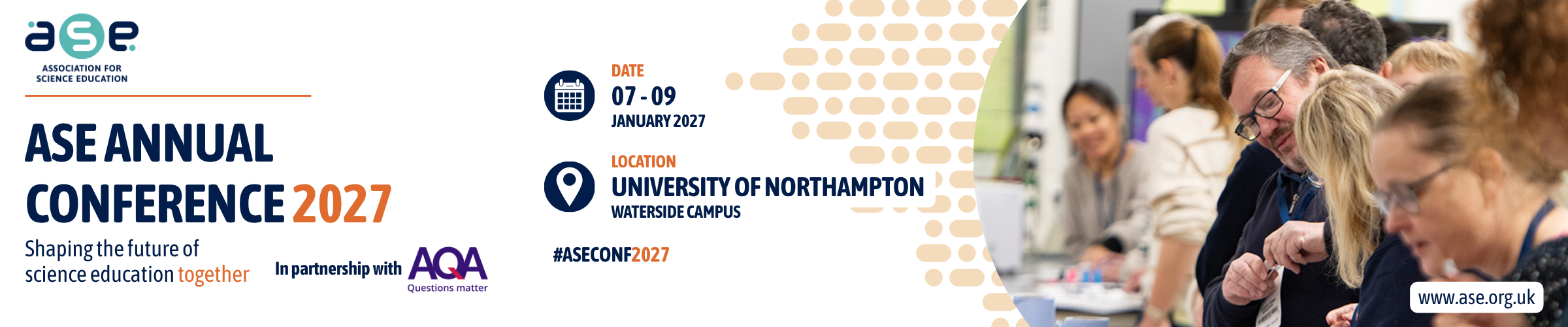
The ASE is delighted to be hosting its’ 2027 Annual Conference at the University of Northampton from 7th to 9th January.


Audience: 14-16 clear filter
arrow_back View All Dates
Saturday, January 9
 

08:45 GMT

CLEAPSS Hands-on workshop drop-in
Saturday January 9, 2027 08:45 - 09:40 GMT
A chance to gets hands-on, and try out some of the latest CLEAPSS practicals.  

Pop in, ask a question, chat with the CLEAPSS advisors!

For queries, please email [email protected]
Speakers
avatar for Matt Endean

Matt Endean

Deputy Director, CLEAPSS
Matt Endean is the Deputy Director of CLEAPSS, an advisory service supporting practical science and technology in schools in the UK. A former teacher, he specializes in health and safety, risk assessment, and laboratory design. Matt plays a pivotal role in developing guidance and... Read More →
Sponsors
avatar for CLEAPSS

CLEAPSS

Founded in 1963, CLEAPSS supports safe, engaging, and innovative practical activities in science (as well as design & technology and art & design). We provide schools and college staff with expert advice, training, resources, and trusted guidance. Providing staff with access to CLEAPSS... Read More →
Saturday January 9, 2027 08:45 - 09:40 GMT
LH017 (Learning Hub Ground Floor)

08:45 GMT

Interrogating PISA datasets with an interactive dashboard
Saturday January 9, 2027 08:45 - 09:40 GMT
The project has taken a design research approach to explore how to facilitate and support statistically appropriate use of secondary data from International Large-Scale Assessments (ILSAs) by a range of stakeholders.  The breadth of the publicly available PISA datasets affords opportunities for school leaders, researchers and policy makers to examine variables beyond attainment data, providing information on a range of contextual factors that have the potential to be invaluable when seeking a deeper understanding of students’ experiences in schools. So, the aim of this project is to improve access to, understanding of, and engagement with PISA data among educational stakeholders through the co-development of an accessible, interactive online dashboard that can support evidence-informed discussion and decision-making.

The need for this platform has arisen as the OCED makes PISA data available, but expertise in both coding and statistics are needed to format the data so valid statistical analysis can be undertaken. For example, decisions regarding what and when comparisons are appropriate need to be made.

In the session, the tension involved in balancing the complexity and the interpretability of complex data when developing a range of visualisations will be explored. I will then discuss key priorities identified by a range of stakeholders and show how these affected the development of the dashboard. Workshop attendees will then have the opportunity to use the dashboard (including the PISA 2025 science specific data which will have been released by then), and to explore its potential benefits.
Speakers
avatar for Judith Hillier

Judith Hillier

Associate Professor of Science Education, University of Oxford

Saturday January 9, 2027 08:45 - 09:40 GMT
LH322 (Learning Hub Level 3)

08:45 GMT

The neuroscience of science lessons
Saturday January 9, 2027 08:45 - 09:40 GMT
Science lessons often ask pupils to process abstract ideas, unfamiliar vocabulary, diagrams, models and practical observations all at once. This session explores how teachers can use selected ideas from cognitive science and neuroscience-informed research to make that complexity more manageable without oversimplifying the science.

The session will focus on three classroom applications: using dual coding to improve explanations and support understanding; applying cognitive load theory to design clearer instruction; and using retrieval practice to strengthen long-term memory.

Along the way, participants will consider where these approaches are most useful in science, where they can be misapplied, and how to adapt them for different contexts and age groups. This is a practical, evidence-informed session designed for classroom teachers and subject leaders who want to refine their teaching.

Participants will leave with a clearer understanding of the research base, concrete examples from science teaching, and strategies they can use to improve pupils’ learning, recall and confidence.

By the end of the session, participants will be able to:
•identify key principles about memory and learning that are relevant to science teaching;
•select and adapt dual coding strategies to support pupils’ explanations of scientific concepts;
•apply cognitive load principles when planning explanations, modelling and tasks;
•use retrieval practice in ways that support durable learning in science;
•evaluate their own classroom practice for opportunities to improve clarity, retention and progression.

Background: When I started teaching, my training did not mention the brain - it was as if we'd forgotten that this is where learning happens! I have a degree in cognitive neuropsychology, so this seemed surprising. Happily, as my career progressed, the sector has moved on to a great understanding of the principles of cognitive science and I have been heartened to see the impact of this on students. Through classroom practice, collaboration with colleagues and engagement with research on memory and learning, I will share an approach that focuses on a small number of evidence-informed principles with clear relevance to science teaching. Rather than offering “quick fixes”, this session draws together practical strategies that have helped make explanations clearer, reduce unnecessary cognitive overload and strengthen long-term retention
Speakers
avatar for Jessica Wood

Jessica Wood

Head of Subject, Ark Curriculum Plus

Saturday January 9, 2027 08:45 - 09:40 GMT
LH115 (Learning Hub Level 1)

08:45 GMT

Frontier Science: How the physical sciences can empower biology - applications of single molecule fluorescence to the biosciences
Saturday January 9, 2027 08:45 - 09:40 GMT
The capability to image single molecules has revolutionised biology.

I will explain how these methods work and  how we are currently applying them to study the molecular basis of neurodegenerative disease.

Lastly I will describe how our early single molecule work on DNA polymerase led to the development of next generation DNA sequencing, now widely used, and the lessons that can be learnt from this experience.
Speakers
SD

Sir David Klenerman

University of Cambridge

Saturday January 9, 2027 08:45 - 09:40 GMT
LH323 (Learning Hub Level 3)

08:45 GMT

I just went blank: the biology and psychology of exam anxiety
Saturday January 9, 2027 08:45 - 09:40 GMT
Crucially, biology and psychology feed each other. Cortisol impairs working memory, which worsens worry, which keeps the amygdala firing, which sustains the stress response. The loop runs until something interrupts it, which is why both physiological strategies (controlled breathing) and cognitive ones (reappraising arousal as challenge, not threat) work.

By the end, participants will:
> understand the biological and psychological mechanisms driving exam anxiety
> recognise the difference between knowing material and being able to show it under pressure
> have practical strategies to help students break the anxiety loop from both directions

Background and context: Exam anxiety is common, and for many students it actively undermines performance - the familiar experience of a capable student who "goes blank" despite knowing the material.
This isn't simply nerves. When the brain appraises an exam as a threat, the amygdala triggers two stress responses: a fast one (adrenaline, via the sympathetic nervous system) and a slower one (cortisol, via the HPA axis). Cortisol directly impairs the prefrontal cortex and hippocampus - the very structures handling working memory and retrieval.
This is the biological mechanism behind the blank mind.
Speakers
avatar for Amanda Clegg

Amanda Clegg

Science and Leadership Consultant, AKC Educational Consultancy
With over 30 years as a teacher and senior leader, I'm passionate about transforming science education through high-quality practical work, team leadership, bespoke cpd and coaching that makes a real difference.
I thrive on mentoring educators to reach their full potential—watch... Read More →
avatar for Karen Collins

Karen Collins

Educational Consultant, Apogee Education, Learning and Development
@kcoscience
Saturday January 9, 2027 08:45 - 09:40 GMT
LH321 (Learning Hub Level 3)

08:45 GMT

Research Meet (1)
Saturday January 9, 2027 08:45 - 09:40 GMT
Research provides a means for exploring teaching and learning in classrooms and other contexts, with some studies suggesting new ways of working. Every year many science education Masters, PhD and EdD students develop an expertise in a specific area of science education which can provide useful insights into how science works in the classroom. Come along to this session to hear a range of findings arising from a number of these studies and join in discussions for those that interest you.
Speakers
avatar for Alastair Gittner

Alastair Gittner

Teacher and Chair of ASE Research Committee, Hallam Teaching School Alliance
Saturday January 9, 2027 08:45 - 09:40 GMT
LH324 (Learning Hub Level 3 lab-type space)

09:55 GMT

CLEAPSS hands-on workshop drop-in
Saturday January 9, 2027 09:55 - 10:50 GMT
A chance to gets hands-on, and try out some of the latest CLEAPSS practicals.  

Pop in, ask a question, chat with the CLEAPSS advisors!

For queries, please email [email protected]
Speakers
avatar for Matt Endean

Matt Endean

Deputy Director, CLEAPSS
Matt Endean is the Deputy Director of CLEAPSS, an advisory service supporting practical science and technology in schools in the UK. A former teacher, he specializes in health and safety, risk assessment, and laboratory design. Matt plays a pivotal role in developing guidance and... Read More →
Sponsors
avatar for CLEAPSS

CLEAPSS

Founded in 1963, CLEAPSS supports safe, engaging, and innovative practical activities in science (as well as design & technology and art & design). We provide schools and college staff with expert advice, training, resources, and trusted guidance. Providing staff with access to CLEAPSS... Read More →
Saturday January 9, 2027 09:55 - 10:50 GMT
LH017 (Learning Hub Ground Floor)

09:55 GMT

Photosynthesis & respiration – place in science curriculum - misconceptions
Saturday January 9, 2027 09:55 - 10:50 GMT
Photosynthesis and respiration are the chemical reactions that enable solar energy to fuel life on this planet. Photosynthesis is also where almost all living substances start their life.

• The energy pathway from solar to respiration underpins life on earth
• It helps students understand the origin of fossil fuels and our climate concerns
• It is made far too complex and complicated when part of the biology curriculum
• I argue that they need a place in the chemistry and physics curriculum not only in biology.

I have written and produced many resources to help students understand the associated physics (energy) and chemistry, which address misconceptions and simplify what are very complex biochemical pathways:

• FuseSchool short video which has had half a million views https://www.youtube.com/watch?v=3XIyweZg6Sw
• SSR articles
https://www.ase.org.uk/resources/school-science-review/issue-382/model-respiration-and-photosynthesis-in-which-oxygen-plays
https://www.ase.org.uk/resources/school-science-review/issue-349/fuel-and-food-are-not-made-energy-constructive-view

• Science issues resource. Www.scienceissues.org.uk
The talk will start with some questions teachers can use on their students to identify misconceptions. Participants will discuss their ideas in pairs (“Tell Each Other”)

I will show the FuseSchool Video and my simple “stretched oxides” photosynthesis model together with this very simple global diagram to show cross-curricular importance. [Can't attach pictue - it shows the degradation ove energy from sunlight to waste heat driving the cycling of matter: fuel+oxygen = carbon dioxide + water

We then debate how we can give these reactions more importance in future science curricula, linking it all with the need to help students understand the science behind climate change (specifically the origin of the extra carbon dioxide we are putting into the atmosphere).
Speakers
avatar for Keith Ross

Keith Ross

Science Teacher Developer, Science Issues
Saturday January 9, 2027 09:55 - 10:50 GMT
LH115 (Learning Hub Level 1)

09:55 GMT

The genetics of sickle cell detection and therapy (MiniOne Systems)
Saturday January 9, 2027 09:55 - 10:50 GMT
Join us on this hands-on workshop where we will unlock the secrets of Sickle Cell Disease.

We will explore the genetics of sickle cell disease and genetic testing.

Extend the narrative by becoming medical geneticists conducting newborn screenings for SCD to determine disease inheritance and susceptibility. We can wrap up with modern therapies now available for SCD.
Speakers
EF

Erika Fong

Director, MiniOne Systems
Molecular Biology Anywhere and for Everyone! The game changing MiniOne Electrophoresis System was first of its kind designed specifically for teachers and students to have equal access to key biotech techniques with engaging activities. Whether used in the classroom lab or at home... Read More →
Sponsors
avatar for MiniOne Systems (Embitec)

MiniOne Systems (Embitec)

Browse our webpage at https://eu.theminione.com for links to:

> The MiniOne Electrophoresis System
> The New e-Pipette
> The MiniOne Incubator
> The Let it Glow Bacterial Transformation MiniLab
> Pipetting and Gel Loading Practice Kits
> MiniOne MiniLabs - complete lab kits for ha


... Read More →
Saturday January 9, 2027 09:55 - 10:50 GMT
CH314 (Creative Hub Level 3)

09:55 GMT

Panel: Big Followings, Real Learning: A Q&A With Science Educators Who Reach Millions
Saturday January 9, 2027 09:55 - 10:50 GMT
We've all seen it: the student who can't focus for ten minutes in class will happily watch twenty or thirty science videos in a row on their phones.

Online science education has grown into a high-quality, mainstream part of how young people learn, sitting alongside the classroom rather than at its edges, and the best creators are now among the most influential science educators in the country. So what do they know that those in the classroom can borrow?

This session, chaired by Dave Allen, brings together some of the most successful science educators working on YouTube, TikTok and beyond for an open Q&A. Ask them how they grab and hold attention, turn a tricky topic into something memorable, and keep the science accurate under the pressure of the feed. It's a practical, honest conversation about the craft of engagement, the quality of learning that online education can deliver, and what genuinely transfers from a phone screen to a classroom.
Speakers
avatar for Stuart Naismith

Stuart Naismith

Primary Teacher / Advisor, STEM with Mr N
I am Teacher of Innovation at Kelvinside Academy, a STEM educator and creator of STEM with Mr N, through which I have created hundreds of freely available STEM education videos and resources for teachers, children and families. Having spent most of my career as a primary classroom... Read More →
avatar for David Allen

David Allen

Associate Professor Learning and Teaching / Outgoing Chair of the ASE 25/26, University of Hertfordshire & Creative Primary Science Education Consultancy
I worked in primary schools for over twenty years as a classteacher, senior leader and Deputy Headteacher. I taught across Key stages 1, 2 and 3 in UK and in Spain. During this time I developed a passion for science, art and design, improvised drama, assessment for learning, creativity... Read More →
Saturday January 9, 2027 09:55 - 10:50 GMT
Leathersellers Hide (Learning Hub Level 4)

09:55 GMT

Research Meet (2)
Saturday January 9, 2027 09:55 - 10:50 GMT
Research provides a means for exploring teaching and learning in classrooms and other contexts, with some studies suggesting new ways of working. Every year many science education Masters, PhD and EdD students develop an expertise in a specific area of science education which can provide useful insights into how science works in the classroom. Come along to this session to hear a range of findings arising from a number of these studies and join in discussions for those that interest you.
Speakers
avatar for Alastair Gittner

Alastair Gittner

Teacher and Chair of ASE Research Committee, Hallam Teaching School Alliance
Saturday January 9, 2027 09:55 - 10:50 GMT
LH324 (Learning Hub Level 3 lab-type space)

09:55 GMT

Staying human in the science learning loop (AI Fairness)
Saturday January 9, 2027 09:55 - 10:50 GMT
Is Generative AI fair for all science learners? The Department for Education names supporting personalised learning as a use case for generative AI in education, while warning that generative AI content can be inaccurate, biased or out of context. Science teachers carry responsibility for managing diversity, equity, inclusion and supporting identity formation in their classrooms. Generative AI is now sits inside that responsibility, often invisibly, as it infers things about students from their names, work, vocabulary and interests.

This accessible session widens the conversation from bias to fairness, looking at how generative AI shapes aspects such as cognitive challenge, assessment, the language and the framing different students encounter in their science learning. Building on research presented at ASE in 2026 (Hedlund, 2025) and on ongoing work into bias and fairness through names and assessment, the session turns research into practical guidance for science classrooms across all phases.

The session is built around being the informed human in the science learning loop. You will explore what to watch for, the quick wins that improve fairness, the mitigated prompts and processes that change what generative AI gives to your students, and how to model critical generative AI use to the students you teach. The session is pitched for a range of confidence levels with generative AI, and is grounded throughout in the realities of the science classroom.

Outcomes

Delegates will be able to:
• Recognise when generative AI is inferring student identity and changing science output as a result.
• Use specific strategies, prompts and processes that support fair generative AI use in their classroom.
• Model critical generative AI use to their students as part of wider digital literacy in the new Curriculum.
• Discuss the fairness implications of generative AI in science learning with colleagues, leaders and students.
Speakers
avatar for Victoria Hedlund

Victoria Hedlund

AI bias researcher, consultant and founder, Gen Ed Labs

Saturday January 9, 2027 09:55 - 10:50 GMT
LH323 (Learning Hub Level 3)

10:50 GMT

Chair Chat
Saturday January 9, 2027 10:50 - 11:15 GMT
Our dedicated Chair Trio invite you to drop-in to the “Chair-Chat” sessions on one of the days of Annual Conference 2027. The Chair is a vital role to the ASE, and the elected Chair provides an authoritative voice for the thousands of members that the ASE supports, along with those working within the wider science education community. Those elected remain part of our Chair Trio for 3 years.

Got a question? Ever wondered about what goes on behind the scenes? Ever thought about getting involved in Committee activities? Are you wanting to know more about Professional Registration or writing an article in one of the ASE journals? First time attending our flagship Conference?

If this is your first ASE Conference, then please come along and say Hello.

We look forward to hearing your questions and will endeavour to answer them or point you in a selection of possible right directions!
Speakers
avatar for David Allen

David Allen

Associate Professor Learning and Teaching / Outgoing Chair of the ASE 25/26, University of Hertfordshire & Creative Primary Science Education Consultancy
I worked in primary schools for over twenty years as a classteacher, senior leader and Deputy Headteacher. I taught across Key stages 1, 2 and 3 in UK and in Spain. During this time I developed a passion for science, art and design, improvised drama, assessment for learning, creativity... Read More →
avatar for Claire Seeley (MA CSciTeach)

Claire Seeley (MA CSciTeach)

Primary Science Education Consultant / Co-Chair of the ASE
Claire Seeley has been a teacher for over thirty years in a wide variety of contexts including both inner city and rural schools England. Claire is also a Primary Science Consultant, providing both continuing professional development and initial teacher training.  She has a passion... Read More →
EP

Emily Perry

Professor of Education, Manchester Metropolitan University
avatar for Natasha Serret

Natasha Serret

Associate Professor of Science Education, Nottingham Trent University
I started my professional career as a classroom teacher and science lead in a London primary school. I was and remain passionate about classroom learning that promotes a scientific mindset alongside the development of an understanding of key scientific concepts.  This professional... Read More →
Saturday January 9, 2027 10:50 - 11:15 GMT
Leathersellers Hide (Learning Hub Level 4)

11:15 GMT

CLEAPSS hands-on workshop drop-in
Saturday January 9, 2027 11:15 - 12:10 GMT
A chance to gets hands-on, and try out some of the latest CLEAPSS practicals.  

Pop in, ask a question, chat with the CLEAPSS advisors!

For queries, please email [email protected]
Speakers
avatar for Matt Endean

Matt Endean

Deputy Director, CLEAPSS
Matt Endean is the Deputy Director of CLEAPSS, an advisory service supporting practical science and technology in schools in the UK. A former teacher, he specializes in health and safety, risk assessment, and laboratory design. Matt plays a pivotal role in developing guidance and... Read More →
Sponsors
avatar for CLEAPSS

CLEAPSS

Founded in 1963, CLEAPSS supports safe, engaging, and innovative practical activities in science (as well as design & technology and art & design). We provide schools and college staff with expert advice, training, resources, and trusted guidance. Providing staff with access to CLEAPSS... Read More →
Saturday January 9, 2027 11:15 - 12:10 GMT
LH017 (Learning Hub Ground Floor)

11:15 GMT

From recruitment to retention - supporting international physics teachers in England
Saturday January 9, 2027 11:15 - 12:10 GMT
This session focuses on the latest findings and recommendations from ASE’s International Science Teachers project, supported by the Gatsby Foundation
Speakers
avatar for Marianne Cutler

Marianne Cutler

Director of Curriculum Innovation, Association for Science Education
avatar for Rob Butler

Rob Butler

Registrar, Association for Science Education
I'm a Chartered Science teacher, the registrar and Project Officer for the ASE (running the Keeping Science Practical project).
I'm a senior professional development leader for the Science Learning Partnership network and I help the Science Council promote their professional registers. I'm an ex-special school senior leader, an ex-science teacher and an OUP author. I jointly run the ASE's Inclusive Science Educati... Read More →
Saturday January 9, 2027 11:15 - 12:10 GMT
LH321 (Learning Hub Level 3)

11:15 GMT

Life finds a way: Teaching evolutionary processes via experimental evolution
Saturday January 9, 2027 11:15 - 12:10 GMT
Evolution is the most important concept in biology, yet it is often taught as an abstract topic with limited opportunities for practical investigation. Misconceptions surrounding evolution and natural selection remain common amongst students and the wider public, while teachers can face challenges relating to subject confidence, curriculum time, resourcing and practical accessibility. This workshop draws on ongoing PhD research at the University of Bath investigating how experimental evolution may support the teaching of evolution in a more engaging, accessible and evidence-informed way.

The session aims to:
• explore common misconceptions surrounding evolution and natural selection;
• examine current challenges and gaps in evolution education;
• share emerging findings from an ongoing research project into experimental evolution in educational settings;
• provide participants with hands-on experience of an experimental evolution activity using Pseudomonas fluorescens;
• reflection on how inquiry-based practical approaches may support evolution education across diverse settings.

Participants will begin by exploring some of the most persistent misconceptions surrounding evolution, including teleological thinking, misunderstandings around “survival of the fittest”, and the idea that evolution only occurs over millions of years. Through discussion and short interactive activities, the workshop will examine why these misconceptions remain prevalent and how they may be reinforced unintentionally within teaching and popular culture.
The session will then introduce an experimental evolution teaching package developed as part of an ongoing PhD project. Using genetically modified Pseudomonas fluorescens, the practical demonstrates the re-emergence of bacterial motility under selection pressure, enabling students to observe evolutionary change over a short timescale. Participants will engage with elements of the practical activity themselves and explore how the approach has been adapted to improve accessibility across a range of educational contexts, including schools with limited laboratory facilities.

Emerging findings from the study will be shared alongside discussion of inquiry-based learning, practical science, accessibility and student engagement. The session will conclude with opportunities for reflection and discussion around broader questions for biology education, including how evolutionary thinking might be more coherently embedded across the curriculum as a conceptual “golden thread”.

By the end of the session, participants will be able to:
• identify common misconceptions associated with evolution education;
• discuss barriers affecting the teaching of evolution in schools;
• explain how experimental evolution can be used to support understanding of natural selection and adaptation;
• evaluate the benefits and limitations of inquiry-based practical approaches within evolution education;
• reflect on how evolutionary concepts could be revisited more coherently within biology teaching.
Speakers
avatar for Elizabeth Morillo-Hall

Elizabeth Morillo-Hall

PhD Researcher, University of Bath
I am a science educator, evolution enthusiast and PhD researcher at the Centre for Evolution, University of Bath. I’m researching how we can teach evolution better, making it practical, accessible and a golden thread running throughout biology rather than something we wheel out... Read More →
Saturday January 9, 2027 11:15 - 12:10 GMT
LH115 (Learning Hub Level 1)
  11-19

11:15 GMT

Making practical science memorable: A cognitive-science informed approach
Saturday January 9, 2027 11:15 - 12:10 GMT
This session aims to help science teachers and leaders to:

> understand how the model of memory can inform decisions about practical science teaching;
> recognise when practical work may overload working memory, limiting learning;
> evaluate the strengths and limitations of different approaches to practical work;
? apply evidence-informed principles to design practical lessons that maximise learning.

Practical work can motivate students and bring science to life—but practical lessons can also place heavy demands on students’ attention, leaving them focused on following instructions or handling equipment rather than learning the intended science.

In this session, we will explore how the model of memory can help teachers make better decisions about practical science teaching. By considering the limitations of working memory and the importance of attention for encoding into long-term memory, we will examine why some practical activities lead to strong learning and others do not.

Participants will compare different approaches to practical work, and discuss when each is most likely to be effective. We will also consider how the purpose of the practical—whether to teach disciplinary knowledge, substantive knowledge, or practical skills—should shape the chosen approach.

Attendees will leave with a better understanding of how to plan and adapt practical lessons so that students think hard, remember more, and learn better.

As a result of attending this session, participants will be able to:

> identify potential sources of cognitive overload in practical science lessons;
> select appropriate practical approaches based on lesson goals and student needs;
> adapt existing practical activities to better support attention, memory, and learning;

Background: Practical work is often seen as central to science education, yet students do not always learn what teachers intend from these experiences. My interest in this area has developed through classroom practice, curriculum design, and engagement with cognitive science research on memory, attention, and cognitive load. Through reflecting on when practical lessons have been most and least effective, and drawing on research-informed approaches such as explicit instruction and the “model of memory,” I have developed a framework for making more deliberate choices about how practical work is organised and delivered. This session brings together classroom experience and evidence-informed thinking to help teachers move beyond “doing” practical work towards securing lasting learning.
Speakers
avatar for Euan Douglas

Euan Douglas

Assistant Head Teacher, St George's Catholic College
I am an Senior Assistant Headteacher responsible for Teaching & Learning and the curriculum at Saint George Catholic College, an Outstanding comprehensive school in Southampton. My involvement with the ASE includes being a member of both my regional committee and previously the 11-19... Read More →
Saturday January 9, 2027 11:15 - 12:10 GMT
LH127 (Learning Hub Level 1)

11:15 GMT

Keynote: Authentic scientific inquiry in school science: Learning from the history and philosophy of science
Saturday January 9, 2027 11:15 - 12:10 GMT
Inquiry-based learning is difficult to put into practice when we are teaching scientific content that is well-known and indisputable. If teachers already have the correct answers, why should students bother trying to find them out for themselves? Drawing from the history of science can help us find interesting questions that today’s mainstream science does not address and does not have ready answers to. I will illustrate this through examples taken from my previous and current work, including the anomalous boiling of water and the puzzle over the workings of the Voltaic battery. Taking inspiration from John Dewey, I focus on the experience of student. How can we help students have a true experience of science, both in experiencing natural phenomena and experiencing scientific inquiry? Dealing with phenomena that deviate from textbook descriptions can allow students to experience nature truly for themselves. Puzzling over how to make sense of such phenomena can give them the experience of actual scientific inquiry.

My discussion in this talk is part of a general attempt to enhance the interaction between science education and the history and philosophy of science (HPS). Despite great efforts by Michael Matthews, Douglas Allchin and others, HPS remains on the fringes of science education, and science education is not a major concern in mainstream HPS. This is a lamentable situation. On the side of philosophy of science, there is obvious potential for engagement with the teaching of the nature of science. From the history of science, I think the most promising contribution is to help students (and teachers) realise that respected past scientists have investigated nature in different ways from what we are now accustomed to, and that there is value in revisiting these alternative approaches.
Speakers
avatar for Hasok Chang

Hasok Chang

Professor, Dept of History and Philosophy of Science, University of Cambridge
Hasok Chang is the Hans Rausing Professor of History and Philosophy of Science at the University of Cambridge. He received his degrees from Caltech and Stanford, and has taught at University College London.

He is the author of Inventing Temperature: Measurement and Scientific Pro... Read More →
Saturday January 9, 2027 11:15 - 12:10 GMT
Leathersellers Hide (Learning Hub Level 4)

11:15 GMT

Using AI effectively to reduce workload - A realistic perspective
Saturday January 9, 2027 11:15 - 12:10 GMT
This interactive workshop will give you a grounded, practical exploration of how AI can support workload reduction without creating additional stress, unrealistic expectations, or dependence on technology.

You will explore real examples of where AI can save time, including planning support, summarising information, drafting routine communications, adapting content for different audiences, generating starting points for resources, and reducing repetitive administrative tasks. Through discussion and short practical activities, you will consider how to evaluate when AI is genuinely useful, when it may be inefficient, and where caution is needed.

A key focus will be on critical use rather than blind adoption. You will consider issues such as accuracy, bias, safeguarding, privacy, and the importance of maintaining professional oversight.

Designed for educators and professionals who are curious about AI but want realistic, manageable approaches rather than technical deep dives or exaggerated claims, this session will leave you with practical ideas, increased confidence, and a clearer understanding of how AI can support, but not replace professional expertise.

Following this session, participants hopefully will be able to:

* Identify appropriate tasks where AI may reduce workload effectively.
* Critically evaluate whether AI is the right tool for a specific task.
* Apply simple AI-supported strategies to improve efficiency in planning, communication, and organisation.
* Recognise common risks and limitations when using AI in professional settings.
* Use AI more intentionally, ethically, and with clearer professional boundaries.
* Trial at least one realistic AI workflow within their own practice.
Speakers
avatar for Joanna Pellereau

Joanna Pellereau

PGCE Course Science Lead, Warwick University Centre for Teacher Education
Having been a physics teacher and Head of Department for over a decade, I am now Physics PGCE lead and a teaching fellow at the Centre for Teacher Education at the University of Warwick. I also take on freelance work and have supported OUP with the Kerboodle resources for the new... Read More →
Saturday January 9, 2027 11:15 - 12:10 GMT
LH322 (Learning Hub Level 3)

12:25 GMT

Beyond the formula: Teaching molar relationships using proportionality (White Rose Education)
Saturday January 9, 2027 12:25 - 13:20 GMT
This workshop challenges teachers to rethink how molar relationships are introduced and taught. Moving beyond the traditional reliance on formulae such as moles = mass ÷ Mr and moles = concentration × volume, it presents a more intuitive, proportional based approach aligned with mathematical reasoning.

Participants will explore how teaching mole calculations through proportional relationships can deepen conceptual understanding, reduce cognitive load and improve student confidence in tackling quantitative chemistry problems. By connecting chemistry more explicitly with familiar mathematical strategies, this approach supports learners in making sense of problems rather than memorising procedures.

Designed for both early career and experienced teachers, the session will provide practical classroom strategies, worked examples, and opportunities to reflect on current practice. Delegates will leave equipped with adaptable methods to enhance student understanding and attainment.
Speakers
DF

David Fairclough

Secondary Science Specialist, White Rose Education
Sponsors
avatar for White Rose Education

White Rose Education

White Rose Education is proud to sponsor the Primary Programme of the ASE 2027 Annual Conference

Created by teachers, mathematicians and scientists, White Rose Education is dedicated to helping every teacher become a world-class teacher.

White Rose Science takes the highly successful approach we pioneered with White Rose Maths and transfers it to the primary science curriculum. It uses a “small steps” approach to science teaching, and closely follows the national curriculum for science for years 1 - 6. It gives

... Read More →
Saturday January 9, 2027 12:25 - 13:20 GMT
LH322 (Learning Hub Level 3)

12:25 GMT

CLEAPSS hands-on workshop drop-in
Saturday January 9, 2027 12:25 - 13:20 GMT
A chance to gets hands-on, and try out some of the latest CLEAPSS practicals.  

Pop in, ask a question, chat with the CLEAPSS advisors!

For queries, please email [email protected]
Speakers
avatar for Matt Endean

Matt Endean

Deputy Director, CLEAPSS
Matt Endean is the Deputy Director of CLEAPSS, an advisory service supporting practical science and technology in schools in the UK. A former teacher, he specializes in health and safety, risk assessment, and laboratory design. Matt plays a pivotal role in developing guidance and... Read More →
Sponsors
avatar for CLEAPSS

CLEAPSS

Founded in 1963, CLEAPSS supports safe, engaging, and innovative practical activities in science (as well as design & technology and art & design). We provide schools and college staff with expert advice, training, resources, and trusted guidance. Providing staff with access to CLEAPSS... Read More →
Saturday January 9, 2027 12:25 - 13:20 GMT
LH017 (Learning Hub Ground Floor)

12:25 GMT

What do I need to do to be ready for chemistry curriculum 2028?
Saturday January 9, 2027 12:25 - 13:20 GMT
Join the team working with the Department for Education to develop the reformed Science Programmes of Study in England and GCSEs subject content as we outline the priorities and evidence underpinning the drafting process. This session focuses on Chemistry KS3 and KS4 plus transition from KS2 and KS1.

Please note the other sessions in the conference programme, on KS1 and KS2, and on biology and physics at KS3 and KS4.
Speakers
avatar for Marianne Cutler

Marianne Cutler

Director of Curriculum Innovation, Association for Science Education
avatar for Laura Daly

Laura Daly

Programme Manager, Education Policy, Royal Society of Chemistry

Sponsors
avatar for SEPA

SEPA

The Science Education Policy Alliance (SEPA) brings together the Association for Science Education, Institute of Physics, Royal Society, Royal Society of Biology and Royal Society of Chemistry to coordinate and collaborate on science education policy, with Professor Dame Athene Donald... Read More →
Saturday January 9, 2027 12:25 - 13:20 GMT
LH115 (Learning Hub Level 1)
  11-19

12:25 GMT

Frontier Science: Exploring Mars
Saturday January 9, 2027 12:25 - 13:20 GMT
I have explored Mars with the Curiosity Rover, orbiters and Martian meteorites.

This talks summarises how we have reached a new understanding about the evolution of Mars and its Habitable, ‘Warm and Wet’ ancient past, and how we plan to continue exploring Mars with new missions – robotic and human.
Speakers
JC

John C Bridges SFHEA

Professor / Planetary Scientist, University of Leicester School of Physics and Astronomy

Saturday January 9, 2027 12:25 - 13:20 GMT
LH323 (Learning Hub Level 3)

12:25 GMT

Relax and unwind with 3 short films on nature
Saturday January 9, 2027 12:25 - 13:20 GMT
Join us to relax and unwind during lunchtime at the ASE Annual Conference. Enjoy three stunning short films showcasing fascinating wildlife and their ecosystems.

‘The Caretakers’ is a journey into the weird, wonderful and truly astonishing lives of the small yet mighty creatures who keep the world turning – beetles. They have been successful for millions of years, but they’re in serious trouble; what does the future hold for these incredibly important animals, and for us if they disappear? 21 minutes. Director – Tom Hanner

‘Creatures of the Kaleidoscope’ Explore one of natures most magical creatures, the Cuttlefish. Embark on a mesmerising journey of nature’s living kaleidoscopes. Follow these elusive creatures as this documentary delves deep into the extraordinary lives of these remarkable cephalopods, see their unique abilities as they morph into a stunning array of colours and shapes in a blink of an eye. Witness the incredible transformation from vulnerable prey to cunning predators, navigating the vast oceans ever changing surroundings and dangers. 18 minutes. Director – Hannah Jodie Alexander

‘Fascinating World of Wood Ants’ This film visualizes the lifecycle of Wood Ants and emphasizes their vital ecological role in the ecosystem. It showcases their journey, social dynamics, and ecological contributions, highlighting the importance of preserving their habitats in the face of environmental challenges. 11 minutes. Director – Siddique Salim Khan

These short films are kindly made available for viewing at ASE’s Annual Conference through ASE’s long-standing collaboration with the Museo de Ciencias of the Universidad de Navarra.
Speakers
avatar for Marie Ann Reynell

Marie Ann Reynell

Director of Development, Museo de Ciencias, Universidad de Navarra (Science Museum, University of Navarra)

Saturday January 9, 2027 12:25 - 13:20 GMT
Leathersellers Hide (Learning Hub Level 4)

12:25 GMT

Talking and thinking at Science on Stage: using simple stimuli and strategies to build a culture of rich scientific talk
Saturday January 9, 2027 12:25 - 13:20 GMT
 Are your students working in groups but not truly thinking together?

In this session, we will explore how strategies such as purposeful oracy games can transform the quality of talk and argumentation in your science classroom. You will be introduced to a simple, repeatable structure that moves students beyond mere prediction to explaining their reasoning, observing with purpose, and reconciling their ideas with evidence. Rather than seeing/dialogue/  as an "extra," you will learn how to weave it into the fabric of your lessons, creating rich, productive environments where good talk becomes a habit.

We will discuss the small, manageable changes you can make to your everyday practice; from a short starter activity to a more extended investigation, that can have a transformative impact on student thinking, engagement, and scientific literacy.

We will also provide practical examples and a framework for designing these sequences, so they are easy to implement and highly effective.
Speakers
avatar for Peter Munroe

Peter Munroe

Head of Chemistry, Uckfield College

avatar for Alex Black

Alex Black

Council Member, Lets Think Forum
Saturday January 9, 2027 12:25 - 13:20 GMT
LH124 (Learning Hub Level 1)

13:35 GMT

Educake X AQA: GCSE to A level transition
Saturday January 9, 2027 13:35 - 14:30 GMT
Join AQA and Educake for a joint session exploring the challenges students face when transitioning from GCSE to A-level Science.

AQA will share valuable data and insights from examiner reports, highlighting some of the common areas where students can struggle as they move from GCSE to A-level. The session will explore practical ways to prepare students for this transition, with ideas and support to help build the knowledge, skills and confidence needed for success at A-level.

There will also be time for moderated questions from the audience, alongside questions submitted in advance, providing an opportunity to further explore the impact of the GCSE-to-A-level transition and discuss effective ways to support students as they progress.

Educake will provide a brief demonstration of how its tools can help teachers identify gaps in essential and prerequisite knowledge, highlight areas for students to focus on, and support the development of more independent learning habits as students prepare for A-level study.
Speakers
avatar for Constance Young

Constance Young

Head of Editorial, Educake

avatar for Damien Gent

Damien Gent

Subject Support - Science Lead, AQA

Sponsors
avatar for AQA

AQA

Proudly partnering the ASE for their 2027 Annual Conference.

Since 1903, we’ve been rewarding achievement by designing and delivering fair and inclusive assessment. We do this because we believe that quality assessment is an essential ingredient for a good education. We’re the most chosen exam board in England and we set and mark the papers

... Read More →
avatar for Educake

Educake

PROUD SPONSORS OF THE 11-19 PROGRAMME AT THE 2027 ASE ANNUAL CONFERENCE

Educake is an award-winning online assessment and revision platform for KS2, KS3 and GCSE. Educake can help you do more teaching, by saving you time on setting homework, marking and analysing results: specification-matched tests can be set in seconds. You get immediate insights into

... Read More →
Saturday January 9, 2027 13:35 - 14:30 GMT
LH127 (Learning Hub Level 1)
  11-19

13:35 GMT

Student agency to use AI tools when learning in science
Saturday January 9, 2027 13:35 - 14:30 GMT
AS students increasingly turn to tools like ChatGPT and Gemini, we introduce a student-agency framework to help learners use AI more critically rather than over-relying on it.

In this workshop computer science education researchers will work with science educators to begin adapting the agency framework for use in the science classroom.
Speakers
VC

Veronica Cucuiat

Raspberry Pi Foundation

JW

Jane Waite

Senior Research Scientist, Raspberry Pi Foundation

Saturday January 9, 2027 13:35 - 14:30 GMT
LH324 (Learning Hub Level 3 lab-type space)

13:35 GMT

Decolonising the science curriculum; using science to challenge racism
Saturday January 9, 2027 13:35 - 14:30 GMT
The session will give science educators across all phases insight into how science has been used in the past to promote racism, how it can now be used to undermine racism and how to include in curriculum topics the contributions of several black scientists.  It will therefore support the aim of the curriculum and assessment review to empower teachers to illustrate the Science curriculum with inclusive examples of individuals working in and contributing to science.  

I have taken this approach because as a science teacher of 20 years I know that black British children often face more barriers to engage with their school education than their peers, that they can sometimes think that science is not for them and my experience is that racism is still an issue in many schools. I therefore to wanted to make a contribution towards changing this big issue as a science educator. I now work at the Faraday Institute for Science and Religion, a Cambridge based research and educational institute, where we have found that integrating ways of knowing from science with those that consider worldviews, philosophy and ethics helps approach big questions, like racism, in a more holistic manner enabling a more effective response.

Using this approach, I developed this presentation which explores the nature of science, considering the elements of both data collection and theory formation and how, for scientists, being aware of one's own world view is important as it may influence theory formation. This was sadly the case for some leading scientists in the past whose scientific work supported a racial hierarchy which still influences thought today. The presentation will suggest ways we can use science to start to redress this by drawing on findings from the human genome project which undermine a genetic basis for race and it will also explore the significant contributions of some black scientists in the development of evolutionary theory, the introduction of immunisations and movement of Halley’s comment for example.

The presentation will give science educators the confidence to begin the journey to ‘decolonise their curriculum’ which can be a difficult one to start and navigate, but they will be inspired to do so and equipped with ideas, examples and a classroom resource, to take the first steps towards helping children who think that science might not be for them, start to believe it might be and help everyone to value contributions from scientists from a wide range of backgrounds.  This will be through learning about those who had to overcome significant barriers to succeed as scientists, sometimes because of their skin colour and celebrating their success.
Speakers
avatar for Cathy Priest

Cathy Priest

Training Lead of the Youth and Schools Team, Faraday Institute for Science and Religion
I taught secondary school science for 20 years in the UK and abroad and led KS4, Biology and Physics departments.  I now work at the Faraday Institute for Science and Religion as the training lead in the youth and schools' team, developing and delivering CPD for in service and trainee... Read More →
Saturday January 9, 2027 13:35 - 14:30 GMT
LH321 (Learning Hub Level 3)

13:35 GMT

The impact of policy on curriculum design: A Policy Group perspective
Saturday January 9, 2027 13:35 - 14:30 GMT
With the recent changes to the National Curriculum following the Curriculum and Assessment Review, schools and subject leads are under pressure to redevelop their local curricula. However, what sort of autonomy do we have over the curriculum that we produce and is it developed with the local context in mind.

This session will provide some insights for teachers or subject leaders across any phase of school about how policy can influence the way we develop our local curriculum.

Additionally, we will aim to provoke discussions around how to avoid "policy pitfalls". Finally, as co-chairs of the policy group we would welcome your thoughts around how the Policy Group should develop work around curriculum to advocate for ASE members.
Speakers
avatar for Helen Darlington

Helen Darlington

Co Chair of ASE Policy Group, South Wirral High School

GB

Gareth Bates

Senior Lecturer in Education / Co-Chair of ASE Policy Group, Anglia Ruskin University

avatar for Marianne Cutler

Marianne Cutler

Director of Curriculum Innovation, Association for Science Education
Saturday January 9, 2027 13:35 - 14:30 GMT
LH322 (Learning Hub Level 3)
  Suitable for All key stages

13:35 GMT

What if the next climate solution is in your classroom? Project Earth - empowering young people to build a better world.
Saturday January 9, 2027 13:35 - 14:30 GMT
Young people have extraordinary ideas for tackling climate change and biodiversity loss. Too often, those ideas never get beyond the classroom.  Project Earth is changing that.

This talk explores how teachers can help young people move from learning science to using science to solve real problems — connecting their ideas with experts, opportunities and the support to take them further.

Don't just teach young people about the future. Give them the tools to help shape it.

Young people have extraordinary potential. Project Earth helps turn it into impact — now..

Speakers
avatar for Becky Parker MBE

Becky Parker MBE

Director (Project Earth) / Physics Teacher / Visiting Professor (School of Physics and Astronomy), Queen Mary University of London
Saturday January 9, 2027 13:35 - 14:30 GMT
LH124 (Learning Hub Level 1)

13:35 GMT

Yes you can!
Saturday January 9, 2027 13:35 - 15:40 GMT
The ASE H&S Group is delighted to run a demonstration workshop for science teachers that shows a range of exciting and eye-catching practical activities, but often thought to be banned or restricted owing to the risks if the activities are carried out wrongly. These demonstrations are great for helping students understand science and get excited about it.

This session will focus on how to undertake these activities to inspire students, and how to do them safely by planning carefully and following the proper safety precautions. It is about using risk assessment as an enabling tool, not a barrier.
Speakers
avatar for Peter Borrows

Peter Borrows

Member of ASE's H&S Group / Consultant / Former Director of CLEAPSS, Troye Scientific
Retired(ish) Director of CLEAPSS.

Member since 1966, and former Chair, of ASE Safety in Science Group (and its predecessors).

Author of 54 articles in Education in Chemistry between 1994 and 2012 on chemistry outdoors, two in School Science Review [(1984), The Pimlico chemistry trail, 66 (235), 221-233 and (2006), Chemistry outdoors, School , 87(320), 23-31] and chapters in two books [ (2004) Chemistry Tr... Read More →

CL

Chris Lloyd

Head of Advisory Service / Member of ASE H&S Committee, SSERC
RW

Ralph Whitcher

Chair of Health & Safety Committee, ASE
Saturday January 9, 2027 13:35 - 15:40 GMT
CH314 (Creative Hub Level 3)

14:45 GMT

(Pearson) Future-ready science: Connecting climate, media literacy and green pathways
Saturday January 9, 2027 14:45 - 15:40 GMT
This workshop will bring together two urgent agendas in science education: helping students make sense of climate and media-based claims, and ensuring they can see clear, meaningful progression into green and vocational futures. It will explore how science curriculum and qualification design can better connect scientific knowledge, evidence evaluation, real-world relevance and future pathways.

Participants will explore how science education can connect disciplinary knowledge with climate literacy, media literacy and green skills; consider how qualification design can make science more relevant and future-facing; and think about how curriculum, assessment and pathways can work together to support informed, motivated and aspirational learners.

Participants will leave with practical ideas for linking science teaching to climate and media literacy, a clearer understanding of how green skills and progression routes can be surfaced within KS4 science, and a stronger framework for thinking about relevance, engagement and future-facing qualification design.
Speakers
avatar for Tosin Oliyide

Tosin Oliyide

Senior Qualifications Manager - Science, Pearson

BT

Becky Thorne

Senior Qualifications Manager, Pearson

Saturday January 9, 2027 14:45 - 15:40 GMT
LH125 (Learning Hub Level 1)

14:45 GMT

Curriculum Change in England for KS1 to KS4
Saturday January 9, 2027 14:45 - 15:40 GMT
Join the team working with the Department for Education to develop the reformed Science Programmes of Study in England and GCSEs subject content as we outline the priorities and evidence underpinning the drafting process. This session focuses on KS3 and KS4 plus transition from KS2 and KS1.

Please note the other sessions in the conference programme, on KS1 and KS2, and on biology, chemistry and physics at KS3 and KS4.
Speakers
avatar for Marianne Cutler

Marianne Cutler

Director of Curriculum Innovation, Association for Science Education
avatar for Lauren McLeod

Lauren McLeod

Head of Education Policy, Royal Society of Biology
Lauren joined the Royal Society of Biology as Head of Education Policy in July 2017. Previously she has worked on gender projects, including Opening Doors, and higher education projects as part of the education team at the Institute of Physics, and as a science teacher in North L... Read More →
avatar for Rachel Hartley

Rachel Hartley

Pedagogy and Professional Practice Strategic Lead, Institute of Physics
avatar for Laura Daly

Laura Daly

Programme Manager, Education Policy, Royal Society of Chemistry

Saturday January 9, 2027 14:45 - 15:40 GMT
LH013 & LH014 (Learning Hub Ground Floor)

14:45 GMT

The best of Science on Stage 2026
Saturday January 9, 2027 14:45 - 15:40 GMT
The biennial Science on Stage Festival took place in Klaipeda, Lithuania in May 2026.  

The Science on Stage Festival brings together hundreds of teachers from across Europe and beyond to share and innovate strategies for teaching science at all levels, from early years through primary to secondary.  In this session, members of the Science on Stage delegation which represented the UK at the Festival will describe and demonstrate some of the best bits from Klaipeda.

This session is being co-ordinated and chaired by Stuart Farmer, Chair of the Science on Stage UK National Steering Committee, along with some of those representing the UK in Klaipeda.
Speakers
avatar for Stuart Farmer

Stuart Farmer

Learning and Skills Manager, IOP and Perimeter Institute
I was a teacher of physics in Scotland for over 30 years before becoming the Scottish Education Manager for IOP in February 2019. Throughout this time I have been active in curriculum and assessment development and providing professional learning for teachers. I am a former Chair... Read More →
avatar for Becky Parker MBE

Becky Parker MBE

Director (Project Earth) / Physics Teacher / Visiting Professor (School of Physics and Astronomy), Queen Mary University of London
MK

Maren Kelly

Head of STEM, St Catherine's Prep School

avatar for Peter Munroe

Peter Munroe

Head of Chemistry, Uckfield College

avatar for Simon Poliakoff

Simon Poliakoff

Physics teacher and Lead Practitioner Teaching and Learning, The Priory School Hitchin
Over the last few years whilst working as a physics teacher Simon has created sets of ideas for teaching physics organised by topic area which are shared freely on a Creative Commons non-commercial licence via the www.teachphysics.org website. The aim has been to bring together practical... Read More →
avatar for Rose Edmondson

Rose Edmondson

Teacher of science and geography, Falinge Park School

avatar for Alex Black

Alex Black

Council Member, Lets Think Forum
Saturday January 9, 2027 14:45 - 15:40 GMT
LH323 (Learning Hub Level 3)

15:55 GMT

Microscale chemistry: What do pupils think about it?
Saturday January 9, 2027 15:55 - 16:50 GMT
There's a gap in the research on STUDENT perception and experience of microscale chemistry.

Why microscale - time, sustainability, ease (literature review of existing research).

The study: Mapped the AQA A level specification (including RPs) against existing microscale practicals. Students completed both activities, and then attended FG interviews and completed questionnaires. This study was conducted with two cohorts, each completing the macro and micro versions throughout Y12.

Findings from research project - what do the students think? Does it aid their understanding? Some interesting findings relating to SEND and cognitive load have been found (study still underway).
The future: Exam boards are beginning to utilise microscale in exam-style questions (electrolysis example in GCSE Chemistry 2024), some discussion and implications.

Outcomes: Attendees will have a deeper understanding of the student experience during practical work, how microscale could be used in their classrooms, and what the benefits are for their students.
Speakers
avatar for Louise Glynn

Louise Glynn

Acting Head of Chemistry, T&L Lead Practitioner, James Allen's Girls School

AM

Andy Markwick

Lecturer in Primary Science Education, University College London

Saturday January 9, 2027 15:55 - 16:50 GMT
LH324 (Learning Hub Level 3 lab-type space)

15:55 GMT

There is another way: Learning lessons on behaviour from AP
Saturday January 9, 2027 15:55 - 16:50 GMT

This session will explore alternatives to mainstream behaviour management policies, by drawing from examples in an alternative provision setting. The session will challenge the traditional rewards and sanctions system and the use of detentions by showing how these systems fail to engage pupils in education in a meaningful way and ultimately leads to harm to all students, but particularly those from disadvantaged backgrounds and those with SEND. It will then explore an alternative approach, using genuinely trauma-informed practice and instilling an intrinsic engagement in learning. We will cover our approach and what can and cannot be easily applied in a mainstream setting.

Outcomes:
Participants should gain:
- an understanding of how and why the current paradigm of behaviour management is not appropriate for a range of learners
An ability to challenge standard approaches to behaviour.
- knowledge of alternative approaches from AP settings and how these can be used to transform behaviour management and policy in mainstream settings

Background: This session is based on our experiences working in an alternative provision setting for the past 4 years...

- at the 2026 Conference, many people Matthew spoke to were interested in our setting’s unique approach to behaviour, specifically the lack of any sanctions or rewards system, and how we successfully educate pupils who have been unable to engage in mainstream, including those who have been permanently excluded.

- this session combines Matthew’s insight as a science teacher and Elijah’s MEd research. It will consider classroom approaches but will also address broader issues and themes in education and will hopefully be of interest to a range of audiences.

- those in leadership positions will have more opportunity to implement school-wide structural changes, but I hope that those in standard teaching roles will also gain from the session and be able to adapt their own practice within the confines of a wider school policy.
Speakers
avatar for Matthew Axbey (they/them)

Matthew Axbey (they/them)

Manager of ICT, Data, Exams, and Assessment Team, Malden Oaks School & Tuition Service
avatar for Elijah Wisken

Elijah Wisken

Teacher of SEN, Rivers Academy West London
Saturday January 9, 2027 15:55 - 16:50 GMT
LH127 (Learning Hub Level 1)

15:55 GMT

A framework for fostering scientific argumentation: Enhanced (CASE)
Saturday January 9, 2027 15:55 - 16:50 GMT
Participants will experience a series of short science-learning episodes designed to model how prediction and the five CASE pillars can foster effective scientific argumentation. Through carefully structured dialogic activities, participants will discuss scientific contexts, make and justify predictions, evaluate competing explanations and reflect on the pedagogical moves that support productive classroom talk.

The session will briefly introduce the theoretical foundations of CASE and the role of prediction in generating cognitive conflict and conceptual engagement. Participants will then work collaboratively through classroom examples that demonstrate how prediction tasks can stimulate reasoning, evidence-based discussion and metacognitive reflection.

Throughout the session, participants will analyse how teacher questioning, social interaction and task design contribute to an environment where scientific argumentation can flourish. Time will also be provided for reflection and action planning so participants can consider how these approaches could transfer to their own contexts.

Background:  Scientific argumentation is increasingly regaining recognition as central to high-quality science education, yet many classrooms still struggle to move beyond short-answer recall or teacher-led questioning. This workshop explores how prediction, when deliberately integrated within the CASE framework, can help create conditions in which students are more willing to articulate, defend and reconsider their thinking.
The conditions that researchers such as Osborne, Kuhn and Erduran have insisted are necessary for successful argumentation will be explored in relation to the CASE pedagogy.

The way that eliciting predictions and explanations creates a classroom culture for dialogic teaching to flourish will be demonstrated throughout the presentation. The presenter has developed and refined approaches that combine the established CASE pillars with explicit prediction routines to encourage deeper reasoning and richer pupil talk. The session is informed by research into cognitive conflict, social construction of understanding and the role of exploratory discussion in science education.
Speakers
avatar for Alex Black

Alex Black

Council Member, Lets Think Forum
avatar for Natasha Serret

Natasha Serret

Associate Professor of Science Education, Nottingham Trent University
I started my professional career as a classroom teacher and science lead in a London primary school. I was and remain passionate about classroom learning that promotes a scientific mindset alongside the development of an understanding of key scientific concepts.  This professional... Read More →
Saturday January 9, 2027 15:55 - 16:50 GMT
LH124 (Learning Hub Level 1)
 

Share Modal

Share this link via

Or copy link

Filter sessions
Apply filters to sessions.
Filtered by Date -