Loading…
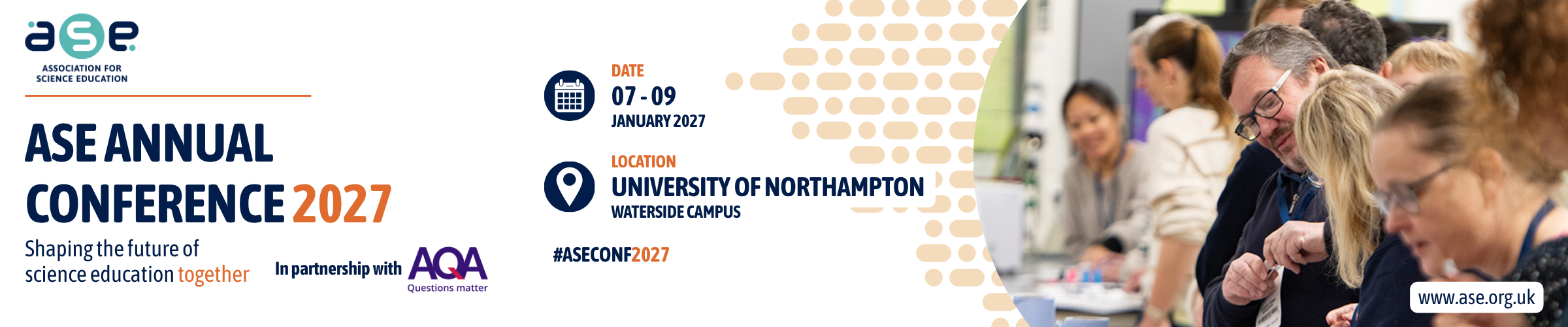
The ASE is delighted to be hosting its’ 2027 Annual Conference at the University of Northampton from 7th to 9th January.


Venue: LH322 (Learning Hub Level 3) clear filter
arrow_back View All Dates
Friday, January 8
 

08:45 GMT

Teaching scientific enquiry
Friday January 8, 2027 08:45 - 09:40 GMT
Conducting experiments is seen as a valuable, if not essential, part of physics education. However, such activities are also costly and time-consuming. Moreover, it is often reported that these activities hardly contribute to the students’ content knowledge, nor that they enhance students’ view on how science works or teaches them how to plan an inquiry independently.

In this interactive presentation, I highlight our approach to teaching scientific inquiry - engaging students in scientific inquiry through a focus on argumentation. I will elaborate on the various studies conducted on teaching scientific inquiry to 14-16y olds (culminated in the dissertation 'Development of a teaching-learning sequence for scientific inquiry through argumentation in secondary physics education').

In addition to a brief overview of the scientific findings, I engage participants hands-on in the activities, provide practical advice and materials that can be directly applied in the own classroom setting.
Speakers
FP

Freek Pols

Assistant Professor, Delft University of Technology

Friday January 8, 2027 08:45 - 09:40 GMT
LH322 (Learning Hub Level 3)

09:55 GMT

Post-16 chemistry masterclass: IR & 1H NMR spectroscopy
Friday January 8, 2027 09:55 - 10:50 GMT
This session will cover IR spectroscopy - interpretation of spectra to determine functional groups & fingerprinting using example spectra run by volunteer delegates to exemplify key teaching and examination points; ditto for 1H NMR spectroscopy - methods of interpreting spectra to determine molecular structure and predicting spectra from known structures - again to exemplify key teaching and examination points.

Outcomes: delegates will be more au fait with what a good examination answer looks like for both IR and 1H NMR and the classic student misconceptions to avoid.


Speakers
avatar for Peter Hoare

Peter Hoare

STEM Outreach Officer, Newcastle University
I am a former chemistry teacher (20 yrs) now working in STEM Outreach at a Russell Group University (16 years) and an experienced (31 yrs) A-level chemistry examiner for a major English exam board. I run many masterclasses, A-level Revision Workshops and Spectroscopy in a Suitcase... Read More →
Friday January 8, 2027 09:55 - 10:50 GMT
LH322 (Learning Hub Level 3)

12:25 GMT

Bring climate change to life through chemistry and real-world contexts
Friday January 8, 2027 12:25 - 13:20 GMT
How can chemistry lessons help learners make sense of climate change and sustainability?

In this session, we explore how sustainability contexts can bring chemical concepts to life and connect them to the global challenges of climate change.

We use examples from historical developments and current research to show how chemistry underpins a range of climate solutions. We will look at how chemists and scientists tackle these issues, helping learners see the relevance of their studies beyond the classroom.

We will explore ready-to-use resources and approaches, and reflect on how teachers could adapt these for their own settings. We will also draw on findings from the Green Shoots report to show how teachers can embed climate change and sustainability more consistently and meaningfully into chemistry teaching.
Speakers
avatar for Rebecca Laye

Rebecca Laye

Education coordinator, professional development & regional engagement, Royal Society of Chemistry

EL

Emma Lumb

Education coordinator, community engagement, education strategic programmes, Royal Society of Chemistry
Friday January 8, 2027 12:25 - 13:20 GMT
LH322 (Learning Hub Level 3)

13:35 GMT

Sonification – using sound to creatively communicate and explore data in the classroom
Friday January 8, 2027 13:35 - 14:30 GMT
In science we predominantly represent data numerically or graphically. Teachers, and students, are comfortable with the idea that we can represent the world by a series of numbers or a line on a graph.

Sonification is an approach to treating and analysing data through sound to create an auditory display. One example that has been fairly widely used is the representation of astronomical data and concepts, including in planetaria. One benefit for astronomers of using sound is because the dataset are extremely large which can make it hard to plot the data in a conventional manner i.e. graphically. However, sound can have a range of parameters such as pitch, volume, tempo and type of instrument. This variety means that it is possible to represent and comprehend a much more complex data set using sound.

In addition, sonification also has use to support people who are blind or vision impaired to access data and visual information more readily.

In this session, participants will make their own (simple) sonifications of different data, and consider how they could use sound to help students explore data in their classrooms.
Speakers
avatar for Carol Davenport

Carol Davenport

Professor of STEM Engagement, Northumbria University

AP

Antonio Portas

Assistant Professor, Northumbria University

Friday January 8, 2027 13:35 - 14:30 GMT
LH322 (Learning Hub Level 3)

14:45 GMT

Building fluency in organic mechanisms (White Rose Education)
Friday January 8, 2027 14:45 - 15:40 GMT
This session explores how a mechanistic approach can improve the teaching of organic chemistry at post-16, helping students move beyond surface memorisation to genuine understanding. Drawing on evidence from examiners’ reports and common errors seen in student work, we will examine why students often struggle with mechanisms and how a more structured, language-rich approach can overcome these barriers.

Delegates will consider how to build student fluency in recognising key features of reactions before tackling mechanisms themselves. This includes confidently identifying homolytic versus heterolytic fission, and distinguishing between addition, substitution, and elimination through analysis of overall equations.
Participants will engage with a range of carefully designed, classroom-tested strategies to scaffold learning across the two years of the course. These include:

•Dual coding approaches to represent mechanisms visually and verbally
•Activities matching mechanistic steps to their chemical meaning
•Diagnostic tasks that require students to select or justify the next step in a mechanism
•Completion and sequencing exercises to reveal and address misconceptions

All resources are grounded in research-informed practice and refined through extensive classroom experience.
The session concludes with dedicated time for reflection and collaboration. Delegates will work in groups to adapt and design resources for their own teaching contexts, ensuring that ideas can be implemented immediately and effectively in the classroom.
Speakers
DF

David Fairclough

Secondary Science Specialist, White Rose Education
Sponsors
avatar for White Rose Education

White Rose Education

White Rose Education is proud to sponsor the Primary Programme of the ASE 2027 Annual Conference

Created by teachers, mathematicians and scientists, White Rose Education is dedicated to helping every teacher become a world-class teacher.

White Rose Science takes the highly successful approach we pioneered with White Rose Maths and transfers it to the primary science curriculum. It uses a “small steps” approach to science teaching, and closely follows the national curriculum for science for years 1 - 6. It gives

... Read More →
Friday January 8, 2027 14:45 - 15:40 GMT
LH322 (Learning Hub Level 3)

16:10 GMT

Frontier Science: What we learn(ed) from rainbows
Friday January 8, 2027 16:10 - 17:05 GMT
Unexpectedly, many concepts and practices central to our physics today, that students and educators could find interesting, originated in the study of rainbows.
Speakers
MB

Michael Berry

Emeritus Professor of Physics, University of Bristol

Friday January 8, 2027 16:10 - 17:05 GMT
LH322 (Learning Hub Level 3)
 

Share Modal

Share this link via

Or copy link

Filter sessions
Apply filters to sessions.
Filtered by Date -