Loading…
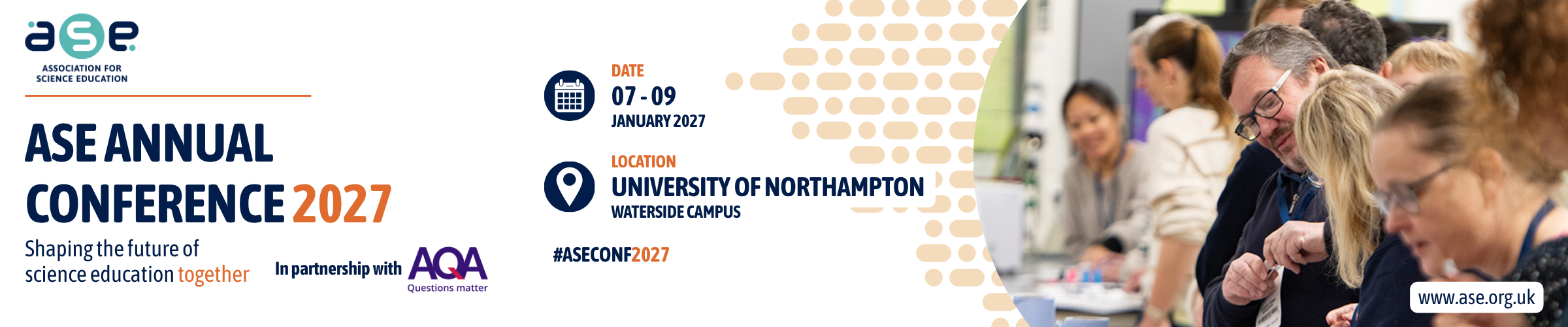
The ASE is delighted to be hosting its’ 2027 Annual Conference at the University of Northampton from 7th to 9th January.


Company: Using AI and technologies in teaching and learning clear filter
arrow_back View All Dates
Friday, January 8
 

08:45 GMT

(OUP) Critical and scientific thinking in the age of AI
Friday January 8, 2027 08:45 - 09:40 GMT
Science teachers are increasingly working with students who encounter AI-generated information every day, both inside and outside school. From chatbot explanations to AI-generated revision materials and scientific imagery, young people are already navigating a world where information can appear authoritative while containing inaccuracies, misconceptions or fabricated content. This session argues that AI literacy belongs within science education because scientific thinking provides one of the strongest frameworks for evaluating AI-generated information critically and responsibly.

This interactive workshop will explore how KS3 science classrooms can support students in developing critical disciplinary literacy in response to the growing influence of generative AI. Rather than focusing on specific tools or software, the session will examine how existing approaches in science education, including evidence evaluation, identifying misconceptions, questioning claims, and communicating scientific ideas accurately, can help students engage thoughtfully with AI-generated content.
The session also considers the increasing importance of supporting students to critically engage with misinformation, disinformation and misleading online content, including scientific conspiracy claims and AI-generated inaccuracies encountered beyond the classroom.

Participants will leave with:
a clearer understanding of the implications of generative AI for science education;
practical classroom strategies for developing critical AI literacy through science;
approaches for helping students evaluate scientific claims and information critically;
increased confidence in discussing AI, accuracy, misinformation and scientific communication within KS3 science contexts;
ideas for embedding AI literacy within existing science curricula and pedagogical approaches.
Speakers
ED

Emma Darcy

AI and Technology for Learning Consultant

Sponsors
avatar for Oxford University Press

Oxford University Press

As part of one of the world’s great universities, we’re driven by a love of learning and a deep conviction that education is a universal good.

For us, every child deserves to be taught by brilliantly professional teachers, working in close partnership with engaged parents, using the best and most inspiring learning resources, technology, and teaching methods. To that end, we work with the brightest, most creative educational... Read More →
Friday January 8, 2027 08:45 - 09:40 GMT
LH127 (Learning Hub Level 1)

13:35 GMT

Sonification – using sound to creatively communicate and explore data in the classroom
Friday January 8, 2027 13:35 - 14:30 GMT
In science we predominantly represent data numerically or graphically. Teachers, and students, are comfortable with the idea that we can represent the world by a series of numbers or a line on a graph.

Sonification is an approach to treating and analysing data through sound to create an auditory display. One example that has been fairly widely used is the representation of astronomical data and concepts, including in planetaria. One benefit for astronomers of using sound is because the dataset are extremely large which can make it hard to plot the data in a conventional manner i.e. graphically. However, sound can have a range of parameters such as pitch, volume, tempo and type of instrument. This variety means that it is possible to represent and comprehend a much more complex data set using sound.

In addition, sonification also has use to support people who are blind or vision impaired to access data and visual information more readily.

In this session, participants will make their own (simple) sonifications of different data, and consider how they could use sound to help students explore data in their classrooms.
Speakers
avatar for Carol Davenport

Carol Davenport

Professor of STEM Engagement, Northumbria University

AP

Antonio Portas

Assistant Professor, Northumbria University

Friday January 8, 2027 13:35 - 14:30 GMT
LH322 (Learning Hub Level 3)

13:35 GMT

Teaching about ‘AI in real-world science’ in the science classroom
Friday January 8, 2027 13:35 - 14:30 GMT
AI technology is changing the fabric of scientific knowledge building.  In biology, for example, AlphaFold predicts the structure of proteins and other biomolecules, changing how drugs are developed and diseases are  studied. In medicine, AI-powered image generation is changing medical diagnostics. In chemistry, AI tools are automating and accelerating organic chemistry and material discovery. In physics, complex AI-based simulations accelerate research across topics, while AI-based robotics is driving change in engineering. Further, scientific inquiry requires new skills for scientists, such as designing ‘AI experiments’, navigating data ethics and governance, evaluating AI models, and interpreting AI system output.

How, then, is school science changing to teach about this new way of scientific working and these new discoveries? What new AI-related real-world science concepts and skills might be taught?

The aim of this workshop is to start this discussion. We will lead a workshop to brainstorm candidate uses of AI in real-world science and consider what concepts and skills might be introduced at different stages of science education.
We will provide examples of how basic AI literacy concepts have been introduced in existing AI lessons covering topics such as ecosystems and healthcare.  We will use these to spark discussion on what content might be taught in classroom science lessons to showcase `AI in real-world science’.  We are particularly interested in stimulating discussion on how scientific inquiry in school might change in the light of AI technology.
 
The outcome from this workshop will be that participants will become more familiar with AI literacy concepts and begin to form ideas about what AI literacy for Science might look like. They will also start to develop ideas for lessons that introduce `AI in real-world science’ into their science classrooms. We do not have the answers to what should be taught and how about `AI in real-world science’, but as computer science education researchers, we would like to facilitate this discussion with science educators to help work towards this goal.
Speakers
JW

Jane Waite

Senior Research Scientist, Raspberry Pi Foundation

BG

Ben Garside

Senior Learning Manager, Raspberry Pi Foundation

Friday January 8, 2027 13:35 - 14:30 GMT
LH125 (Learning Hub Level 1)

14:45 GMT

Talking Science: who needs teachers anymore? Teaching science in the age of AI (SEPA)
Friday January 8, 2027 14:45 - 15:40 GMT
This year's Talking Science explores the evolving role of teachers in a world increasingly shaped by artificial intelligence. As AI transforms how young people learn, communicate and access knowledge, what does this mean for the future of science teaching? The session will consider both the opportunities and challenges facing science educators in supporting young people to become scientifically literate.
Following short stimulus inputs from our speakers, delegates will discuss and prioritise their recommendations for policy and practice that will help ensure the benefits of AI are realised equitably across science education. The discussion will explore implications for curriculum, assessment, teacher expertise, equity and students' future engagement with science.
SEPA intends to produce a short summary of key themes emerging from the discussion.

In common with our previous Talking Science sessions, this session promises thought-provoking insights and lively debate. We look forward to seeing you there and your contributions.

The Science Education Policy Alliance (SEPA) brings together the Association for Science Education, Institute of Physics, Royal Society, Royal Society of Biology and Royal Society of Chemistry to coordinate and collaborate on science education policy www.se-pa.co.uk

Refreshments will be served at the end of this session, courtesy of SEPA, for 25 minutes.

Speakers
avatar for Victoria Hedlund

Victoria Hedlund

AI bias researcher, consultant and founder, Gen Ed Labs

avatar for Miles Berry

Miles Berry

Professor of Computing Education, University of Roehampton

avatar for Marianne Cutler

Marianne Cutler

Director of Curriculum Innovation, Association for Science Education
Sponsors
avatar for SEPA

SEPA

The Science Education Policy Alliance (SEPA) brings together the Association for Science Education, Institute of Physics, Royal Society, Royal Society of Biology and Royal Society of Chemistry to coordinate and collaborate on science education policy, with Professor Dame Athene Donald... Read More →
Friday January 8, 2027 14:45 - 15:40 GMT
LH013 & LH014 (Learning Hub Ground Floor)

16:10 GMT

The silent teacher: How classroom design co-creates science learning
Friday January 8, 2027 16:10 - 17:05 GMT
You may know the idea of the Third Teacher: the Reggio Emilia principle that the physical environment is as formative as any instructor. What might this mean for your science classroom?

This interactive workshop explores how conscious spatial design — layout, naturalness, stimulation, and pupil-controlled affordances — can deepen engagement, support scientific thinking, and strengthen collaborative inquiry. The session itself is designed to demonstrate the very principles it explores.

You'll move through three activities — individual reflection, small-group application, and collective visioning — surfacing answers grounded in your own classroom experience and actionable research. You'll leave with concrete techniques to apply immediately, and the opportunity to help shape what comes next: a founding circle for a UK-wide action research network exploring classroom design in secondary science at scale. This is the future of science education — and we'll build it together.

Participants will be able to:
•Reflect critically on how their classroom's physical features currently support or constrain pupil engagement, cognition, and behaviour
•Apply evidence-based spatial design techniques to enhance science learning outcomes immediately
•Join a founding action research network with shared resources, peer collaboration, and opportunities to both contribute to and benefit from emerging findings

This session aims to:
• convene a founding circle for a UK-wide action research network exploring the transformative potential of classroom design in secondary science settings
• empower teachers and practitioners with evidence-based, immediately applicable answers, built directly from their own classroom experience

Background: Across years of action researching transformative learning experiences, a pattern emerged: expert facilitators consistently build a deliberate relationship with the physical space before their sessions begin. This observation sparked a master's thesis — An Architecture for Empowerment: Exploring How Physical Environments Co-Create Human Capacity — synthesising environmental psychology, 4E Cognition, neuroscience, and architectural theory. Its core finding: physical environments are not backdrops to learning but active co-creators of cognitive, emotional, and relational capacity. Science classrooms — with their fixed benches, equipment-laden surfaces, and competing sensory demands — represent a largely untapped frontier for this work.
Speakers
MZ

Milán Zoltán Páczai

Secondary Science Teacher & Researcher, Alec Reed Academy

Friday January 8, 2027 16:10 - 17:05 GMT
LH344 (Learning Hub Level 3 lab-type space)
 

Share Modal

Share this link via

Or copy link

Filter sessions
Apply filters to sessions.
Filtered by Date -