Loading…
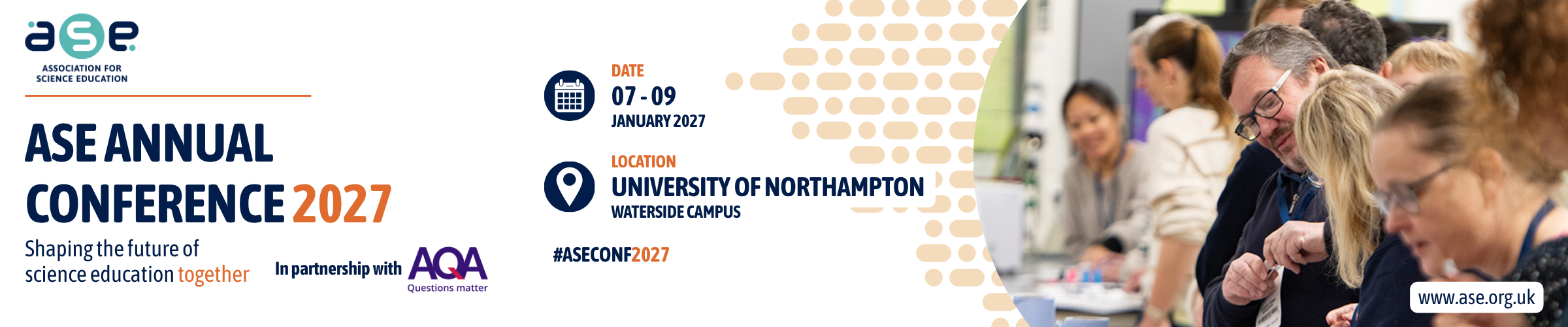
The ASE is delighted to be hosting its’ 2027 Annual Conference at the University of Northampton from 7th to 9th January.


Audience: Teacher Developers clear filter
arrow_back View All Dates
Friday, January 8
 

08:45 GMT

The future of the physics teaching workforce
Friday January 8, 2027 08:45 - 09:40 GMT
The last year has seen radical changes in the numbers of trainee physics teachers recruited, retained as well as those returning to the profession.

What does the future hold?

The Institute of Physics laid out its own vision for a thriving teaching workforce in its 3Rs report, published in September 2025. What has changed since then and what have we learned?
Speakers
avatar for Chris Shepherd

Chris Shepherd

Manager (Teaching Workforce), Institute of Physics

GB

Gemma Butt

Project Officer (Teaching Workforce), Institute of Physics

Friday January 8, 2027 08:45 - 09:40 GMT
LH324 (Learning Hub Level 3 lab-type space)

08:45 GMT

Closing the primary science CPD gap: flexible models that work (White Rose Education)
Friday January 8, 2027 08:45 - 09:40 GMT
Participants will be invited to explore an emerging solution: online, on-demand professional development for teachers. Drawing on experience of working with schools and delivering primary science CPD across a range of settings and contexts, we will examine how on-demand PD can support improvements in teacher confidence and subject knowledge, critically evaluate the strengths and limitations of digital professional development. Participants will be invited to reflect on the limitations that are experienced within their own settings.

The session will position on-demand CPD not as a replacement for all professional learning, but as a pragmatic, forward-thinking response to current system challenges; offering a way to broaden participation and improve consistency in primary science teaching, while encouraging participants to discuss how these approaches align with their own contexts.

Session format:
•Explore and briefly discuss key findings from the State of Primary Science 2025 report related to CPD access and teacher development
•Discuss on-demand CPD in primary science, examining design principles that promote engagement, retention and classroom impact
•Critically evaluate the strengths and limitations of online approaches, including issues of motivation, accountability and depth of learning
•Share and reflect on examples of how on-demand CPD might support improvements in subject knowledge, pedagogy and confidence

Intended outcomes:
•Interpret key CPD-related findings from State of Primary Science 2025
•Evaluate how on-demand CPD can support teacher confidence and subject knowledge
•Critically assess strengths and limitations of digital professional development
•Identify practical approaches for implementing or advocating scalable CPD solutions.
Speakers
avatar for Joe Partridge

Joe Partridge

Primary Science Specialist, White Rose Education
With over a decade of experience as a teacher, I specialise in STEM subjects and digital content creation. In my current role at White Rose Education I develop resources that support primary teachers, aligning with the national curriculum and fostering engagement in science. Through... Read More →
avatar for Dan Breeze

Dan Breeze

Head of Primary Science, White Rose Education

Sponsors
avatar for White Rose Education

White Rose Education

White Rose Education is proud to sponsor the Primary Programme of the ASE 2027 Annual Conference

Created by teachers, mathematicians and scientists, White Rose Education is dedicated to helping every teacher become a world-class teacher.

White Rose Science takes the highly successful approach we pioneered with White Rose Maths and transfers it to the primary science curriculum. It uses a “small steps” approach to science teaching, and closely follows the national curriculum for science for years 1 - 6. It gives

... Read More →
Friday January 8, 2027 08:45 - 09:40 GMT
Leathersellers Hide (Learning Hub Level 4)

09:55 GMT

Research in action: unlocking better science teaching
Friday January 8, 2027 09:55 - 10:50 GMT
This session will explore how action research has been used to drive meaningful and sustained improvements in science teaching and learning at The Manchester Grammar School. Framed around the principle of teachers as researchers, we will share how small-scale, classroom-based inquiry has empowered colleagues to take ownership of their professional development and directly shape departmental practice.

Over the course of the session, we will present a series of practitioner-led research projects carried out across the science department. We will outline how these projects were structured, supported, and embedded into a wider CPD programme, including the role of collaborative discussion, learning walks, and professional dialogue.

Crucially, we will evaluate the impact of this approach beyond individual classrooms, demonstrating how insights from action research have informed departmental priorities, strengthened consistency in teaching, and contributed to a culture of reflective practice. We will also reflect on the challenges of implementing this model and how they were addressed to ensure engagement and sustainability.

The session will include opportunities for discussion, enabling participants to consider how a similar approach could be adapted to their own contexts. Attendees will leave with practical strategies for embedding action research into CPD and for fostering a culture where evidence-informed practice can thrive.
Speakers
AW

Anna Wicking

Assistant Head (Professional Development and Digital Innovation), The Manchester Grammar School

JA

Jason Ashton

Physics Teacher, The Manchester Grammar School
Friday January 8, 2027 09:55 - 10:50 GMT
LH323 (Learning Hub Level 3)

09:55 GMT

Keynote: Raising the bar - ambition, curiosity and depth in science
Friday January 8, 2027 09:55 - 10:50 GMT
What does an ambitious science education look like from primary through to secondary? This session will explore how we can keep expectations high for all pupils, prioritise depth before pace, and use rich texts, images, examples and questions to provoke curiosity and build secure knowledge.

Mary Myatt will consider what happens when we move beyond coverage and activity and give pupils the intellectual substance and time they need to think, make connections and encounter the power of the discipline. The session will also explore how assessment can support, rather than distort, this ambition.
Speakers
avatar for Mary Myatt

Mary Myatt

Educational writer, speaker, blogger, consultant, Myatt & Co
I'm Mary Myatt an education adviser, writer and speaker working with schools, trusts and organisations across the UK. My work focuses on curriculum, teaching and learning, leadership and, increasingly, how we make Key Stage 3 more ambitious and intellectually generous for every pupil... Read More →
Friday January 8, 2027 09:55 - 10:50 GMT
LH013 & LH014 (Learning Hub Ground Floor)

10:50 GMT

Biology educators tea/coffee and muffins (sponsored by Miss Estruch Teach & Tell)
Friday January 8, 2027 10:50 - 11:15 GMT
If your focus is teaching or supporting biology lessons, come along for a networking session with complimentary tea/coffee and a muffin, to discuss how Miss Estruch Teach & Tell can support your practice!
Sponsors
avatar for Miss Estruch Teach & Tell

Miss Estruch Teach & Tell

Miss Estruch Teach & Tell
Miss Estruch Teach & Tell is the proud sponsor of the Biology Education Research Programme (BERG) on Thursday of Conference, 

'Teach & Tell is run by Miss Estruch (Katie Estruch), a biology teacher since 2009 and former Head of Department, now helping teachers get their most valu... Read More →
Friday January 8, 2027 10:50 - 11:15 GMT
Learning Hub Level 2 landing space outside rooms LH227-230

10:50 GMT

Physics and tea with the IOP
Friday January 8, 2027 10:50 - 11:15 GMT
We'd love to talk about physics education and how we can help you, your school or your MAT - and we've got treats. Join the IOP team to tell us what's going well and what you think we should be doing to support the profession.
Speakers
avatar for Eleanor Wylie

Eleanor Wylie

Professional Support Coach, Institute of Physics

IH

Ian Horsewell

Professional Community and Retention Strategic Lead, Institute of Physics
Sponsors
avatar for Institute of Physics (IOP)

Institute of Physics (IOP)

The Institute of Physics (IOP) is the professional body and learned society for physics in the UK and Ireland, with an active role in promoting co-operation in physics around the world. We strive to make physics accessible to people from all backgrounds.  

Come along and visit an

... Read More →
Friday January 8, 2027 10:50 - 11:15 GMT
Learning Hub Level 3 landing space (outside 344-347)

10:50 GMT

Chair Chat
Friday January 8, 2027 10:50 - 11:15 GMT
Our dedicated Chair Trio invite you to drop-in to the “Chair-Chat” sessions on one of the days of Annual Conference 2027. The Chair is a vital role to the ASE, and the elected Chair provides an authoritative voice for the thousands of members that the ASE supports, along with those working within the wider science education community. Those elected remain part of our Chair Trio for 3 years.

Got a question? Ever wondered about what goes on behind the scenes? Ever thought about getting involved in Committee activities? Are you wanting to know more about Professional Registration or writing an article in one of the ASE journals? First time attending our flagship Conference?

If this is your first ASE Conference, then please come along and say Hello.

We look forward to hearing your questions and will endeavour to answer them or point you in a selection of possible right directions!
Speakers
avatar for David Allen

David Allen

Associate Professor Learning and Teaching / Outgoing Chair of the ASE 25/26, University of Hertfordshire & Creative Primary Science Education Consultancy
I worked in primary schools for over twenty years as a classteacher, senior leader and Deputy Headteacher. I taught across Key stages 1, 2 and 3 in UK and in Spain. During this time I developed a passion for science, art and design, improvised drama, assessment for learning, creativity... Read More →
avatar for Claire Seeley (MA CSciTeach)

Claire Seeley (MA CSciTeach)

Primary Science Education Consultant / Co-Chair of the ASE
Claire Seeley has been a teacher for over thirty years in a wide variety of contexts including both inner city and rural schools England. Claire is also a Primary Science Consultant, providing both continuing professional development and initial teacher training.  She has a passion... Read More →
EP

Emily Perry

Professor of Education, Manchester Metropolitan University
avatar for Natasha Serret

Natasha Serret

Associate Professor of Science Education, Nottingham Trent University
I started my professional career as a classroom teacher and science lead in a London primary school. I was and remain passionate about classroom learning that promotes a scientific mindset alongside the development of an understanding of key scientific concepts.  This professional... Read More →
Friday January 8, 2027 10:50 - 11:15 GMT
Leathersellers Hide (Learning Hub Level 4)

11:15 GMT

Creativity & curiosity for all: the impact of student-led science
Friday January 8, 2027 11:15 - 12:05 GMT
This interactive workshop explores the impact of project-based learning in science education, including through the lens of the CREST Awards, a nationally recognised framework for student-led STEM project work. Drawing on research evidence and programme evaluation, as well as the stories and experiences of teachers and young people- the session will examine how structured project work can enhance student engagement, attainment, and the development of wider scientific skills.

The session begins by situating project-based learning within the broader evidence base- which will be based on a report by Jennifer De Witt, including research demonstrating improvements in outcomes when students engage in inquiry-driven projects.

Participants will then explore CREST as a case study of effective implementation. CREST provides a flexible, student-led approach to project work across age phases, supporting engagement with real-world scientific challenges. Evaluation evidence indicates that participation can lead to improved attainment and progression into STEM, alongside enhanced confidence and aspiration.

A central feature of the workshop is a panel discussion bringing together teachers and CREST graduates. This provides an opportunity to explore lived experiences of project work, including its impact on motivation, identity, and classroom practice. Delegates will engage directly with panellists through facilitated discussion and audience questions.

The session concludes with structured reflection and planning, enabling participants to identify practical strategies for embedding project work within their own settings.

By the end of the session, participants will:

Understand the evidence base underpinning project-based learning in science education
Explore how CREST operationalises effective project work in practice
Reflect on the impact of project work through teacher and student perspectives
Identify practical approaches to embedding project-based learning in their own contexts
Develop one actionable change informed by evidence and discussion
Speakers
avatar for Maria Rossini

Maria Rossini

Head of Education, British Science Association
Talk to me able making STEM accessible to all young people, lego, disability and anything related to CREST www.crestawards.org
GB

Gemma Butt

Project Officer (Teaching Workforce), Institute of Physics

Friday January 8, 2027 11:15 - 12:05 GMT
LH324 (Learning Hub Level 3 lab-type space)

11:15 GMT

New to Science Leadership
Friday January 8, 2027 11:15 - 12:10 GMT
Leading people is not the same as teaching students! Middle leaders are the engine room of schools and are worth investing in.

In this session, we will draw on the New to Science Leadership course (the most recent cohort led in autumn 2026 by ASE in partnership with Astin Consulting) to answer questions such as:

- what kind of training best prepares teachers for leading their peers?
- is leading the same as managing?
- how to prepare for a difficult conversation, how to run an effective departmental meeting, how to lead change?

Ideal for teachers new to leadership (or aspiring to), or those responsible for developing new leaders.
Speakers
avatar for Christina Astin

Christina Astin

Coach and Education Consultant, Physics Partners and Astin Consulting
http://www.linkedin.com/in/christina-astin
Friday January 8, 2027 11:15 - 12:10 GMT
LH323 (Learning Hub Level 3)

11:15 GMT

Panel: Thriving and surviving your first few years (for Early Career Teachers)
Friday January 8, 2027 11:15 - 12:10 GMT
Come along and listen to the panel, chaired by Martin Reece - a mix of ECT's, mentors and teachers in the early stages of their careers.

They will share their professional insight into their successes and challenges so far. What have they learnt? What would they recommend? What would they do differently? Listen to their top tips on how to manage wellbeing alongside the daily demands of teaching and hear how they have steered their ongoing professional development.

Join us. Listen. Ask questions and come away feeling enlightened!
Speakers
avatar for Martin Reece

Martin Reece

Science Education Consultant

Friday January 8, 2027 11:15 - 12:10 GMT
Leathersellers Hide (Learning Hub Level 4)

11:15 GMT

PISA 2025: Outcomes and implications for the Teaching and Learning of science
Friday January 8, 2027 11:15 - 12:10 GMT
The primary focus of the PISA Assessment in 2025 was on the outcomes of school science education for 15-year-olds. The 2025 Assessment framework, which was the basis of testing in over 90 countries in 2025, introduced three new elements.
First, two of the original competencies in the 2015 framework were merged. This change enabled the introduction of a new third competency that measured students’ ability to “research, evaluate and use scientific information for decision making”.
Second, because of the importance of educating students about the environment, climate change a specific focus on environmental education was added. The framework for this was elaborated in the document Agency in the Anthropocene.  

This framework has three new competencies with a focus on education for sustainability and climate change. Finally, the concept of attitudes to science has been broadened to the notion of science identity which introduces the notion of capital. This talk will explain these changes, their rationale and illustrate ways in which they were measured with sample items. In addition, it will present the findings from the results published in September 2026, and discuss their implications.
Speakers
avatar for Jonathan Osborne

Jonathan Osborne

Professor, Stanford University
My career started by teaching science in London comprehensives in 1972 for 9 years.  Curently I am the Kamalachari Professor in Science Education, Emeritus, in the Graduate School of Education, Stanford University in California but now back in the UK. I was President of the US National... Read More →
Friday January 8, 2027 11:15 - 12:10 GMT
LH124 (Learning Hub Level 1)

11:15 GMT

Promoting argument-driven explanation in Earth & Environmental Science
Friday January 8, 2027 11:15 - 12:10 GMT
In this session attendees will be introduced to Model-Evidence-Link (MEL) instructional materials designed to assist American learners as they construct arguments to evaluate the plausibility of evidence connected to models and the research base that supports using these scaffolds. These MEL diagrams allow students to think critically about socio-scientific issues by evaluating connections between lines of evidence and alternative explanatory claims.  

Explorations that utilize the MEL scaffold promote changes in epistemic judgments, including claim plausibility, and help students move toward a more civically minded and scientific stance. Student discourse is a critical part of these activities and include negotiation toward scientific consensus.

MEL activities for available for teaching about socio-scientific issues include climate change, dead zones, energy, extreme weather, fracking, freshwater resources, fossils, moon formation, nuclear energy, origins of the universe, soil and food security and wetlands. All materials are freely available under a Creative Commons license. Participants receive access to all instructional materials and instructional guides, found here:

https://serc.carleton.edu/mel/index.html

Speakers
DG

Donna Governor

President, NSTA, America

avatar for Lorraine Ramirez-Villarin

Lorraine Ramirez-Villarin

Associate Professor, University of North Georgia, USA

Friday January 8, 2027 11:15 - 12:10 GMT
LH125 (Learning Hub Level 1)

11:15 GMT

Rising to the challenge: improving pedagogy & practice in physics education
Friday January 8, 2027 11:15 - 12:10 GMT

This session will look at two specific EEF guidance reports in detail with a physics-specific lens: Improving Secondary Science and Effective Professional Development. We will draw on a wider evidence-base concerning the challenges of adult behaviour change and its influence on improving teacher practice. This session will consider individual and organisational impact and will be relevant to teachers and leaders of physics.

Background: The Ogden Trust has worked closely with Durrington Research School and The EEF on the Working Through Others programme, a new pillar of The EEF's impact work focused on developing and delivering evidence-informed practice. The results of this collaboration have informed The Ogden Trust's new strategy and programme development.
Speakers
avatar for Jackie Flaherty

Jackie Flaherty

Head of Teaching and Learning, The Ogden Trust

BC

Ben Crockett

Co-Director, Durrington Research school
Ben is an Assistant Director at Durrington Research School, and Assistant Headteacher at Durrington High having joined the school in 2013. Ben has previously been head of Geography.  As part of his wider school role, Ben in responsible for ensuring the quality and consistency of... Read More →
Friday January 8, 2027 11:15 - 12:10 GMT
LH127 (Learning Hub Level 1)

12:25 GMT

(Pearson) Science reform in action - what comes next for teachers and learners?
Friday January 8, 2027 12:25 - 13:20 GMT
Science education is entering a pivotal period of change. This interactive, evidence-informed session will explore how reform can translate ambitious national intent into qualifications, assessment and classroom practice that work for teachers and learners. Drawing on Pearson’s engagement with teachers, science leaders, students and subject communities, the session will consider  what successful reform should achieve , what different stages of science reform could mean for subject leaders, teachers and students, and what schools will need to implement changes successfully.
Session aims
  • Make science reform tangible and relevant for classroom practitioners and leaders.
  • Surface practitioner priorities, risks and implementation need so that teacher and learner experience informs future qualification thinking.
  • Build confidence by identifying proportionate preparation schools can undertake while policy and qualification details continue to develop.
Delegate takeaways
  • A phased school-readiness checklist.
  • Practical actions departments can begin without overcommitting.
  • A sharper understanding of potential implications for learners, teachers and departmental delivery.
  • Questions and discussion prompts to use with departments, senior leaders and trust teams.
This session is followed by a catered lunch, sponsored by Pearson, for secondary educators and early career teachers or trainees. Please join us to continue the networking opportunity and further explore how Pearson can support you.
Speakers
avatar for Shauna O'Brien

Shauna O'Brien

Head of Science, Pearson

avatar for Tosin Oliyide

Tosin Oliyide

Senior Qualifications Manager - Science, Pearson

Friday January 8, 2027 12:25 - 13:20 GMT
LH013 & LH014 (Learning Hub Ground Floor)

12:25 GMT

Bring climate change to life through chemistry and real-world contexts
Friday January 8, 2027 12:25 - 13:20 GMT
How can chemistry lessons help learners make sense of climate change and sustainability?

In this session, we explore how sustainability contexts can bring chemical concepts to life and connect them to the global challenges of climate change.

We use examples from historical developments and current research to show how chemistry underpins a range of climate solutions. We will look at how chemists and scientists tackle these issues, helping learners see the relevance of their studies beyond the classroom.

We will explore ready-to-use resources and approaches, and reflect on how teachers could adapt these for their own settings. We will also draw on findings from the Green Shoots report to show how teachers can embed climate change and sustainability more consistently and meaningfully into chemistry teaching.
Speakers
avatar for Rebecca Laye

Rebecca Laye

Education coordinator, professional development & regional engagement, Royal Society of Chemistry

EL

Emma Lumb

Education coordinator, community engagement, education strategic programmes, Royal Society of Chemistry
Friday January 8, 2027 12:25 - 13:20 GMT
LH322 (Learning Hub Level 3)

12:25 GMT

Chemical grenades
Friday January 8, 2027 12:25 - 13:20 GMT
Most teachers have been confronted in the classroom by a "chemical grenade" - a question from a pupil that may or may not have been intended to cause damage, but which was also both hard to answer and very interesting, often just touching the edges of the syllabus.  

By sharing some of the most interesting chemical grenades from my teaching, I hope to outline an approach to answering these questions in the pursuit of developing teachers' chemistry knowledge and ability to explain abstract concepts from physical an inorganic chemistry at GCSE and A-level in a "rigorous but hand waving" way that pupils might appreciate.  

Some grenades to be considered, most drawn from A-level pupils, include: "When an equilibrium responds to an increase in pressure, does the pressure ever return to its old value?", "If copper complexes are coloured because of d-d transitions, why don't they just re-emit the light they absorbed?", "How do chiral molecules rotate plan polarised light differently when they are randomly oriented?", "Why doesn't adding a solid to an equilibrium mixture change the position of equilibrium?"  

I hope to show that working out the answers to these questions, and then how to present the answer to pupils, can be tricky, but also leads to a better understanding of the chemistry being taught.
Speakers
avatar for Matthew Smith

Matthew Smith

Head of Chemistry, St Pauls School
Matthew has been teaching high school chemistry for 16 years and is in charge of a team of 13 chemists at St Paul's School. His department teaches about 750 pupils and has been building microscale and small scale chemistry into their curriculum for several years, and he and his team... Read More →
Friday January 8, 2027 12:25 - 13:20 GMT
LH127 (Learning Hub Level 1)

12:25 GMT

Frontier Science: Engineering the future
Friday January 8, 2027 12:25 - 13:30 GMT
In this talk, IChemE President Ollie Folayan will share his journey into chemical engineering, describe a day in the life of an engineer, talk about the work he has done to widen access to underrepresented groups and highlight the forces shaping engineering in the future.
Speakers
OF

Ollie Folayan FREng CEng FIChemE

Head of Process Engineering, Costain

Friday January 8, 2027 12:25 - 13:30 GMT
LH345 (Learning Hub Level 3 lab-type space)

12:25 GMT

What's the point of teaching science? What we've found from research
Friday January 8, 2027 12:25 - 13:30 GMT
Science is a mandatory subject across most nations, and we too often take its privileged position for granted. Much has been written about the purpose of education but far less when it comes to the specifics of science education.

Science teaching and curriculum development should be grounded in sound reasons for its presence on the curriculum along with what it should contain and what it should stand for. Over the last year data has been gathered, supported by the ASE, to probe how science teachers perceive the purpose of science education. Surveys have been able to establish certain standpoints are more widely help than others; in this presentation we will look at this research and its findings, and look at science education through the lenses of utility, curiosity, culture and citizenship. This research has implications for all involved in science education, from the classroom through to curriculum policy makers.

By the end of the session colleagues will hopefully have some alternative perspectives on why science education is so important and why its importance will only grow over time.
Speakers
avatar for Mark Whalley

Mark Whalley

Senior Lecturer in Education, University of Chester
I'm a senior lecturer in Educational Leadership at the University of Chester. My main teaching covers Professional Learning and Change Leadership but I also tutor across the MA Educational Leadership programme. My principal research interest is in teacher retention and by focusing... Read More →
Friday January 8, 2027 12:25 - 13:30 GMT
LH344 (Learning Hub Level 3 lab-type space)

13:35 GMT

Mathematics support for serving science teachers - seeking a way forward
Friday January 8, 2027 13:35 - 14:30 GMT
Building on our work investigating the mathematical skills of trainee science teachers, in this session we will explore the needs of serving teachers. The aim of the session is to inform our next steps to support trainees and serving science teachers with the maths skills required to teach GCSE sciences.

In this session we will:
(a) identify mathematical skills challenges
(b) revisit issues experienced by trainees
(c) identify the issues for serving teachers using:
(i) a survey of GCSE Examiners’ reports
(ii) an overview of existing CPD provision for serving teachers together with lessons from uptake and evaluation information.

Working closely with trainee teachers, we have begun to review existing resources that might help teachers to improve their maths skills.
In this session participants will be asked about:
(a) the resources teachers and teacher developers use to develop maths skills of serving teachers
(b) whether an online self-assessment tool would be helpful
(c) what additional CPD provision may help
(d) the possible role of online asynchronous support
(e) resources that might support science teachers to improve their maths skills pedagogy

Background: With over 60 years of Physics teaching experience between them as well as a background of supporting Science teachers with Physics, Ally Davies, Liz Nourshargh and Caroline Neuberg have been working together on the maths skills of trainee science teachers since 2021, initially as part of the IOP Physics Teacher Educator Programme. Since then, they have presented at conferences, published a paper, written maths support materials and delivered Maths CPD on behalf of a number of organisations. As they continue to work with trainee Science teachers and deliver maths CPD for a variety of organisations, they aim to ensure that the tools developed are suitable for and freely available to all Science teachers.
Speakers
avatar for Ally Davies

Ally Davies

Consultant, Ally Physics
At this conference I'll be speaking about recent work on maths skills of trainee science teachers and considering what support might be helpful for in service teachers of science.
In my semi-retirement, I'm also working to improve representation of minoritised groups/identities... Read More →
avatar for Caroline Neuberg

Caroline Neuberg

Senior Lecturer in Education / Consultant, Leeds Trinity University
Dr. Caroline Neuberg is a Senior Lecturer in Secondary Education at Leeds Trinity University (LTU). The second Intensive Training and Practice (ITAP) completed by her science trainees focuses on signature pedagogies, dedicated to practical work. Many of the trainees, who have experienced... Read More →
Friday January 8, 2027 13:35 - 14:30 GMT
LH324 (Learning Hub Level 3 lab-type space)

13:35 GMT

Primary TeachMeet Lightning Talks
Friday January 8, 2027 13:35 - 14:30 GMT
Fast, focused, and full of inspiration, our TeachMeet Lightning Talks are a celebration of ideas that work.

Hear from fellow primary educators sharing short, sharp insights from their classrooms: something they’ve tried, something that’s shifted practice, or something that’s made a real difference to pupils.

From rethinking the curriculum to small tweaks with big impact, each talk offers a glimpse into real practice – honest, practical, and usable. Dip in, get inspired, and leave with a handful of ideas you’ll want to try straight away.

This session is coordinated by the ASE Primary Committee who will be present to help and support throughout the session - come along and join in!


Speakers
avatar for Angharad Pass

Angharad Pass

Primary Science Specialist Education Consultant
The Padlet for the Teachmeet is here: https://padlet.com/saraheamesscienceleader/ase-conf-saturday-10th-january-2026-primary-science-teach-me-ruozfsim8u6eq9lz
Friday January 8, 2027 13:35 - 14:30 GMT
Creative Hub Atrium Level 1

13:35 GMT

Helping KS2 children understand climate change: practical lessons
Friday January 8, 2027 13:35 - 14:30 GMT
Climate change is now part of everyday classroom conversation, yet many primary teachers still feel uncertain about how best to explain complex climate topics in a balanced, age-appropriate and scientifically confident way.

This highly practical and interactive workshop draws on lessons learned through delivering climate workshops to KS2 pupils in primary schools across the Midlands, together with the development of The Climate Classroom educational podcast and companion educational materials.

The session will focus on practical, classroom-tested approaches for helping children understand key climate ideas clearly: what greenhouse gases do, why the planet is warming, how food, transport and materials connect to climate, and how solutions and innovation can be discussed without creating fear or confusion.

Participants will experience adaptable techniques including role play, discussion prompts, short quizzes, visual imagery and simple explanation frameworks designed for KS2 and early KS3 pupils.

The session will also consider how teachers can prepare well using reliable materials and trusted scientific sources, while still responding honestly to unexpected pupil questions that may need follow-up after the lesson.

Sources discussed will include NASA, NOAA, the IPCC, the WMO and the UK Met Office.

Participants will leave with practical classroom strategies, classroom-tested activity ideas, greater confidence in discussing climate change, and examples of freely accessible climate literacy resources suitable for KS2 and early KS3 classrooms.
Speakers
GD

Graham Davies

Climate Educator & Podcast Host, The Climate Classroom

Friday January 8, 2027 13:35 - 14:30 GMT
LH229 (Learning Hub Level 2)

13:35 GMT

Teaching about ‘AI in real-world science’ in the science classroom
Friday January 8, 2027 13:35 - 14:30 GMT
AI technology is changing the fabric of scientific knowledge building.  In biology, for example, AlphaFold predicts the structure of proteins and other biomolecules, changing how drugs are developed and diseases are  studied. In medicine, AI-powered image generation is changing medical diagnostics. In chemistry, AI tools are automating and accelerating organic chemistry and material discovery. In physics, complex AI-based simulations accelerate research across topics, while AI-based robotics is driving change in engineering. Further, scientific inquiry requires new skills for scientists, such as designing ‘AI experiments’, navigating data ethics and governance, evaluating AI models, and interpreting AI system output.

How, then, is school science changing to teach about this new way of scientific working and these new discoveries? What new AI-related real-world science concepts and skills might be taught?

The aim of this workshop is to start this discussion. We will lead a workshop to brainstorm candidate uses of AI in real-world science and consider what concepts and skills might be introduced at different stages of science education.
We will provide examples of how basic AI literacy concepts have been introduced in existing AI lessons covering topics such as ecosystems and healthcare.  We will use these to spark discussion on what content might be taught in classroom science lessons to showcase `AI in real-world science’.  We are particularly interested in stimulating discussion on how scientific inquiry in school might change in the light of AI technology.
 
The outcome from this workshop will be that participants will become more familiar with AI literacy concepts and begin to form ideas about what AI literacy for Science might look like. They will also start to develop ideas for lessons that introduce `AI in real-world science’ into their science classrooms. We do not have the answers to what should be taught and how about `AI in real-world science’, but as computer science education researchers, we would like to facilitate this discussion with science educators to help work towards this goal.
Speakers
JW

Jane Waite

Senior Research Scientist, Raspberry Pi Foundation

BG

Ben Garside

Senior Learning Manager, Raspberry Pi Foundation

Friday January 8, 2027 13:35 - 14:30 GMT
LH125 (Learning Hub Level 1)

14:45 GMT

Is science for everyone? Tackling unconscious bias in primary schools.
Friday January 8, 2027 14:45 - 15:40 GMT
Many children do not think that science is relevant or important to their lives, now or in the future. Research shows that children are already being influenced by gender-based beliefs at 7 years old or even earlier and have made up their minds before the age of 11 that science is not for them. Teachers can play a key role in challenging these views before they become too entrenched. The Science 4 Everyone materials are a range of freely accessible resources that teachers and school leadership teams can use to raise awareness of unconscious bias and its potential to influence pupils’ science capital and attitudes towards science. They are used in this session to reflect on challenges faced when making science accessible to all.

The presenters will use their extensive experience from the classroom and from working with teachers and students in both the informal and formal science education sector to reflect on what makes the most difference to ensuring that children believe science is for everyone.

This session is aimed at classroom teachers, science leaders and teacher developers who work with them, and aims to:
• Share evidence from research, including issues around unconscious bias and stereotype threat and their relation to pupils’ science career ambitions.
• Outline resources and effective practical strategies that teachers have found to be effective. Examples will be used from schools and informal settings that have promoted inclusion and equity by using these materials and approaches
• Give participants opportunity to try out and discuss some of Science4Everyone practical toolkit materials that can be readily integrated into curriculum design to address the unconscious biases that we all hold
• Encourage participants to reflect on which strategies might be most useful to address the needs of the children in their schools and reflect on how to audit, implement and review actions to inspire all children to see science as meaningful and relevant in their own lives.

Participants will:
• know more about unconscious bias and its impact on inclusive science teaching, the support freely accessible from the Science 4 Everyone materials and the links to research evidence about the importance of pupils developing a science identity.
• reflect on what is working well in their own setting and where improvements could be made.
• have opportunity to reflect on which strategies might be most useful and begin to plan how they could audit needs, implement priorities and review actions as part of a development cycle.
Speakers
FG

Francesca Gale

Head of Science Engagement and Enrichment, Welcome Connecting Science
avatar for Alex Farrer

Alex Farrer

PSQM Development Lead, Primary Science Quality Mark
PSQM Professional Learning Partner.
Primary Science Teaching Trust Fellow.
Member of the PSQM Expert Advisory Group.
Member of the ASE Teacher Developers’ Committee.
Accredited trainer of the Primary Science Capital Teaching Approach.
Co-author of the PSTT resources See Through Sci... Read More →
Friday January 8, 2027 14:45 - 15:40 GMT
LH115 (Learning Hub Level 1)

14:45 GMT

Education system building
Friday January 8, 2027 14:45 - 15:40 GMT
Central aims for the session: (a) to support participants in understanding what constitutes educational system building and (b) how to categorise and evaluate their own leadership efforts to identify key areas of focus for continuous improvement.

Education system building is an empirically evidenced approach to educational improvement. System building involves teachers and school leaders collaborating to organise, support, and manage teaching and learning across five key domains of practice:

1. Building educational infrastructure: designing formal teaching materials (schemes of work, assessments) and establishing social resources for learning (norms, values, and relationships among students, teachers, and leaders)

2. Teacher professional learning for supporting use of infrastructure in practice: formal CPD, coaching, and opportunities for peer learning (co-planning, peer observation, lesson study, collaborative data analysis)

3. Managing environmental relationships: navigating external environmental influences (exam boards, DfE, inspection bodies, cultural and political shifts), and engaging environmental actors (universities, professional bodies, community actors)

4. Monitoring and managing performance for continuous improvement: monitoring and evaluating teaching and learning (data analysis, staff appraisal, observations of teaching and department routines, and designing mechanisms for teacher feedback), and identifying areas for continuous improvement

5. Developing and distributing academic leadership: structuring teams and roles (HODs, curriculum leads), and encouraging leadership of initiative across all staff

In reflecting on my work as a HOD in three schools, I can organise my activities into each of these domains, and identify domains where my efforts are focused in an average week. I can also compare across my different schools and see how work in each domain looked different depending on the context. This can be a useful framework for reflection to identify 'gaps' in our leadership practice.

However, this lens is most powerful for helping us coordinate improvement efforts across these domains. For example, it can help us to identify when data being collected is not being used to (re)design students’ educational experiences, or staff appraisal routines are not used to shape teacher learning initiatives and/or (re)configure informal leadership roles. A system building frame also helps leaders to conceptualise why some approaches that explicitly work across domains, like lesson study, can be incredibly powerful.

In this session, I will outline the key findings from the education system building research coming out of the US, and draw on my experience as a science leader in England to reframe this for a UK educational context, as well as provide participants with an opportunity to audit their own leadership practice, and learn from other leaders how their work looks similar/different through a system building lens.
Speakers
ES

Emily Seeber

Head of Science, Lord Wandsworth College

Friday January 8, 2027 14:45 - 15:40 GMT
LH344 (Learning Hub Level 3 lab-type space)

14:45 GMT

Talking Science: who needs teachers anymore? Teaching science in the age of AI (SEPA)
Friday January 8, 2027 14:45 - 15:40 GMT
This year's Talking Science explores the evolving role of teachers in a world increasingly shaped by artificial intelligence. As AI transforms how young people learn, communicate and access knowledge, what does this mean for the future of science teaching? The session will consider both the opportunities and challenges facing science educators in supporting young people to become scientifically literate.
Following short stimulus inputs from our speakers, delegates will discuss and prioritise their recommendations for policy and practice that will help ensure the benefits of AI are realised equitably across science education. The discussion will explore implications for curriculum, assessment, teacher expertise, equity and students' future engagement with science.
SEPA intends to produce a short summary of key themes emerging from the discussion.

In common with our previous Talking Science sessions, this session promises thought-provoking insights and lively debate. We look forward to seeing you there and your contributions.

The Science Education Policy Alliance (SEPA) brings together the Association for Science Education, Institute of Physics, Royal Society, Royal Society of Biology and Royal Society of Chemistry to coordinate and collaborate on science education policy www.se-pa.co.uk

Refreshments will be served at the end of this session, courtesy of SEPA, for 25 minutes.

Speakers
avatar for Victoria Hedlund

Victoria Hedlund

AI bias researcher, consultant and founder, Gen Ed Labs

avatar for Miles Berry

Miles Berry

Professor of Computing Education, University of Roehampton

avatar for Marianne Cutler

Marianne Cutler

Director of Curriculum Innovation, Association for Science Education
Sponsors
avatar for SEPA

SEPA

The Science Education Policy Alliance (SEPA) brings together the Association for Science Education, Institute of Physics, Royal Society, Royal Society of Biology and Royal Society of Chemistry to coordinate and collaborate on science education policy, with Professor Dame Athene Donald... Read More →
Friday January 8, 2027 14:45 - 15:40 GMT
LH013 & LH014 (Learning Hub Ground Floor)

16:10 GMT

Frontier Science: What we learn(ed) from rainbows
Friday January 8, 2027 16:10 - 17:05 GMT
Unexpectedly, many concepts and practices central to our physics today, that students and educators could find interesting, originated in the study of rainbows.
Speakers
MB

Michael Berry

Emeritus Professor of Physics, University of Bristol

Friday January 8, 2027 16:10 - 17:05 GMT
LH322 (Learning Hub Level 3)

16:10 GMT

Integrated instructions and microscale practical work
Friday January 8, 2027 16:10 - 17:05 GMT
Effective practical work can be challenging for students for many reasons, not least the overload on their working memory. Students’ understanding of the chemical concepts underlying a practical observation or measurement relies on them cognitively attending to a wide range of matters: their theoretical understanding of the world, new and recalled skills and knowledge, instruction in written and verbal form, the materials and equipment, and the social environment of the classroom.

This session will discuss two key aspects of improving students’ experience and engagement with practical work. Microscale practical tasks make use of smaller quantities of chemicals, simpler equipment and techniques, and a more rapid progression from start to observations and measurements. Integrated instructions use simplified guidance incorporated into diagrammatic representations of equipment and method. Participants will see how these approaches have been embedded throughout the chemistry curriculum, including the selection of suitable tasks, typical student responses and outcomes, and the process of securing staff buy-in. Links will be drawn between examination syllabuses and the conceptual understanding developed through these practicals.

Outcomes: Participants will be able to identify opportunities for microscale practical work, adapt instructions to reduce extraneous demand, and plan steps for implementation in their own departments.
Speakers
avatar for Bob Worley

Bob Worley

Part Time Advisor, CLEAPSS
Bob Worley FRSC MSc was the 2021 winner of the Royal Society of Chemistry Prize for Excellence in Secondary Education. He taught for 20 years and afterwards became the Senior Advisor at CLEAPSS dealing with school chemistry laboratory safety, from which he pioneered microscale chemistry... Read More →
avatar for David Paterson

David Paterson

Assistant Head Teacher, Aldenham School

Friday January 8, 2027 16:10 - 17:05 GMT
LH323 (Learning Hub Level 3)

16:10 GMT

Preparing for participation: Lesson prep and high participation strategies
Friday January 8, 2027 16:10 - 17:05 GMT
During the session, we will:

* Explain what we mean by lesson preparation, and some key strategies that secure high participation in lessons (including Call and Response, Turn and Talk, mini-whiteboards)
* Share our experiences embedding these in our own practice, and in establishing these across departments and schools
* Facilitate discussion on how these practices might be applied in attendee's contexts


As a result of the session:
* Teachers will have a new approach to lessons - preparation rather than planning
* Teachers will have a good understanding of some high participation strategies that they can use in the classroom
* Leaders and teacher developers will have advice and ideas for implementing these in their contexts

Background: Historically, the quality of teaching and learning (and in turn student outcomes) in science lagged behind other subjects in our MAT and the national picture for science. This led to a period of reflection and learning, drawing on works from the 'CogSciSci' network of authors and bloggers, the 'In Action' series of books and 'Teach Like A Champion'. One output of this was what we called a Framework for Good Science Teaching, which put checking for understanding as one of the 4 central pillars, and in particular the use of high participation strategies to ensure all students cognitively participate in the lessons. Beyond this, the whole purpose of the framework was to move colleagues away from 'lesson planning' - typically endless resource creation - to 'lesson preparation', where staff intellectually engage with the resources available to consider how to best use them with their students. We will talk about our experiences across the Trust, and within one specific school where this has had significant impact on students' understanding of science. We intend to support further learning on these strategies through online webinars and writings in ASE publications, for attendees to continue their professional development.
Speakers
DB

Deb Barnett

Director of Science, Co-op Academies Trust

LD

Laura Dufty

Head of Science, Co-op Academies Trust
Friday January 8, 2027 16:10 - 17:05 GMT
LH324 (Learning Hub Level 3 lab-type space)

16:10 GMT

Teacher confidence: The key missing link in primary science improvement
Friday January 8, 2027 16:10 - 17:05 GMT
Teacher confidence is frequently discussed in primary science, yet it is rarely treated as a strategic priority within school improvement planning or within the support structures offered by organisations working alongside schools. This session explores the argument that meaningful and sustained improvements in primary science cannot happen without intentional investment in teacher confidence.

Drawing on examples from classroom, school and trust-level practice, participants will reflect on how confidence influences curriculum enactment, practical science, pupil engagement and teaching quality. The session will explore why confidence is often overlooked because it is perceived as difficult to measure, despite its clear impact on outcomes for both teachers and pupils.

Participants will also be challenged to consider the extent to which current professional development and science support models genuinely create space for teachers to develop confidence over time. Rather than viewing confidence as a by-product of training, the session will argue that it should be deliberately planned for, revisited and evaluated as part of sustainable improvement work.

The session will further explore the link between teacher inclusion and pupil inclusion, recognising that teachers who feel disconnected from science or perceive the subject as “not for them” may find it more challenging to deliver engaging and ambitious science experiences for children.

Through discussion, reflection and analysis of case studies, participants will leave with practical ideas for how teacher confidence can become a visible and valued part of school improvement conversations and wider science support programmes.

Participants will:
> Reflect on the impact of teacher confidence on science teaching, learning and inclusion
> Consider examples of how schools, trusts and science organisations can intentionally developed teacher confidence over time
> Consider how teacher confidence could be incorporated into improvement planning, professional development and external science support programmes
> Identify practical ways to revisit, monitor and evaluate teacher confidence within their own contexts
> Recognise teacher confidence as a strategic factor in achieving sustainable improvement in primary science

This session draws on my experience as a primary teacher, Science subject leader and nationally recognised Science consultant, working with schools, trusts and organisations to improve science provision across a range of contexts. Through this work, a recurring theme has emerged: where teachers lack confidence in science, this significantly influences the quality of teaching, curriculum enactment and pupil engagement.

My interest in this area has developed through supporting teachers and leaders over time and recognising that confidence is often treated as incidental rather than intentional within school improvement. Schools readily plan and budget for curriculum resources, schemes and assessment systems, yet teacher confidence is rarely identified as something that can be deliberately developed, revisited and evaluated. Equally, organisations supporting schools in science education often focus on provision, resources or subject knowledge without explicitly addressing how teachers experience science themselves.

This is particularly important within primary science, where some teachers may feel that science “isn’t for them”, limiting participation, risk-taking and engagement within the subject. The session also reflects current national priorities outlined in Every Child Achieving and Thriving (2026), particularly the emphasis on sustainable school improvement, workforce development and inclusive practice. While inclusion is often discussed in relation to pupils, this session considers the importance of inclusion for teachers too: if teachers themselves do not feel included, capable or confident within science, this inevitably impacts the experiences and opportunities available to children.
Speakers
avatar for Becki Price

Becki Price

Science consultant and teacher, The Willows Primary School

CW

Chris Wemyss

Teacher and Subject Leader, Gladstone Primary School

Friday January 8, 2027 16:10 - 17:05 GMT
LH115 (Learning Hub Level 1)

16:10 GMT

Panel: Planning and upskilling CPD for curriculum reform
Friday January 8, 2027 16:10 - 17:05 GMT
This panel brings together CPD, curriculum and science leaders to share how they are approaching the challenge of preparing themselves and their colleagues for the new Programme of Study. Hear how schools are identifying professional learning needs, developing subject knowledge and pedagogical expertise, and planning CPD to build staff confidence and capacity ahead of implementation.

The panel will provide an opportunity to hear directly from those working at the chalkface about the approaches they are taking, the challenges they are encountering and the priorities they have identified as they prepare for curriculum reform.

The discussion will consider the importance of sustained professional learning and how schools can make the most of the time available before September 2028, rather than treating curriculum change as a one-off and finite task.
Whether you are a science leader, curriculum leader, teacher developer or involved in planning professional learning, join us to hear practical experiences and ideas that can inform your own approach to preparing for the new curriculum.
Speakers
avatar for Marianne Cutler

Marianne Cutler

Director of Curriculum Innovation, Association for Science Education
Friday January 8, 2027 16:10 - 17:05 GMT
LH013 & LH014 (Learning Hub Ground Floor)

17:10 GMT

Meet the ASE 11-19 Committee
Friday January 8, 2027 17:10 - 17:30 GMT
If you are a secondary teacher or science education consultant, come along to the "Meet the 11 to 19 Committee" session at the end of Friday of Annual Conference 2027.

Got a question? Ever wondered about what goes on behind the scenes? Ever thought about getting involved in Committee activities? Are you wanting to know more about Professional Registration or writing an article for one of the ASE journals?

We look forward to listening to your questions and will endeavour to answer them!
Speakers
RM

Rebecca McCready

Chair of ASE 11 to 19 Committee, Duke's Secondary school, SE Northumberland

Friday January 8, 2027 17:10 - 17:30 GMT
LH323 (Learning Hub Level 3)

17:10 GMT

Meet the ASE Primary Committee
Friday January 8, 2027 17:10 - 17:30 GMT
If you are a primary science educator, come along to the "Meet the Primary Committee" session at the end of Friday of Annual Conference 2027.

Got a question? Ever wondered about what goes on behind the scenes? Ever thought about getting involved in Committee activities? Are you wanting to know more about Professional Registration or writing an article in Primary Science or one of the ASE journals?

We look forward to listening to your questions and will endeavour to answer them!
Speakers
avatar for Angharad Pass

Angharad Pass

Primary Science Specialist Education Consultant
The Padlet for the Teachmeet is here: https://padlet.com/saraheamesscienceleader/ase-conf-saturday-10th-january-2026-primary-science-teach-me-ruozfsim8u6eq9lz
Friday January 8, 2027 17:10 - 17:30 GMT
LH124 (Learning Hub Level 1)
 

Share Modal

Share this link via

Or copy link

Filter sessions
Apply filters to sessions.
Filtered by Date -