Loading…
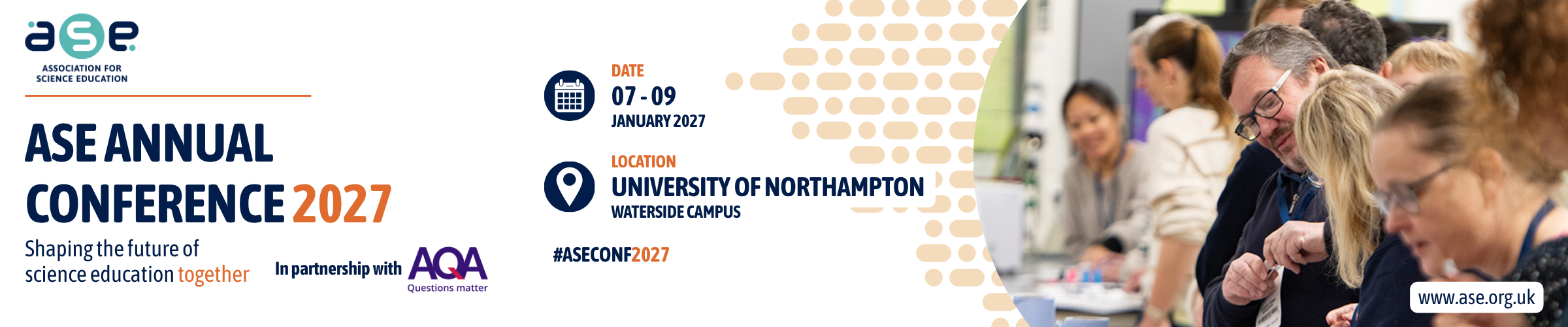
The ASE is delighted to be hosting its’ 2027 Annual Conference at the University of Northampton from 7th to 9th January.


Audience: FE/Skills clear filter
arrow_back View All Dates
Friday, January 8
 

08:45 GMT

Are we the change? Making ESD effective through inner development
Friday January 8, 2027 08:45 - 09:40 GMT
The aim of this session is to invite science teachers practising ESD to honestly examine their inner relationship to change-making, and discover what the IDG framework offers in response. Also to equip participants with practical, IDG-grounded techniques to help pupils experience sustainability as a way of living, not merely a body of knowledge.

"ESD is more than knowledge and skills — it is a way of living." If this is true: Are we living it? And what might quietly prevent us?

This workshop holds space for both. You'll be invited to notice — honestly and without judgement — how your own sustainability work feels from the inside: the urgency, the satisfaction, the fatigue, and perhaps the subtle resistance when genuine progress appears. You'll encounter the identity trap: the deeply human tendency to become so invested in change-making as a source of meaning that we unknowingly slow our own progress.

Far from a counsel of despair, this is an opening. The IDG framework offers a practical map of the inner capacities that ESD actually demands — and techniques for cultivating them, in yourself and in your pupils.

You'll leave knowing which IDG dimensions your teaching currently develops and which remain untouched — and with a few concrete techniques to help yourself and your pupils experience sustainability as lived reality rather than distant abstraction.

Participants should be able to:
> Recognise the identity trap in their own ESD practice and approach it with curiosity rather than resistance
> Identify which IDG dimensions their current teaching cultivates and which remain underdevelope
> Apply at least one embodied, IDG-grounded technique to help pupils experience sustainability as a way of living

Background: A 2010 School Science Review article observed that ESD requires "tenacity and a specific way of working — it is a way of living." Yet years working across sustainability groups revealed a paradox for me: the more committed the change-maker, the more likely they were to have lost felt, embodied connection to what a sustainable future actually looks like to inhabit. Busy change-making had quietly replaced the lived experience of the change itself.
A second, more confronting pattern emerged: we often unknowingly derive identity, purpose, and meaning from the change-making process. When genuine solutions surface, they are subtly resisted — completing the work would require reinventing ourselves. Kegan and Lahey (2009) name this the immunity to change: competing commitments operating largely beneath awareness.

The Inner Development Goals framework (IDG Foundation, 2021), co-created with over 1,000 researchers and practitioners, maps 23 inner skills across five dimensions — Being, Thinking, Relating, Collaborating, and Acting — as the missing complement to the SDGs, and offers a rigorous developmental path for the inner work ESD actually demands.
Speakers
MZ

Milán Zoltán Páczai

Secondary Science Teacher & Researcher, Alec Reed Academy

Friday January 8, 2027 08:45 - 09:40 GMT
LH125 (Learning Hub Level 1)

09:55 GMT

My pipette is a lab - the many uses of the single-use pipette
Friday January 8, 2027 09:55 - 10:50 GMT
In this session participants will engage in experiments which are conducted solely in a plastic pipette. We will do four experiments on kinetics, equilibrium and extraction.

Participants will measure with and combine different compounds in a pipette and they will observe changes inside the pipette bulb. Our aim is to showcase an easy method to do popular practicals at a lower cost, both timewise and financially. Participants will be left with experiments that work and can be directly applied in their classroom in the same week if they wish. My interest in microscale practicals is born out of necessity - in my country labs are greatly lacking.

In the last 10 or so years I teach teachers in microscale methods and try new experiments in my classroom. In the last few years I work closely with colleagues from UK (school teachers and CLEAPSS) to develop new experiments.
Speakers
avatar for Nasko Stamenov

Nasko Stamenov

Lecturer, Sofia University, Sofia, Bulgaria
Nasko Stamenov is a chemistry educatior and communicator. He holds a MSc in Materials' science from the Sofia University, Bulgaria, where he currently teaches 'Methodology of the chemistry experiment'. As sciemce communicator Nasko has a weekly show on the Bulgarian National tele... Read More →
Friday January 8, 2027 09:55 - 10:50 GMT
CH314 (Creative Hub Level 3)

09:55 GMT

Post-16 chemistry masterclass: IR & 1H NMR spectroscopy
Friday January 8, 2027 09:55 - 10:50 GMT
This session will cover IR spectroscopy - interpretation of spectra to determine functional groups & fingerprinting using example spectra run by volunteer delegates to exemplify key teaching and examination points; ditto for 1H NMR spectroscopy - methods of interpreting spectra to determine molecular structure and predicting spectra from known structures - again to exemplify key teaching and examination points.

Outcomes: delegates will be more au fait with what a good examination answer looks like for both IR and 1H NMR and the classic student misconceptions to avoid.


Speakers
avatar for Peter Hoare

Peter Hoare

STEM Outreach Officer, Newcastle University
I am a former chemistry teacher (20 yrs) now working in STEM Outreach at a Russell Group University (16 years) and an experienced (31 yrs) A-level chemistry examiner for a major English exam board. I run many masterclasses, A-level Revision Workshops and Spectroscopy in a Suitcase... Read More →
Friday January 8, 2027 09:55 - 10:50 GMT
LH322 (Learning Hub Level 3)

09:55 GMT

Keynote: Raising the bar - ambition, curiosity and depth in science
Friday January 8, 2027 09:55 - 10:50 GMT
What does an ambitious science education look like from primary through to secondary? This session will explore how we can keep expectations high for all pupils, prioritise depth before pace, and use rich texts, images, examples and questions to provoke curiosity and build secure knowledge.

Mary Myatt will consider what happens when we move beyond coverage and activity and give pupils the intellectual substance and time they need to think, make connections and encounter the power of the discipline. The session will also explore how assessment can support, rather than distort, this ambition.
Speakers
avatar for Mary Myatt

Mary Myatt

Educational writer, speaker, blogger, consultant, Myatt & Co
I'm Mary Myatt an education adviser, writer and speaker working with schools, trusts and organisations across the UK. My work focuses on curriculum, teaching and learning, leadership and, increasingly, how we make Key Stage 3 more ambitious and intellectually generous for every pupil... Read More →
Friday January 8, 2027 09:55 - 10:50 GMT
LH013 & LH014 (Learning Hub Ground Floor)

10:50 GMT

Biology educators tea/coffee and muffins (sponsored by Miss Estruch Teach & Tell)
Friday January 8, 2027 10:50 - 11:15 GMT
If your focus is teaching or supporting biology lessons, come along for a networking session with complimentary tea/coffee and a muffin, to discuss how Miss Estruch Teach & Tell can support your practice!
Sponsors
avatar for Miss Estruch Teach & Tell

Miss Estruch Teach & Tell

Miss Estruch Teach & Tell
Miss Estruch Teach & Tell is the proud sponsor of the Biology Education Research Programme (BERG) on Thursday of Conference, 

'Teach & Tell is run by Miss Estruch (Katie Estruch), a biology teacher since 2009 and former Head of Department, now helping teachers get their most valu... Read More →
Friday January 8, 2027 10:50 - 11:15 GMT
Learning Hub Level 2 landing space outside rooms LH227-230

10:50 GMT

Chair Chat
Friday January 8, 2027 10:50 - 11:15 GMT
Our dedicated Chair Trio invite you to drop-in to the “Chair-Chat” sessions on one of the days of Annual Conference 2027. The Chair is a vital role to the ASE, and the elected Chair provides an authoritative voice for the thousands of members that the ASE supports, along with those working within the wider science education community. Those elected remain part of our Chair Trio for 3 years.

Got a question? Ever wondered about what goes on behind the scenes? Ever thought about getting involved in Committee activities? Are you wanting to know more about Professional Registration or writing an article in one of the ASE journals? First time attending our flagship Conference?

If this is your first ASE Conference, then please come along and say Hello.

We look forward to hearing your questions and will endeavour to answer them or point you in a selection of possible right directions!
Speakers
avatar for David Allen

David Allen

Associate Professor Learning and Teaching / Outgoing Chair of the ASE 25/26, University of Hertfordshire & Creative Primary Science Education Consultancy
I worked in primary schools for over twenty years as a classteacher, senior leader and Deputy Headteacher. I taught across Key stages 1, 2 and 3 in UK and in Spain. During this time I developed a passion for science, art and design, improvised drama, assessment for learning, creativity... Read More →
avatar for Claire Seeley (MA CSciTeach)

Claire Seeley (MA CSciTeach)

Primary Science Education Consultant / Co-Chair of the ASE
Claire Seeley has been a teacher for over thirty years in a wide variety of contexts including both inner city and rural schools England. Claire is also a Primary Science Consultant, providing both continuing professional development and initial teacher training.  She has a passion... Read More →
EP

Emily Perry

Professor of Education, Manchester Metropolitan University
avatar for Natasha Serret

Natasha Serret

Associate Professor of Science Education, Nottingham Trent University
I started my professional career as a classroom teacher and science lead in a London primary school. I was and remain passionate about classroom learning that promotes a scientific mindset alongside the development of an understanding of key scientific concepts.  This professional... Read More →
Friday January 8, 2027 10:50 - 11:15 GMT
Leathersellers Hide (Learning Hub Level 4)

11:15 GMT

PISA 2025: Outcomes and implications for the Teaching and Learning of science
Friday January 8, 2027 11:15 - 12:10 GMT
The primary focus of the PISA Assessment in 2025 was on the outcomes of school science education for 15-year-olds. The 2025 Assessment framework, which was the basis of testing in over 90 countries in 2025, introduced three new elements.
First, two of the original competencies in the 2015 framework were merged. This change enabled the introduction of a new third competency that measured students’ ability to “research, evaluate and use scientific information for decision making”.
Second, because of the importance of educating students about the environment, climate change a specific focus on environmental education was added. The framework for this was elaborated in the document Agency in the Anthropocene.  

This framework has three new competencies with a focus on education for sustainability and climate change. Finally, the concept of attitudes to science has been broadened to the notion of science identity which introduces the notion of capital. This talk will explain these changes, their rationale and illustrate ways in which they were measured with sample items. In addition, it will present the findings from the results published in September 2026, and discuss their implications.
Speakers
avatar for Jonathan Osborne

Jonathan Osborne

Professor, Stanford University
My career started by teaching science in London comprehensives in 1972 for 9 years.  Curently I am the Kamalachari Professor in Science Education, Emeritus, in the Graduate School of Education, Stanford University in California but now back in the UK. I was President of the US National... Read More →
Friday January 8, 2027 11:15 - 12:10 GMT
LH124 (Learning Hub Level 1)

12:25 GMT

(Pearson) Science reform in action - what comes next for teachers and learners?
Friday January 8, 2027 12:25 - 13:20 GMT
Science education is entering a pivotal period of change. This interactive, evidence-informed session will explore how reform can translate ambitious national intent into qualifications, assessment and classroom practice that work for teachers and learners. Drawing on Pearson’s engagement with teachers, science leaders, students and subject communities, the session will consider  what successful reform should achieve , what different stages of science reform could mean for subject leaders, teachers and students, and what schools will need to implement changes successfully.
Session aims
  • Make science reform tangible and relevant for classroom practitioners and leaders.
  • Surface practitioner priorities, risks and implementation need so that teacher and learner experience informs future qualification thinking.
  • Build confidence by identifying proportionate preparation schools can undertake while policy and qualification details continue to develop.
Delegate takeaways
  • A phased school-readiness checklist.
  • Practical actions departments can begin without overcommitting.
  • A sharper understanding of potential implications for learners, teachers and departmental delivery.
  • Questions and discussion prompts to use with departments, senior leaders and trust teams.
This session is followed by a catered lunch, sponsored by Pearson, for secondary educators and early career teachers or trainees. Please join us to continue the networking opportunity and further explore how Pearson can support you.
Speakers
avatar for Shauna O'Brien

Shauna O'Brien

Head of Science, Pearson

avatar for Tosin Oliyide

Tosin Oliyide

Senior Qualifications Manager - Science, Pearson

Friday January 8, 2027 12:25 - 13:20 GMT
LH013 & LH014 (Learning Hub Ground Floor)

12:25 GMT

Beyond keywords: Disciplinary literacy in Post-16 science curricula
Friday January 8, 2027 12:25 - 13:20 GMT
This interactive session will explore how disciplinary literacy can be embedded into post-16 science curricula to support learners in moving beyond the memorisation of key terms towards reading, writing, reasoning and communicating like scientists.

The session draws on work developed at Milton Keynes College Group within a growing sixth form context, where disciplinary literacy has been used as a curriculum design principle across A Level and Applied Science provision. The approach was developed in response to a familiar post-16 challenge: learners may know isolated scientific vocabulary, but struggle to interpret exam questions, explain processes precisely, evaluate evidence, or communicate using the conventions of the discipline. Drawing on research-informed practice in disciplinary literacy, curriculum design, and assessment, the session will show how science teachers can make the hidden demands of scientific reading, writing, and thinking more explicit.

Participants will examine examples of how diagnostic questions can reveal gaps in conceptual understanding, command-word interpretation, and scientific reasoning. The session will also consider how independent study booklets and structured writing tasks can help learners practise the forms of explanation, evaluation and evidence use required in Biology, Chemistry and Forensic Science. There will also be a demonstration of tools which are used to identify specific AO gaps which relate to terminology/application of language and how we address it.

During the session, participants will be able to review sample resources, view the tools we use and given time to consider how similar approaches could be adapted for their own phase, subject or qualification context.

By the end of the session, participants will be able to:

1. Identify the specific literacy demands within post-16 science tasks;
2. Distinguish between teaching scientific vocabulary and developing disciplinary scientific thinking.
3. Use diagnostic questions to uncover barriers to scientific understanding.
4. Adapt examples of disciplinary literacy resources for Biology, Chemistry, Forensic Science or related pathways.
5. Consider how disciplinary literacy can support curriculum planning for academic, applied and future technical science routes.

The session is intended for science teachers, curriculum leaders, post-16 practitioners and anyone interested in strengthening students’ access to complex scientific knowledge through practical, evidence-informed pedagogy.
Speakers
AR

Afsan Redwan

Deputy Head of Sixth Form, Milton Keynes College
Friday January 8, 2027 12:25 - 13:20 GMT
LH231 (Learning Hub Level 2)

12:25 GMT

Frontier Science: Engineering the future
Friday January 8, 2027 12:25 - 13:30 GMT
In this talk, IChemE President Ollie Folayan will share his journey into chemical engineering, describe a day in the life of an engineer, talk about the work he has done to widen access to underrepresented groups and highlight the forces shaping engineering in the future.
Speakers
OF

Ollie Folayan FREng CEng FIChemE

Head of Process Engineering, Costain

Friday January 8, 2027 12:25 - 13:30 GMT
LH345 (Learning Hub Level 3 lab-type space)

12:25 GMT

What's the point of teaching science? What we've found from research
Friday January 8, 2027 12:25 - 13:30 GMT
Science is a mandatory subject across most nations, and we too often take its privileged position for granted. Much has been written about the purpose of education but far less when it comes to the specifics of science education.

Science teaching and curriculum development should be grounded in sound reasons for its presence on the curriculum along with what it should contain and what it should stand for. Over the last year data has been gathered, supported by the ASE, to probe how science teachers perceive the purpose of science education. Surveys have been able to establish certain standpoints are more widely help than others; in this presentation we will look at this research and its findings, and look at science education through the lenses of utility, curiosity, culture and citizenship. This research has implications for all involved in science education, from the classroom through to curriculum policy makers.

By the end of the session colleagues will hopefully have some alternative perspectives on why science education is so important and why its importance will only grow over time.
Speakers
avatar for Mark Whalley

Mark Whalley

Senior Lecturer in Education, University of Chester
I'm a senior lecturer in Educational Leadership at the University of Chester. My main teaching covers Professional Learning and Change Leadership but I also tutor across the MA Educational Leadership programme. My principal research interest is in teacher retention and by focusing... Read More →
Friday January 8, 2027 12:25 - 13:30 GMT
LH344 (Learning Hub Level 3 lab-type space)

13:35 GMT

Ideas exchange to catalyse and support school and research partnerships
Friday January 8, 2027 13:35 - 14:30 GMT
In this session I am to  explore ‘what works’ in initiatives that support schools and universities/researchers to work together.  

Welcoming educators, senior leaders, and STEM professionals with experience funding or supporting research in schools to an exploratory workshop finding out what works to involve young people directly in research and innovation. Come along to learn more. Discussions will also inform the design of a new grant aimed at supporting educators to build the confidence and capacity to tap into existing programmes connecting schools and researchers or run their own research projects.

Outcomes: Participants will share and learn about best practice in integrating participating in research in teaching and learning approaches.

Participants will connect with others with an interest in supporting a culture of research and innovation in UK schools.

Participants will influence the design of a pilot grant being developed by the British Science Association.

There are a number of ways that schools can engage with researchers, including through schemes like IRIS, Orbyts and the Royal Society Partnership scheme. However visibility of, and access to these opportunities is not always consistent. With funding from UKRI, the British Science Association will be supporting UK schools in challenging circumstances to deepen their relationships with research and researchers; by taking part in existing schemes or running their own research projects.

The workshop is for educators, senior leaders, and STEM professionals with experience of funding, supporting, or brokering relationships with research and researchers, as well as educators interested in connecting their students with real research.
Speakers
avatar for Susan Matambanadzo

Susan Matambanadzo

Education Manager, British Science Association
Friday January 8, 2027 13:35 - 14:30 GMT
LH321 (Learning Hub Level 3)

13:35 GMT

From clean air to biodiversity: Building student agency in real-world science (Earth Museum)
Friday January 8, 2027 13:35 - 14:30 GMT
This session explores how EarthLearn and EarthTogether are supporting schools to develop a coherent, future-facing approach to environmental science education, Moving beyond single-issue topics, these initiatives connect themes such as air quality, climate and biodiversity through real-world student-driven enquiry. Drawing on the Air  We Breathe programme as a case study from King's Group Academies, we will demonstrate how local contexts can be used to engage students with global challenges, build data literacy and foster meaningful action. We will also introduce Minibeasts and Me, a new biodiversity-focused programme that extends this model into the study of ecosystems and the natural world.

Participants will gain insight into how authentic contexts, collaboration across schools and partners, and a strong emphasis on student agency can transform science learning. Through interactive discussion and practical examples, the session will consider how these approaches can be adapted across different settings and phases. Aligned with the conference theme, this session highlights how working together can support the development of connected, relevant and empowering science education that equips young people to understand and shape their world. 
Speakers
JO

Janet Owen FRSA, AMA

Executive Director, The Earth Museum

PS

Pauline Stirling

Learning Coordinator, The Earth Museum
LP

Louisa Perkins

The Earth Museum
Sponsors
avatar for Earth Museum

Earth Museum

From global to local - learning that connects communities.
One of the most powerful aspects of our learning platform is its' ability to bridge the global and the local. As well as presenting global programmes, we bring together community-centres stories from around the world and weave meaningful connects between them - helping learners understand... Read More →
Friday January 8, 2027 13:35 - 14:30 GMT
LH323 (Learning Hub Level 3)

13:35 GMT

Teaching about ‘AI in real-world science’ in the science classroom
Friday January 8, 2027 13:35 - 14:30 GMT
AI technology is changing the fabric of scientific knowledge building.  In biology, for example, AlphaFold predicts the structure of proteins and other biomolecules, changing how drugs are developed and diseases are  studied. In medicine, AI-powered image generation is changing medical diagnostics. In chemistry, AI tools are automating and accelerating organic chemistry and material discovery. In physics, complex AI-based simulations accelerate research across topics, while AI-based robotics is driving change in engineering. Further, scientific inquiry requires new skills for scientists, such as designing ‘AI experiments’, navigating data ethics and governance, evaluating AI models, and interpreting AI system output.

How, then, is school science changing to teach about this new way of scientific working and these new discoveries? What new AI-related real-world science concepts and skills might be taught?

The aim of this workshop is to start this discussion. We will lead a workshop to brainstorm candidate uses of AI in real-world science and consider what concepts and skills might be introduced at different stages of science education.
We will provide examples of how basic AI literacy concepts have been introduced in existing AI lessons covering topics such as ecosystems and healthcare.  We will use these to spark discussion on what content might be taught in classroom science lessons to showcase `AI in real-world science’.  We are particularly interested in stimulating discussion on how scientific inquiry in school might change in the light of AI technology.
 
The outcome from this workshop will be that participants will become more familiar with AI literacy concepts and begin to form ideas about what AI literacy for Science might look like. They will also start to develop ideas for lessons that introduce `AI in real-world science’ into their science classrooms. We do not have the answers to what should be taught and how about `AI in real-world science’, but as computer science education researchers, we would like to facilitate this discussion with science educators to help work towards this goal.
Speakers
JW

Jane Waite

Senior Research Scientist, Raspberry Pi Foundation

BG

Ben Garside

Senior Learning Manager, Raspberry Pi Foundation

Friday January 8, 2027 13:35 - 14:30 GMT
LH125 (Learning Hub Level 1)

14:45 GMT

Talking Science: who needs teachers anymore? Teaching science in the age of AI (SEPA)
Friday January 8, 2027 14:45 - 15:40 GMT
This year's Talking Science explores the evolving role of teachers in a world increasingly shaped by artificial intelligence. As AI transforms how young people learn, communicate and access knowledge, what does this mean for the future of science teaching? The session will consider both the opportunities and challenges facing science educators in supporting young people to become scientifically literate.
Following short stimulus inputs from our speakers, delegates will discuss and prioritise their recommendations for policy and practice that will help ensure the benefits of AI are realised equitably across science education. The discussion will explore implications for curriculum, assessment, teacher expertise, equity and students' future engagement with science.
SEPA intends to produce a short summary of key themes emerging from the discussion.

In common with our previous Talking Science sessions, this session promises thought-provoking insights and lively debate. We look forward to seeing you there and your contributions.

The Science Education Policy Alliance (SEPA) brings together the Association for Science Education, Institute of Physics, Royal Society, Royal Society of Biology and Royal Society of Chemistry to coordinate and collaborate on science education policy www.se-pa.co.uk

Refreshments will be served at the end of this session, courtesy of SEPA, for 25 minutes.

Speakers
avatar for Victoria Hedlund

Victoria Hedlund

AI bias researcher, consultant and founder, Gen Ed Labs

avatar for Miles Berry

Miles Berry

Professor of Computing Education, University of Roehampton

avatar for Marianne Cutler

Marianne Cutler

Director of Curriculum Innovation, Association for Science Education
Sponsors
avatar for SEPA

SEPA

The Science Education Policy Alliance (SEPA) brings together the Association for Science Education, Institute of Physics, Royal Society, Royal Society of Biology and Royal Society of Chemistry to coordinate and collaborate on science education policy, with Professor Dame Athene Donald... Read More →
Friday January 8, 2027 14:45 - 15:40 GMT
LH013 & LH014 (Learning Hub Ground Floor)

16:10 GMT

Frontier Science: What we learn(ed) from rainbows
Friday January 8, 2027 16:10 - 17:05 GMT
Unexpectedly, many concepts and practices central to our physics today, that students and educators could find interesting, originated in the study of rainbows.
Speakers
MB

Michael Berry

Emeritus Professor of Physics, University of Bristol

Friday January 8, 2027 16:10 - 17:05 GMT
LH322 (Learning Hub Level 3)

16:10 GMT

Panel: Planning and upskilling CPD for curriculum reform
Friday January 8, 2027 16:10 - 17:05 GMT
This panel brings together CPD, curriculum and science leaders to share how they are approaching the challenge of preparing themselves and their colleagues for the new Programme of Study. Hear how schools are identifying professional learning needs, developing subject knowledge and pedagogical expertise, and planning CPD to build staff confidence and capacity ahead of implementation.

The panel will provide an opportunity to hear directly from those working at the chalkface about the approaches they are taking, the challenges they are encountering and the priorities they have identified as they prepare for curriculum reform.

The discussion will consider the importance of sustained professional learning and how schools can make the most of the time available before September 2028, rather than treating curriculum change as a one-off and finite task.
Whether you are a science leader, curriculum leader, teacher developer or involved in planning professional learning, join us to hear practical experiences and ideas that can inform your own approach to preparing for the new curriculum.
Speakers
avatar for Marianne Cutler

Marianne Cutler

Director of Curriculum Innovation, Association for Science Education
Friday January 8, 2027 16:10 - 17:05 GMT
LH013 & LH014 (Learning Hub Ground Floor)

16:10 GMT

The silent teacher: How classroom design co-creates science learning
Friday January 8, 2027 16:10 - 17:05 GMT
You may know the idea of the Third Teacher: the Reggio Emilia principle that the physical environment is as formative as any instructor. What might this mean for your science classroom?

This interactive workshop explores how conscious spatial design — layout, naturalness, stimulation, and pupil-controlled affordances — can deepen engagement, support scientific thinking, and strengthen collaborative inquiry. The session itself is designed to demonstrate the very principles it explores.

You'll move through three activities — individual reflection, small-group application, and collective visioning — surfacing answers grounded in your own classroom experience and actionable research. You'll leave with concrete techniques to apply immediately, and the opportunity to help shape what comes next: a founding circle for a UK-wide action research network exploring classroom design in secondary science at scale. This is the future of science education — and we'll build it together.

Participants will be able to:
•Reflect critically on how their classroom's physical features currently support or constrain pupil engagement, cognition, and behaviour
•Apply evidence-based spatial design techniques to enhance science learning outcomes immediately
•Join a founding action research network with shared resources, peer collaboration, and opportunities to both contribute to and benefit from emerging findings

This session aims to:
• convene a founding circle for a UK-wide action research network exploring the transformative potential of classroom design in secondary science settings
• empower teachers and practitioners with evidence-based, immediately applicable answers, built directly from their own classroom experience

Background: Across years of action researching transformative learning experiences, a pattern emerged: expert facilitators consistently build a deliberate relationship with the physical space before their sessions begin. This observation sparked a master's thesis — An Architecture for Empowerment: Exploring How Physical Environments Co-Create Human Capacity — synthesising environmental psychology, 4E Cognition, neuroscience, and architectural theory. Its core finding: physical environments are not backdrops to learning but active co-creators of cognitive, emotional, and relational capacity. Science classrooms — with their fixed benches, equipment-laden surfaces, and competing sensory demands — represent a largely untapped frontier for this work.
Speakers
MZ

Milán Zoltán Páczai

Secondary Science Teacher & Researcher, Alec Reed Academy

Friday January 8, 2027 16:10 - 17:05 GMT
LH344 (Learning Hub Level 3 lab-type space)

17:10 GMT

Meet the ASE 11-19 Committee
Friday January 8, 2027 17:10 - 17:30 GMT
If you are a secondary teacher or science education consultant, come along to the "Meet the 11 to 19 Committee" session at the end of Friday of Annual Conference 2027.

Got a question? Ever wondered about what goes on behind the scenes? Ever thought about getting involved in Committee activities? Are you wanting to know more about Professional Registration or writing an article for one of the ASE journals?

We look forward to listening to your questions and will endeavour to answer them!
Speakers
RM

Rebecca McCready

Chair of ASE 11 to 19 Committee, Duke's Secondary school, SE Northumberland

Friday January 8, 2027 17:10 - 17:30 GMT
LH323 (Learning Hub Level 3)
 

Share Modal

Share this link via

Or copy link

Filter sessions
Apply filters to sessions.
Filtered by Date -