Loading…
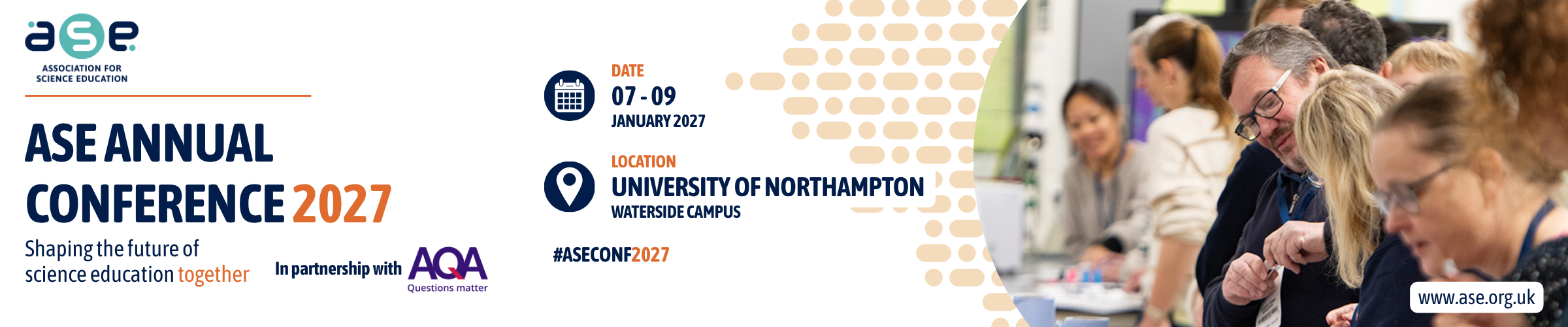
The ASE is delighted to be hosting its’ 2027 Annual Conference at the University of Northampton from 7th to 9th January.


Type: Primary clear filter
arrow_back View All Dates
Thursday, January 7
 

08:45 GMT

BERG: Learning about biology in the Early Years
Thursday January 7, 2027 08:45 - 09:40 GMT
The initial learning about biological organism, naming, form and function,  begins in the earliest  years before any formal learning facilitation and  builds on the child’s understanding. These foundations are rarely discussed in training and with communities. This talk will cover how earliest learners construct undemanding of themselves and other organisms in form, function and habitat. This knowledge is from research, teaching and observations.  Learners   learn their biology beginning with  experiencing their needs and actions as a biological organisms. Such understanding forms the basis of their subsequent interpretation of species and is the basis of subsequent anthropomorphic interpretations. Their interactions and observations of the Environment and organisms, contributes to their understanding  in three categories, identified from everyday environment  Applying a grounded theory analysis of the observations they made and what caught their interest, and on their narratives verbal and actions.  These categories emerged:

1. NAMING and HABITATS - identification of organisms, naming, personal names, everyday names and scientific perhaps, locations, criterial attributes.

2. SYSTEMS - interrelationships horizontally and vertically.

3. TIME – much is not instant - germination, dimension, evolution, life cycles, change in form and function which for the early years is a very difficult idea. Identify the sequence in which names, form, function and behaviours are learnt.

The learner’s understanding develops progressively with age and opportunities to observe and interact with plant and animals. As children are biological beings, they acquire an understanding of basic life functions from first-hand experience as well as a rudimentary understanding of the biological form and function of organisms in their relationship with the environment, (Ghazili and Tolmie, 2014).

In the first quarter of the 21st century, the situation has not improved since educational researchers wrote in at the turn of the century that’ insufficient work has not been done on how children view living organisms in their environment ,Tunnicliffe and Reiss, 1999a). Such acquisition of understanding is in stages. From the first image animal shape in a soft toy replicating an animal to sightings in the environment, or images on various media. And Plant sightings in their everyday. lants are frequently neglected in formal study, there id still a ‘plant blindness’ (Wandersee and Schussler, 2001).

As the. Early leaner meets various organisms they acquire some understanding which is extended through formal teaching. Young children name animals and plants. Usually the first name becomes the superordinate category. For example, if the first object noticed and named in the sky is bird, anything else observed thereafter, e.g. a plane is called ‘bird’. Similarly green ‘objects’ that do not move around are ‘plants’, subcategories referred to by everyday names such as weeds, fruits, vegetables, flowers, trees. grass . This learning persists often in everyday life for use however, despite subsequent teaching. Learning about the biological world is crucial in developing understanding   and action in managing a sustainable world (Tunnicliffe and Reiss, 1999) but there is a long way to go yet.
Speakers
avatar for Dr Lady Sue Dale Tunnicliffe

Dr Lady Sue Dale Tunnicliffe

Patron / Retired Reader in Science Eduction IOE, CASTME and UCL IOE
Dr Sue Dale Tunnicliffe was Reader in Science Education at UCL IOE, an experienced teacher of all ages, as well as at universities. Sue is a Former OFTSED inspector and Head of Education at the Zoological Society and has published both academic papers and 13 books . Sue is particularly... Read More →

Sponsors
avatar for Miss Estruch Teach & Tell

Miss Estruch Teach & Tell

Miss Estruch Teach & Tell
Miss Estruch Teach & Tell is the proud sponsor of the Biology Education Research Programme (BERG) on Thursday of Conference, 

'Teach & Tell is run by Miss Estruch (Katie Estruch), a biology teacher since 2009 and former Head of Department, now helping teachers get their most valu... Read More →

Thursday January 7, 2027 08:45 - 09:40 GMT
LH231 (Learning Hub Level 2)

08:45 GMT

Co-designing an assessment matrix for thinking scientifically outdoors
Thursday January 7, 2027 08:45 - 09:40 GMT
This session aims to enable participants to:

• Understand how children’s thinking scientifically can be assessed meaningfully in outdoor primary science
• Explore a research informed Thinking Scientifically Assessment Matrix that supports progression across primary phases
• Engage with examples of how the matrix has been co designed and trialled with experienced teachers in real classrooms
• Consider how assessment can strengthen, rather than constrain, outdoor science learning
• Reflect on how a shared assessment framework can support trainee teachers, Early Career Teachers and whole school professional learning

Outdoor science offers rich opportunities for curiosity, talk, investigation, and sense making; yet many teachers report uncertainty about how to assess thinking in these spaces. In this interactive session, participants will be introduced to a Thinking Scientifically Assessment Matrix designed to support assessment for learning in outdoor primary science. They will explore how the matrix makes children’s scientific thinking visible, supports progression over time, and aligns with everyday classroom practice rather than adding to the teacher's workload. Drawing on real examples from classrooms, the session will share how teachers have trialled the matrix outdoors, what has been learned through co-design, and how assessment has been embedded into practical, exploratory learning. Participants will be invited to engage with sample learning scenarios, consider where evidence of thinking might be captured, and reflect on how a shared framework could support consistency across year groups or within professional learning communities. The session will be relevant for classroom teachers, subject leaders, mentors, and those supporting teacher development.

By the end of the session, participants will be able to:
• Identify key features of progression in children’s scientific thinking across the primary age range, in outdoor contexts.
• Use an assessment matrix to recognise and interpret evidence of thinking in outdoor science lessons
• Adapt assessment approaches to support exploratory, enquiry rich learning
• Apply shared assessment language to support planning, reflection, and professional dialogue within and across schools
• Support trainee teachers and Early Career Teachers in developing confidence with assessment of primary science, particularly in outdoor and enquiry based contexts
• Integrate a research informed assessment framework within ITE programmes to strengthen coherence between university based theory and school based practice
• Consider next steps for embedding the assessment of thinking scientifically within their own settings

This session draws on EdD research, which focused on the creation and application of a Thinking Scientifically Assessment Matrix designed to articulate progression in children’s scientific thinking. The research explored how early career teachers used the matrix to support planning, teaching, and assessment in primary science, particularly in outdoor learning contexts, where assessment is often perceived as challenging or impractical. Building on this work, I am currently collaborating with experienced primary teachers through a structured programme of professional learning and classroom trialling. Together, we are refining the matrix through lesson observations, peer discussion, and shared analysis of children’s learning. This knowledge exchange approach values teacher expertise alongside research informed pedagogy, with the long term aim of making outdoor science learning assessable, sustainable, and impactful beyond the Early Years.
Speakers
RL

Rebecca Lee

Class Teacher, Kimberley Primary School

AK

Aamir Khalique

Class Teacher, Roundhill Primary School
Thursday January 7, 2027 08:45 - 09:40 GMT
LH115 (Learning Hub Level 1)

08:45 GMT

Co-developing spatial computing climate change play toolkit with children
Thursday January 7, 2027 08:45 - 09:40 GMT
This interactive workshop introduces a proof-of-concept student toolkit for using spatial computing to support climate change education in primary-aged multicultural settings. The session draws on my doctoral research at the University of Leeds, which examines how spatial computing can be co-developed within a climate change play curriculum with Indonesian and Malaysian children living in the UK.

The aim of the session is to share a research-informed and practice-facing approach to climate change education that is child-centred, culturally responsive and suitable for primary-aged learners. Rather than presenting technology as a novelty, the session considers how virtual reality, augmented reality, digital mapping, LEGO robotics and 3D modelling can help children explore climate change causes, impacts, mitigation and adaptation through active, visual and playful learning.

The session will begin with a short introduction to the research context and the meaning of spatial computing in primary climate change education. I will then share examples from six participatory workshops, showing how children’s discussions, drawings, digital artefacts, mapping activities and reflections shaped the toolkit’s content, learning approaches and activity design. These examples will include children’s use of VR to explore climate-affected environments, digital maps to compare climate issues across countries, LEGO sensors to model environmental systems, and AR/3D modelling to design climate solutions.

The main focus will be the student toolkit developed from the research. By the time of the conference, this toolkit will have been reviewed with children through a co-review workshop. This is not presented as a final validation exercise, but as part of the wider co-development process, where children’s responses help refine the clarity, relevance and usability of the resource.

Participants will examine selected toolkit activities and consider how they might work in primary classrooms, after-school clubs, teacher education or informal learning settings. Using a short feedback template, they will reflect on the toolkit’s climate change content, use of spatial computing, opportunities for children’s participation, cultural responsiveness and practical classroom feasibility.

By the end of the session, participants will be able to identify ways of using spatial computing to support climate change learning, explain how children’s contributions can inform curriculum development, and critically consider how a proof-of-concept toolkit can be adapted for their own educational context.
Speakers
MZ

Muhammad Zulfadhli Kamarudin

Postgraduate Researcher, School of Education, University of Leeds

Thursday January 7, 2027 08:45 - 09:40 GMT
LH124 (Learning Hub Level 1)

09:55 GMT

Pedagogical approaches for teaching emotive issues in primary science
Thursday January 7, 2027 09:55 - 10:50 GMT
Aims of this session:  
> To raise awareness of the link between the primary National Curriculum content and the lived experiences of children and families.
> To help delegates pre-empt potentially emotive issues within the science National Curriculum and consider sensitive pedagogical responses.

Emotive issues in science, really?  Science is often considered to be a fact-based subject; we don’t always anticipate that science lessons may evoke emotional responses from children (or their families).

During this session, we aim to consider the primary science curriculum through the eyes of a child who may find some topics challenging. These are not always the topics that we expect, and there are more than you might think. If you’re a child who does not live with biological relations, how do lessons on inherited traits in humans feel to you? If your parents struggle to afford good-quality food, what do activities highlighting a healthy diet mean to you?

We will consider how topics such as these can be addressed with sensitivity in the classroom without watering down or avoiding the scientific content.

Outcomes: Delegates will be introduced to a different mindset when teaching science.
Delegates should be able to identify aspects of the primary National Curriculum which may evoke an emotional response or cause unintended upset to the children they teach and their families.
Delegates should leave the session with some ideas about how they would/would not teach potentially emotive topics.

We are experienced teacher educators who have supported student teachers to get to grips with the science National Curriculum. We have also sat with students who have regretted the approaches they took in lessons when they taught the science curriculum in a factually correct way but did not fully consider the lived experiences of the children they teach. This prompted us to develop a taught session, called ‘Teaching science with sensitivity’, which we deliver to all our trainees. Feedback from students is always positive, and we would be keen to share our work with a wider audience. In doing so, we appreciate that many delegates have rich experience that they could contribute to discussion within the session.

Topics that we include are:

The human body, including physical differences, the importance of exercise, a healthy diet, hygiene/dental health and hygiene, drugs and alcohol. Potential concerns: Body differences, body image, addiction within the family, and the impact of socio-economic backgrounds.

Living, dead and things that have never been alive - Potential concern: death.
Food chains – Potential concern: awareness of the brutality of predation.
Fossils and evolution - Potential concern: conflict with science and families’ cultural/religious beliefs.
Living things and their habitats, life cycles and reproduction - Potential concern: sustainability/habitat destruction.
Inheritance and Selection – Potential concern: upset caused to children who do not live with their biological parents.
Speakers
avatar for Nicola Treby

Nicola Treby

Associate Professor and Head of Primary Core Subjects, University of Roehampton

VM

Vanessa Matthews

Senior Lecturer in Primary Science and Assistant Programme Leader BA year 2, University of Roehampton

Thursday January 7, 2027 09:55 - 10:50 GMT
LH125 (Learning Hub Level 1)

09:55 GMT

Purposeful practical work for inclusion in primary science
Thursday January 7, 2027 09:55 - 10:50 GMT
Aims: This session aims to share research findings and new professional development resources for purposeful practical work to support inclusion in primary science. We will consider examples of adaptive teaching and how practical work can be used to enable children to sense that science is ‘for them’ and is accessible to their needs.

The purposeful use of practical work in primary science provides a range of opportunities for inclusive practice. Drawing on research from the Nuffield and Comino Foundation funded practical work project (2023-26), this session will consider how purposeful practical work can be used most effectively to support all learners. With examples from across the four nations of the UK, we will discuss adaptive teaching and the importance of essential experiences to support disadvantaged learners. We will use the outcomes of the research projects and the examples from a range of schools to stimulate discussion and reflection on the nature of inclusive practical work in primary science. Links will be made across research projects such as SEERIH’s ‘Shining a light on inclusive science’ and the Teacher Assessment in Primary Science (TAPS) projects, to show how key messages align across the primary science community.

Outcomes: Attendees will develop an awareness of the research base for practical work in primary science and become familiar with the proposed pedagogy model. By discussing examples selected from the professional development materials, they will reflect on practice in their own context.

Background: The Nuffield Foundation funded research project (2023-25) considered practical work from a primary perspective, proposing a pedagogy model to support practice. With support from the Comino Foundation, the project follow-on (2025-26) involved visits to 30 teachers in 20 schools across the four nations of the UK. The new bank of professional development videos model adaptive teaching and purposeful use of practical work in primary science.
Speakers
avatar for Lynne Bianchi

Lynne Bianchi

Professor / Director, SEERIH, University of Manchester
Vice Dean for Social Responsibility, Equality, Diversity, Inclusion & Accessibility 
Director of Science & Engineering Education Research and Innovation Hub
Comino Foundation Associate  
Great Science Share for Schools Campaign Director 
Principal Fellow of the HEA  
RSA Fellow

@Uo... Read More →
avatar for Sarah Earle

Sarah Earle

Professor of Science Education, Bath Spa University
Sarah Earle is Professor of Primary Science Education at Bath Spa University. Previously a primary school teacher, she now leads the Teacher Assessment in Primary Science (TAPS), the Focus4TAPS professional learning programme and Nuffield research into practical work projects. She... Read More →
Thursday January 7, 2027 09:55 - 10:50 GMT
LH115 (Learning Hub Level 1)

11:15 GMT

Beyond chick hatching: Humane alternatives for teaching life cycles
Thursday January 7, 2027 11:15 - 12:10 GMT

Speakers
avatar for Daisy Hall

Daisy Hall

Science Education and Outreach Manager, Animal Aid

Thursday January 7, 2027 11:15 - 12:10 GMT
LH125 (Learning Hub Level 1)

11:15 GMT

Building professional curiosity, joy and agency in trainee teachers
Thursday January 7, 2027 11:15 - 12:10 GMT
At the Nottingham Institute of Education, we have remained committed to ensuring that professional curiosity, agency and joy underpin our science provision across our primary initial teacher education (ITE) programmes. Maintaining this ambition against a national context of financial pressures in the university sector while meeting government reforms as articulated through the Initial Teacher Training Early Career Framework (ITTECF), the introduction of ITAP (Intensive Training and Practice) and the new OFTSED ITT Inspection Framework has not been easy. Our concern is that some of these challenges are contributing to a constrained provision of primary science in ITE.

We know that we are not alone and we would like to use this session as an opportunity to collectively celebrate and identify next steps in nurturing professional curiosity, agency and joy for our next generation of primary science teachers.
We invite you to join us in this interactive presentation where you will be able to share and reflect on how science is positioned in your own teacher educator settings.
(Outcomes) By the end of the session, you will:
• Gain a developed awareness of practice-based approaches (e.g. outdoor learning, informal contexts, micro-teaching, practitioner research projects) for embedding professional curiosity and developing critical research engagement in primary science ITE.
• Critically reflect on how ITE programmes currently develop research engagement and how this can establish professional agency.
• Consider wider possibilities, through the ASE and beyond, that will empower student teachers and ECTs in their professional development of their subject, curriculum and pedagogical knowledge in primary science.

Aims:
• Understand how science can be given a strong, coherent and joyful profile across a primary ITE curriculum
• Explore how purposeful and critical engagement with research can be scaffolded for student teachers and ECTs.
• Collaborate as a community of teacher educators to support the identification of practical strategies that can embed professional curiosity and joy in primary science ITE.

Background: At the Nottingham Institute of Education, we have remained committed to ensuring that professional curiosity, agency and joy underpin our science provision across our primary initial teacher education (ITE) programmes. Working as a team of primary science initial teacher educators in England, we have reflected on how to maintain this ambition against a national context of financial pressures in the university sector while meeting government reforms as articulated through the Initial Teacher Training Early Career Framework (ITTECF) and the introduction of ITAP (Intensive Training and Practice. Our concern is that some of these challenges are contributing to a diminished and constrained provision of primary science in ITE.

Our approach has evolved through our ITE undergraduate and postgraduate curriculum design, collaboration with expert practitioners, specialist science expertise within our university and local partnership schools. External examiner feedback and student outcomes have supported the development of this approach, highlighting its impact on confidence, agency and subject knowledge.

We will reflect on how we have deliberately designed, within our primary ITE curriculum, opportunities that encourage a critical engagement with research in primary science. This includes utilising external evidence-informed professional support such as the Primary Science Enhancement Award (PSEA), embedding science within ITAP so that foundational teaching foci, such as high-quality talk and questioning, can be developed through the lens of primary science and promoting practitioner enquiry in primary science within our final dissertation action research projects.

Speakers
AM

Alison Murphy

Senior Lecturer, Nottingham Trent University

avatar for Natasha Serret

Natasha Serret

Associate Professor of Science Education, Nottingham Trent University
I started my professional career as a classroom teacher and science lead in a London primary school. I was and remain passionate about classroom learning that promotes a scientific mindset alongside the development of an understanding of key scientific concepts.  This professional... Read More →
Thursday January 7, 2027 11:15 - 12:10 GMT
LH115 (Learning Hub Level 1)

12:25 GMT

The language of discovery: Making scientific vocabulary work for everyone
Thursday January 7, 2027 12:25 - 13:30 GMT
The session begins with everyday objects that prompt close observation, enabling learners to notice patterns and features that naturally lead into specific primary science phenomena. Each activity is deliberately structured with scaffolds that support pupils in articulating their ideas and using scientific language with increasing confidence. In line with research emphasising science as a distinct linguistic practice (Lemke, 1990), the session foregrounds opportunities for learners to develop and apply scientific vocabulary through guided talk, modelling, and structured interaction.

All materials have been developed directly from classroom practice and draw on a range of pedagogical approaches, including inquiry‑based learning, dialogic teaching, and explicit vocabulary instruction, to ensure accessibility for all learners. The design of the session reflects current evidence that vocabulary must be explicitly taught and embedded within meaningful contexts to support understanding, as highlighted by the Education Endowment Foundation.
Speakers
HR

Hellen Remant

Science Education Consultant, Putting Learning First

Thursday January 7, 2027 12:25 - 13:30 GMT
LH127 (Learning Hub Level 1)

13:35 GMT

(CLEAPSS) Observing practical primary science lessons: A framework for leaders
Thursday January 7, 2027 13:35 - 14:30 GMT
Observing a practical science lesson is very different from observing a standard lesson, yet most science leads and senior leaders receive little or no training in how to do it well.

This interactive session introduces a structured framework developed by CLEAPSS Primary to help you focus on what really matters when observing practical science. Using video clips from a real lesson and guided discussion, you will explore key focus areas including purpose, lesson practicalities, adaptive teaching, and purposeful feedback, each supported by prompts to help you make confident, considered judgements.

By the end of the session, you will leave with a practical tool you can use straight away to observe lessons, structure your thinking, and provide feedback that makes a real difference to science teaching in your school.
Ideal for: science leads, senior leader with responsibility for science and consultants who support schools to improve science.

By the end of this session, delegates will be able to:
• Describe how observing a practical science lesson differs from most others
• Use a structured framework to focus your observations on what matters most in practical science
• Apply a set of guided prompts to make confident, concise judgements across all aspects of a practical lesson
• Recognise what high-quality practical science looks like across key domains, including purpose, lesson practicalities, adaptive teaching, and purposeful feedback
• Provide clear, evidence-informed feedback that supports teacher development and improves outcomes for pupils

CLEAPSS exists to support effective practical work in schools. Our experience working with schools nationwide means we are uniquely placed to know what makes a strong practical science lesson. Generic lesson observation training leaves many leaders, even experienced ones, ill-equipped to evaluate the learning that a practical lesson brings, or to make meaningful recommendations for improvement. CLEAPSS’ wealth of experience in this area has been distilled into a simple, accessible resource that helps practitioners focus on what really matters.
Speakers
avatar for Sally Fulford

Sally Fulford

Primary Consultant, CLEAPSS
Ex -secondary and primary science teacher now working (and loving my roles) as a consultant for Primary CLEAPSS, the Ogden Trust, PSQM, TAPS and more. Based in Devon.
JH

Jason Harding

Primary Section Leader, CLEAPSS
Sponsors
avatar for CLEAPSS

CLEAPSS

Founded in 1963, CLEAPSS supports safe, engaging, and innovative practical activities in science (as well as design & technology and art & design). We provide schools and college staff with expert advice, training, resources, and trusted guidance. Providing staff with access to CLEAPSS... Read More →
Thursday January 7, 2027 13:35 - 14:30 GMT
LH124 (Learning Hub Level 1)

13:35 GMT

Climate change in the new primary curriculum
Thursday January 7, 2027 13:35 - 14:30 GMT
Climate change is one of the most significant challenges that humankind has ever faced and providing high quality climate change and sustainability education is imperative. The session will explore the interdisciplinary nature of climate change within the primary curriculum. It will consider how learning might be best sequenced and connected to instil in pupils an understanding of the science, geographical impacts, possible mitigations and adaptations of climate change.

The government’s response to the Curriculum and Assessment Review clearly positions climate change and sustainability education within the remit of science and geography. Through a range of practical activities the session will demonstrate how to plan and implement a coherent approach to the teaching and learning of climate change.
Delegates will be prompted to discuss the specific elements that are to be taught within and across the two subjects as well as the possible connections with other foundation subjects such as citizenship and DT. Ofsted outline the importance that learning does not occur in silos and this is particularly pertinent for global issues such as climate change where pupils need to gain an in-depth understanding of the processes that underpin anthropogenic climate change as well as the wide range of impacts. The session will explore how to ensure that climate change education is relevant, hopeful and accessible in part be focusing in on small scale local impacts as well as the large scale global affects of climate change.

There will be the chance to discuss how geographical thinking can be used to interpret scientific data and imagine a range of possible futures, empowering pupils to be part of the solution as informed and active global citizens.

Outcomes:
> Understanding of how to effectively embed climate change content across the primary curriculum
> Make connections between the causes and effects of climate change
Speakers
avatar for Marianne Cutler

Marianne Cutler

Director of Curriculum Innovation, Association for Science Education
JC

Joe Cannell

Primary Curriculum Lead, The Geographical Assocation

Thursday January 7, 2027 13:35 - 14:30 GMT
LH115 (Learning Hub Level 1)

14:45 GMT

Metals are solid aren’t they? Tackling misconceptions through responsive teaching
Thursday January 7, 2027 14:45 - 15:40 GMT
How can children’s misconceptions be identified and addressed to secure scientific understanding?

This session explores how formative assessment approaches can be used not just to identify misconceptions, but to inform responsive teaching and curriculum planning. Drawing on their own extensive experience in the classroom and from working with hundreds of teachers in primary schools, the presenters will share practical strategies, diagnostic tools and planning approaches that help teachers discover and tackle common misunderstandings in science. Participants will leave with materials for adapting sequences of learning, examples of pupil thinking and tested classroom-ready resources that make a difference to developing more accurate scientific thinking.

This session is aimed at classroom teachers and science leaders, and aims to:

• Share evidence from research, including issues common misconceptions that children hold.
• Discuss evidence-informed resources and practical strategies that teachers can use to understand and address common misconceptions that children hold in science. Examples will be used from schools that have trialled these materials and approaches and reflected on their effectiveness
• Give participants opportunity to try out and discuss some of the resources to identify their own misconceptions
• Encourage participants to reflect on which strategies might be most useful to address the needs of the children in their schools, and begin to plan how to audit, implement and review actions to adapt teaching and planning.
Speakers
avatar for Jo Montgomery CSciTeach

Jo Montgomery CSciTeach

Primary Science Education Consultant, Dr Jo Science Solutions
RSC Excellence in Primary Education Prize 2024. With both a teaching and science background, Dr. Jo Montgomery has more than 20 years’ experience working with children and schools to support science education from Early Years to university. Passionate about encouraging curiosity... Read More →
avatar for Alex Farrer

Alex Farrer

PSQM Development Lead, Primary Science Quality Mark
PSQM Professional Learning Partner.
Primary Science Teaching Trust Fellow.
Member of the PSQM Expert Advisory Group.
Member of the ASE Teacher Developers’ Committee.
Accredited trainer of the Primary Science Capital Teaching Approach.
Co-author of the PSTT resources See Through Sci... Read More →
Thursday January 7, 2027 14:45 - 15:40 GMT
LH125 (Learning Hub Level 1)

14:45 GMT

Working scientifically in Early Years (nursery and reception)
Thursday January 7, 2027 14:45 - 15:40 GMT
Aims:
> To provide examples of good practice in working scientifically in the Early Years.
> To clarify what the different areas of working scientifically are and how best to use them in every day science in Nursery/Reception.

Objectives:
> To allow practitioners to see the possibilities when using the different areas when working scientifically in class with young children.
> To provide examples of work and discuss what other people do in class to enhance the different areas when working scientifically.
> To enable other practitioners to share good practice with both myself and the group in discussion.

As an experienced teacher of 37 years, PSTT Fellow and Early Years Educational Consultant, I want to share my ideas and knowledge with others, having seen that working scientifically is often overlooked with young children but there are lots of opportunities to be had.
Speakers
EA

Elaine Arbuckle

Early Years Education Consultant, Half Pint Science

Thursday January 7, 2027 14:45 - 15:40 GMT
LH124 (Learning Hub Level 1)
  Primary

16:10 GMT

Primary Speed Science
Thursday January 7, 2027 16:10 - 17:25 GMT
Get up close with some of the most experienced voices in primary science in this fast-paced, high-energy session. In Primary Speed Science, you’ll rotate between tables, spending a focused eight minutes with each expert - just enough time to ask questions, explore ideas, and gain practical insights you can take straight back to your setting.
 
Whether you’re grappling with curriculum design, enquiry, assessment, or subject leadership, this is your chance to have real conversations with people who’ve been there and done it. No long talks, just sharp thinking, honest answers, and meaningful connections.

Speakers
avatar for Angharad Pass

Angharad Pass

Primary Science Specialist Education Consultant
The Padlet for the Teachmeet is here: https://padlet.com/saraheamesscienceleader/ase-conf-saturday-10th-january-2026-primary-science-teach-me-ruozfsim8u6eq9lz
Thursday January 7, 2027 16:10 - 17:25 GMT
LH013 & LH014 (Learning Hub Ground Floor)
  Primary
 

Share Modal

Share this link via

Or copy link

Filter sessions
Apply filters to sessions.
Filtered by Date -