Loading…
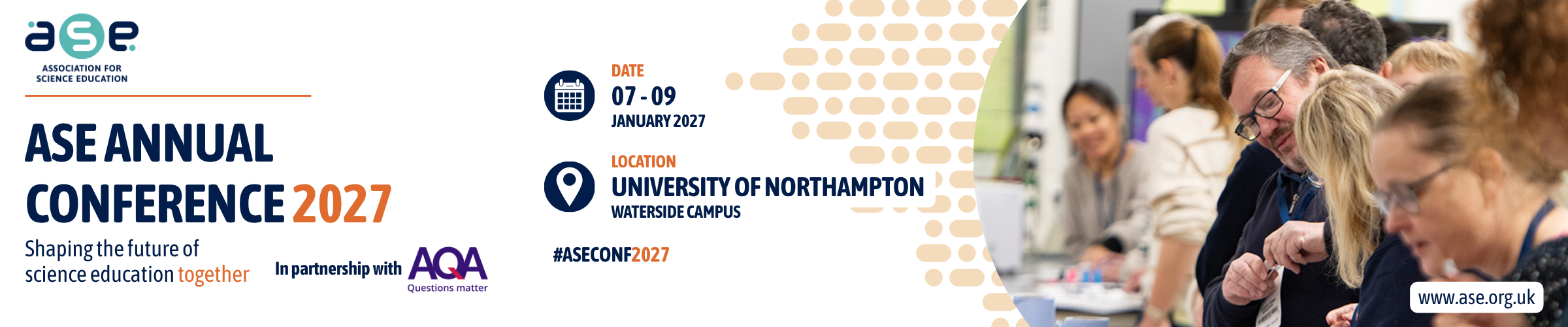
The ASE is delighted to be hosting its’ 2027 Annual Conference at the University of Northampton from 7th to 9th January.


Company: Using AI and technologies in teaching and learning clear filter
arrow_back View All Dates
Thursday, January 7
 

08:45 GMT

From Typhoid Mary to airborne diseases: Transmission and tracking
Thursday January 7, 2027 08:45 - 09:40 GMT
This session explores how Micro: bit technology can be used alongside case studies and practical classroom activities to help students investigate how diseases spread.

Developed during the COVID pandemic through collaborative teacher learning, the approach was designed to model both airborne and more traditional contact-based transmission. Participants will see how these activities can support engagement with current, real-world science through problem solving, discussion, and enquiry.

The session will share the background to the work, outline how the activities were developed for classroom use, and demonstrate how Micro: bits and disease-transmission scenarios can be used to promote STEM learning and scientific sensemaking. Resources will be shared digitally with attendees.

1. Use case studies and Micro: bit technology to engage students in investigating disease transmission through relevant, real-world contexts.
2. Plan opportunities for students to apply science inquiry and problem-solving approaches as they analyse evidence and identify possible sources of infection.
3. Adapt an integrative STEM activity that supports exploration, sensemaking, and discussion of disease transmission in the classroom.
Speakers
avatar for Christine Royce

Christine Royce

Professor, Shippensburg University, USA

avatar for Beverly DeVore-Wedding

Beverly DeVore-Wedding

Retiring President, NSTA, America

Thursday January 7, 2027 08:45 - 09:40 GMT
LH127 (Learning Hub Level 1)

08:45 GMT

Co-developing spatial computing climate change play toolkit with children
Thursday January 7, 2027 08:45 - 09:40 GMT
This interactive workshop introduces a proof-of-concept student toolkit for using spatial computing to support climate change education in primary-aged multicultural settings. The session draws on my doctoral research at the University of Leeds, which examines how spatial computing can be co-developed within a climate change play curriculum with Indonesian and Malaysian children living in the UK.

The aim of the session is to share a research-informed and practice-facing approach to climate change education that is child-centred, culturally responsive and suitable for primary-aged learners. Rather than presenting technology as a novelty, the session considers how virtual reality, augmented reality, digital mapping, LEGO robotics and 3D modelling can help children explore climate change causes, impacts, mitigation and adaptation through active, visual and playful learning.

The session will begin with a short introduction to the research context and the meaning of spatial computing in primary climate change education. I will then share examples from six participatory workshops, showing how children’s discussions, drawings, digital artefacts, mapping activities and reflections shaped the toolkit’s content, learning approaches and activity design. These examples will include children’s use of VR to explore climate-affected environments, digital maps to compare climate issues across countries, LEGO sensors to model environmental systems, and AR/3D modelling to design climate solutions.

The main focus will be the student toolkit developed from the research. By the time of the conference, this toolkit will have been reviewed with children through a co-review workshop. This is not presented as a final validation exercise, but as part of the wider co-development process, where children’s responses help refine the clarity, relevance and usability of the resource.

Participants will examine selected toolkit activities and consider how they might work in primary classrooms, after-school clubs, teacher education or informal learning settings. Using a short feedback template, they will reflect on the toolkit’s climate change content, use of spatial computing, opportunities for children’s participation, cultural responsiveness and practical classroom feasibility.

By the end of the session, participants will be able to identify ways of using spatial computing to support climate change learning, explain how children’s contributions can inform curriculum development, and critically consider how a proof-of-concept toolkit can be adapted for their own educational context.
Speakers
MZ

Muhammad Zulfadhli Kamarudin

Postgraduate Researcher, School of Education, University of Leeds

Thursday January 7, 2027 08:45 - 09:40 GMT
LH124 (Learning Hub Level 1)

08:45 GMT

AI integration in science education
Thursday January 7, 2027 08:45 - 09:40 GMT
Artificial Intelligence (AI) is rapidly transforming how students access information, construct knowledge, and engage with scientific ideas. For science educators, this presents both exciting opportunities and important responsibilities. This session explores how AI can be meaningfully and ethically integrated into science teaching to support inquiry-based learning, deepen conceptual understanding, and strengthen assessment practices across primary and secondary contexts.

Rather than positioning AI as a replacement for traditional teaching approaches, the session emphasises its role as a powerful partner in learning. Participants will explore how AI tools can help students generate hypotheses, visualise abstract processes, interpret data, model scientific phenomena, and refine scientific explanations. Practical classroom examples will demonstrate how AI can scaffold thinking while maintaining the integrity of disciplinary knowledge and scientific reasoning.

A key focus of the session is supporting teachers in developing students’ scientific literacy in an AI-rich environment. As learners increasingly rely on intelligent systems to gather and synthesise information, they must also learn to question sources, evaluate outputs critically, and recognise limitations and bias within AI-generated responses. Strategies will be shared for helping students become reflective users of AI who can distinguish between evidence-based reasoning and plausible but inaccurate outputs.

Participants will also examine how AI can support inclusive science education. AI-powered tools can help differentiate instruction, provide accessible explanations, support multilingual learners, and offer alternative ways for students to demonstrate understanding. Examples will highlight how thoughtful integration of AI can increase participation and confidence among learners who may otherwise feel excluded from science learning.

Assessment is another important dimension addressed in the session. As AI tools become more widely available, educators are reconsidering how to design tasks that promote authentic scientific thinking. The session will present approaches for designing assessments that value process, reasoning, and interpretation over simple recall, while also using AI to support formative feedback and student reflection. These approaches encourage learners to engage more deeply with scientific practices such as modelling, argumentation, and evaluation of evidence.

Ethical considerations will be woven throughout the session, including responsible classroom use, transparency, data awareness, and supporting students to understand how AI systems function. Participants will leave with practical strategies for introducing AI in ways that align with curriculum expectations and uphold professional standards.

This interactive session is designed for educators who are curious about using AI in science education but want practical guidance grounded in pedagogy rather than technology alone. Through discussion, examples, and collaborative reflection, participants will develop confidence in identifying opportunities where AI can enhance—not replace—effective science teaching.

By the end of the session, participants will have concrete ideas they can adapt immediately within their own classrooms and departments to support thoughtful, future-ready science learning.
Speakers
TS

Tammie Schrader

Science Education Consultant, Oakesdale School District/Hagan Foundation

Thursday January 7, 2027 08:45 - 09:40 GMT
LH113 (Learning Hub Level 1)

11:15 GMT

AI use in Trainees and Early Career Teachers
Thursday January 7, 2027 11:15 - 12:10 GMT

This session will explore how AI is influencing trainee and early career teachers beyond practical use, focusing on professional identity development in a changing educational landscape.

You will hear findings from research into how trainee teachers are currently using AI to support planning, learning, reflection, and professional practice, alongside key themes around confidence, dependency, authenticity, and perceptions of expertise.

The session will then examine how AI may shape identity development during the transition from training into independent practice, raising questions around autonomy, judgement, professional voice, and the evolving role of the teacher.

The final part of the lecture will introduce the next phase of research focusing on ECTs, exploring identity development in the early years of teaching and launching a wider survey to gather insight into lived experiences of AI use in practice.


Outcomes:
Following this session, participants will hopefully be able to:

* Recognise key patterns in how trainee teachers engage with AI.
* Critically consider how AI may shape professional identity and autonomy.
* Reflect on implications for teacher education, mentoring, and induction.
* Identify emerging challenges around authenticity, confidence, and dependency.
* Engage with research-informed discussion around AI and identity development.
* Consider how AI use may influence teachers beyond efficiency and workload.

This session is grounded in research conducted at the University of Warwick exploring how trainee teachers are engaging with AI and how this intersects with their developing professional identity. As AI becomes increasingly embedded in educational practice, it raises important questions not only about workload and efficiency, but about how emerging teachers construct confidence, autonomy, expertise, and authenticity.

The project has explored how trainee teachers use AI for planning, idea generation, academic support, and reflective practice, alongside wider considerations around ethics, professional boundaries, and dependency. This work has led to a broader interest in how AI may continue to shape identity formation beyond initial teacher training. What the research has shown is that trainees are using AI, and the project is investigating what this means for both ITE and schools going forward.

The next phase of this research expands to newly practising teachers, examining how Early Career Teachers navigate AI use while developing identity, confidence, and professional agency in their early years of practice and we hope to promote this phase at the ASE Conference.
Speakers
JL

Jonty Leese

Associate Professor and Head of International PGCE Programmes, University of Warwick

avatar for Joanna Pellereau

Joanna Pellereau

PGCE Course Science Lead, Warwick University Centre for Teacher Education
Having been a physics teacher and Head of Department for over a decade, I am now Physics PGCE lead and a teaching fellow at the Centre for Teacher Education at the University of Warwick. I also take on freelance work and have supported OUP with the Kerboodle resources for the new... Read More →
Thursday January 7, 2027 11:15 - 12:10 GMT
LH324 (Learning Hub Level 3 lab-type space)

11:15 GMT

Preparing future teachers for generative AI: critical, creative, and ethical
Thursday January 7, 2027 11:15 - 12:10 GMT
The session will explore how student teachers currently use generative AI critically, ethically and practically as part of their developing professional practice. Rather than presenting generative AI as a shortcut or a threat, the session will position AI as a tool that requires teacher judgement, subject knowledge and careful pedagogical decision-making. The session will highlight research conducted into how student teachers currently use generative AI in their teaching practice.


Participants will be able to:
- describe emerging patterns in how student teachers are using generative AI in their preparation, planning and professional learning;
- identify key opportunities, concerns and support needs arising from student teachers’ current AI use;
- evaluate AI-generated educational materials using criteria such as accuracy, appropriateness, inclusion, bias and pedagogical value;
- distinguish between AI use that supports professional learning and AI use that risks over-reliance or weak pedagogical decision-making;
Speakers
RG

Ryan Gallagher

Programme Director in Science Education, University College Cork, Ireland

SM

Stephen Murphy

Deputy Programme Director in Science Education, University College Cork, Ireland
Thursday January 7, 2027 11:15 - 12:10 GMT
LH322 (Learning Hub Level 3)

12:25 GMT

BERG: Collaborating on AI, assessment, and inclusion in HE biosciences
Thursday January 7, 2027 12:25 - 13:20 GMT
This interactive session will explore how collaborative, cross-institutional communities of practice can support higher education science educators in responding to emerging pedagogical challenges. The session will introduce the collaborative work of the BERG Higher Education Working Group through two current thematic areas: AI and assessment and decolonising the curriculum.

Through a series of short reflective case studies and emerging examples from participating HEIs, contributors will share approaches, challenges, and ongoing questions relating to inclusive curricula, assessment design, and the impact of generative AI on teaching and learning.

Participants will then be invited to discuss their own institutional experiences, challenges, and priorities within these areas. The session will encourage collaborative dialogue across disciplines and institutions, recognising that many of these challenges extend beyond bioscience education alone.

The session will conclude with a shared reflection on the role of collaborative networks and communities of practice in supporting responsive, inclusive, and evidence-informed approaches to science education in higher education.

Outcomes: - Participants will be able to:

Share current challenges and emerging practices relating to AI, assessment, and inclusive curricula within higher education science education.

Reflect on how different HEIs are responding to shared pedagogical and curricular challenges.

Discuss opportunities and barriers associated with collaborative approaches to educational change.

Consider how cross-institutional communities of practice can support ongoing professional dialogue and development.

Higher education science educators are navigating rapid pedagogical, curricular, and technological change. In response to shared challenges across the sector, members of the Biology Education Research Group (BERG) Higher Education Working Group, part of the Royal Society of Biology, established collaborative thematic groups focused on AI and assessment, and decolonising the curriculum. These groups bring together educators and academics from multiple HEIs to share practice, reflect on emerging challenges, and explore approaches to inclusive and responsive science education.
Speakers
CS

Caroline Smith

Assistant Head of School - Curriculum Innovation and Student Experience, University of Westminster

SR

Sarah Rayment

Nottingham Trent University, Senior Lecturer in Molecular Sciences
Dr Sarah Rayment is a senior lecturer in bioscience within SST. She is co-course leader for Bioscience courses with Integrated Foundation year and centre director for the bioscience scholarship research centre. She is passionate about skill development: whether through authentic student... Read More →
Sponsors
avatar for Miss Estruch Teach & Tell

Miss Estruch Teach & Tell

Miss Estruch Teach & Tell
Miss Estruch Teach & Tell is the proud sponsor of the Biology Education Research Programme (BERG) on Thursday of Conference, 

'Teach & Tell is run by Miss Estruch (Katie Estruch), a biology teacher since 2009 and former Head of Department, now helping teachers get their most valu... Read More →
Thursday January 7, 2027 12:25 - 13:20 GMT
LH231 (Learning Hub Level 2)

13:35 GMT

Harnessing game based learning in science
Thursday January 7, 2027 13:35 - 14:30 GMT
Game-Based Learning (GBL) offers powerful opportunities to enhance engagement, motivation, and conceptual understanding in science education. As science educators seek approaches that support curiosity, resilience, and active participation, well-designed learning games—both digital and non-digital—can create meaningful contexts in which students explore scientific ideas through investigation, collaboration, and problem-solving. This session explores how game-based approaches can be integrated thoughtfully into science teaching to support disciplinary knowledge, scientific practices, and inclusive classroom participation.

Rather than treating games as rewards or add-ons, the session focuses on using game-based strategies as structured learning experiences that align with curriculum goals and support progression in scientific understanding. Participants will explore how game mechanics such as challenge, narrative, feedback, role-play, and iteration can be used to strengthen students’ reasoning, modelling, and evidence-based thinking. Examples will include classroom-ready activities that support topics such as ecosystems, forces, energy, particle models, and scientific enquiry skills across primary and secondary settings.

A key emphasis of the session is the role of games in supporting inquiry-based science learning. Game environments naturally encourage experimentation, hypothesis testing, and revision of ideas—processes that mirror authentic scientific practice. Participants will consider how carefully designed gameplay can help learners explore complex systems, visualize abstract concepts, and develop persistence when working through challenging ideas. These approaches help students move beyond memorization towards deeper conceptual understanding.

The session will also highlight how game-based learning can support inclusion and participation. Games can provide alternative entry points into science for learners who may not respond as positively to traditional instructional formats. Collaborative gameplay can encourage discussion, peer explanation, and shared reasoning, helping to build confidence and scientific identity among a wider range of students. Examples will demonstrate how low-cost and accessible game strategies can be adapted for diverse classroom contexts without requiring specialist technology.
Assessment is another important focus. Participants will explore how teachers can use gameplay to gather evidence of student thinking through observation, dialogue, and reflective activities embedded within game experiences. Approaches will be shared for designing purposeful learning games that make students’ reasoning visible while maintaining high expectations for scientific accuracy and rigor. These strategies support formative assessment while promoting engagement and curiosity.

Importantly, the session will address how teachers can select or adapt games in ways that maintain strong pedagogical purpose. Participants will consider how to evaluate whether a game supports conceptual learning rather than distraction, and how gameplay can be integrated within sequences of lessons rather than used in isolation. Practical frameworks will help teachers identify opportunities where game-based approaches can enhance—not replace—effective science teaching.

This interactive session is suitable for educators across primary and secondary phases who are interested in expanding their teaching repertoire through evidence-informed and classroom-ready strategies. Through discussion, shared examples, and collaborative reflection, participants will leave with practical ideas they can adapt immediately to support engaging, rigorous, and inclusive science learning through game-based approaches.
Speakers
avatar for Ed Walsh

Ed Walsh

Science Education Consultant, Ed Walsh Consulting
An author and CPD presenter, I was a teacher for 20 years, 12 of them as team leader.  I then worked as a consultant, supporting teachers and science teams, training teachers and developing curriculum materials.  I am now a Series Editor for Collins, CPD Trainer for AQA and Development... Read More →
TS

Tammie Schrader

Science Education Consultant, Oakesdale School District/Hagan Foundation

Thursday January 7, 2027 13:35 - 14:30 GMT
LH344 (Learning Hub Level 3 lab-type space)

16:10 GMT

Click, create, captivate: Use video media to engage and challenge learning
Thursday January 7, 2027 16:10 - 17:05 GMT
Aims:
•Learn about a range of free digital platforms that can be used to create video content
•Understand how the use of video content can transform learning, as shown by the PIC/RAT model
•Learn how to create their own videos or templates to scaffold tasks for pupils
From TikTok to Teams calls, many platforms offer video editing software features for free, therefore creating video content has never been easier.

‘If you truly understand something, you can teach it to others’
Getting pupils to make their own videos gives every learner a voice and develops a variety of additional transferable skills, ranging from literacy and oracy to collaboration and digital skills.

Join Dr Ben Scott as he showcases examples of pupil’s work that demonstrate their understanding of science ranging from digital lab report videos, creating models of atomic concepts and revision videos. These tasks engage and challenge learners to be more creative in how they express their understanding. Apart from showcasing some of his favourite go to tools, he will also demonstrate how he uses rubrics to design and mark these types of assessments.

Outcomes:
-Be more confident about harnessing video editing software in their own classrooms
-Be able to design rubrics to create and mark their own pupil video assignments
-Record their own videos to help support their own lessons and learners

Since Covid, Ben has been passionate about the use of technology in teaching and found many digital tools remained in his classroom when he returned to face-to-face teaching. This led to him becoming a digital research and development coordinator as part of the Teaching and Learning school team. Ben has been selected as a UK Adobe Innovator for the last two years, recognised for his creativity in science teaching. He is also a founding member of the National PedTech Partnership, a UK focus group of digital thought leaders who are developing a pedagogy first, technology second approach within their school institutions. Using a variety of digital tools, he continues to implement innovative ways to challenge pupil’s learning, through engaging and creative means, to assess their knowledge and understanding. Creating YouTube style video content has been particularly powerful.
Speakers
avatar for Benjamin Scott

Benjamin Scott

Science Teacher, Dr Challoner's High School
Thursday January 7, 2027 16:10 - 17:05 GMT
LH127 (Learning Hub Level 1)
 

Share Modal

Share this link via

Or copy link

Filter sessions
Apply filters to sessions.
Filtered by Date -