Loading…
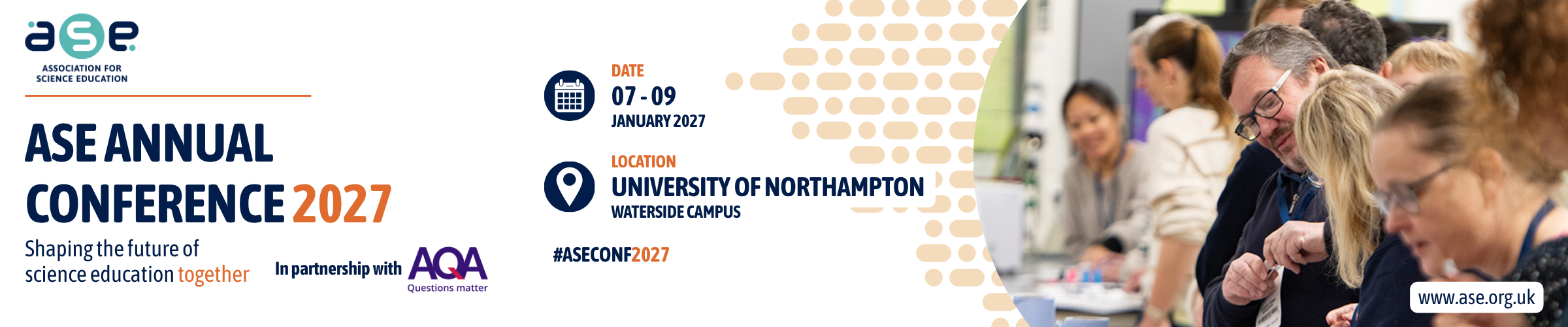
The ASE is delighted to be hosting its’ 2027 Annual Conference at the University of Northampton from 7th to 9th January.


Company: Research clear filter
arrow_back View All Dates
Thursday, January 7
 

08:45 GMT

Why did they leave? Exploring the reasons physics teachers left teaching
Thursday January 7, 2027 08:45 - 09:40 GMT
There continues to be a physics teacher recruit and retention crisis across the nations of the UK.  
There is little point in governments investing heavily in teacher recruitment if qualified teachers then leave the profession in large numbers.

With this in mind, Mark Whalley and Stuart Farmer have conducted research in both England and Scotland into identifying the reasons why physics teachers have recently left the profession. In this session, these reasons will be explored and comparisons made between the situations in Scotland and England, which factors are in common and which are different in the two nations where there has been an increasing divergence in educational policy in the last two decades. How do factors such as accountability and performativity, administrative workload, pupil behaviour, relationships with colleagues, and career progression routes impact on teacher wellbeing and their decisions to stay or leave teaching?
Speakers
avatar for Stuart Farmer

Stuart Farmer

Learning and Skills Manager, IOP and Perimeter Institute
I was a teacher of physics in Scotland for over 30 years before becoming the Scottish Education Manager for IOP in February 2019. Throughout this time I have been active in curriculum and assessment development and providing professional learning for teachers. I am a former Chair... Read More →
avatar for Mark Whalley

Mark Whalley

Senior Lecturer in Education, University of Chester
I'm a senior lecturer in Educational Leadership at the University of Chester. My main teaching covers Professional Learning and Change Leadership but I also tutor across the MA Educational Leadership programme. My principal research interest is in teacher retention and by focusing... Read More →
Thursday January 7, 2027 08:45 - 09:40 GMT
LH321 (Learning Hub Level 3)

08:45 GMT

BERG: Learning about biology in the Early Years
Thursday January 7, 2027 08:45 - 09:40 GMT
The initial learning about biological organism, naming, form and function,  begins in the earliest  years before any formal learning facilitation and  builds on the child’s understanding. These foundations are rarely discussed in training and with communities. This talk will cover how earliest learners construct undemanding of themselves and other organisms in form, function and habitat. This knowledge is from research, teaching and observations.  Learners   learn their biology beginning with  experiencing their needs and actions as a biological organisms. Such understanding forms the basis of their subsequent interpretation of species and is the basis of subsequent anthropomorphic interpretations. Their interactions and observations of the Environment and organisms, contributes to their understanding  in three categories, identified from everyday environment  Applying a grounded theory analysis of the observations they made and what caught their interest, and on their narratives verbal and actions.  These categories emerged:

1. NAMING and HABITATS - identification of organisms, naming, personal names, everyday names and scientific perhaps, locations, criterial attributes.

2. SYSTEMS - interrelationships horizontally and vertically.

3. TIME – much is not instant - germination, dimension, evolution, life cycles, change in form and function which for the early years is a very difficult idea. Identify the sequence in which names, form, function and behaviours are learnt.

The learner’s understanding develops progressively with age and opportunities to observe and interact with plant and animals. As children are biological beings, they acquire an understanding of basic life functions from first-hand experience as well as a rudimentary understanding of the biological form and function of organisms in their relationship with the environment, (Ghazili and Tolmie, 2014).

In the first quarter of the 21st century, the situation has not improved since educational researchers wrote in at the turn of the century that’ insufficient work has not been done on how children view living organisms in their environment ,Tunnicliffe and Reiss, 1999a). Such acquisition of understanding is in stages. From the first image animal shape in a soft toy replicating an animal to sightings in the environment, or images on various media. And Plant sightings in their everyday. lants are frequently neglected in formal study, there id still a ‘plant blindness’ (Wandersee and Schussler, 2001).

As the. Early leaner meets various organisms they acquire some understanding which is extended through formal teaching. Young children name animals and plants. Usually the first name becomes the superordinate category. For example, if the first object noticed and named in the sky is bird, anything else observed thereafter, e.g. a plane is called ‘bird’. Similarly green ‘objects’ that do not move around are ‘plants’, subcategories referred to by everyday names such as weeds, fruits, vegetables, flowers, trees. grass . This learning persists often in everyday life for use however, despite subsequent teaching. Learning about the biological world is crucial in developing understanding   and action in managing a sustainable world (Tunnicliffe and Reiss, 1999) but there is a long way to go yet.
Speakers
avatar for Dr Lady Sue Dale Tunnicliffe

Dr Lady Sue Dale Tunnicliffe

Patron / Retired Reader in Science Eduction IOE, CASTME and UCL IOE
Dr Sue Dale Tunnicliffe was Reader in Science Education at UCL IOE, an experienced teacher of all ages, as well as at universities. Sue is a Former OFTSED inspector and Head of Education at the Zoological Society and has published both academic papers and 13 books . Sue is particularly... Read More →
Sponsors
avatar for Miss Estruch Teach & Tell

Miss Estruch Teach & Tell

Miss Estruch Teach & Tell
Miss Estruch Teach & Tell is the proud sponsor of the Biology Education Research Programme (BERG) on Thursday of Conference, 

'Teach & Tell is run by Miss Estruch (Katie Estruch), a biology teacher since 2009 and former Head of Department, now helping teachers get their most valu... Read More →
Thursday January 7, 2027 08:45 - 09:40 GMT
LH231 (Learning Hub Level 2)

09:55 GMT

BERG: Re-framing the quadrat beyond counting daisies
Thursday January 7, 2027 09:55 - 10:50 GMT
The session presents a research-informed reconceptualisation of the quadrat through two complementary lenses.
First, informed by Barad’s agential realism and sociomaterial perspectives, we consider how tools actively shape knowledge, attention, and experience. Through iterative design and reflection, we have developed approaches that disrupt conventional ecological practices, incorporating art (e.g. Dürer’s Great Piece of Turf), narrative, and structured noticing to broaden engagement with ecological complexity.

Second, LCT (Maton), particularly its semantic dimension, offers a framework for analysing how learning moves between concrete experiences and abstract concepts. In ecology, this involves shifts between everyday observations and disciplinary language. Examining these shifts across classroom and field contexts helps explain how knowledge and disciplinary understanding develop. This work builds on Sanders and Davies (2023) and aligns with current priorities in science education.

Participant Experience
Participants will rethink the quadrat as a tool for exploring ecosystems, interdependence, scale, and human–environment relationships. Drawing on Barad and Maton, we examine how every pedagogical choice creates an “agential cut,” foregrounding certain aspects of the natural world while excluding others.

Participants will engage with the Toothpick Safari, a flexible, narrative-based alternative to traditional quadrat work. Examples from school and teacher education contexts show how this approach encourages richer discussions about interdependence, multiple scales (micro to macro), deep time, evolution, and human impact.

The session models how uncertainty and open-ended inquiry can be productive in teaching, supporting deeper ecological understanding. Participants will also reflect critically on their own use of tools, tasks, and instructions.

Outcomes - by the end of the session, participants will be able to:

Recognise the agential cuts within their teaching practices

Use quadrats to support narrative, relational, and inquiry-based learning

Design adaptable outdoor activities that prioritise noticing over counting

Explain how material tools shape what counts as knowledge in science

Connect classroom and outdoor learning to support ecological understanding and disciplinary language development.

This session supports teachers, teacher educators, and outdoor learning practitioners to rethink the quadrat as more than a measuring device, positioning it instead as a tool for ecological inquiry. Participants will explore how Karen Barad’s concepts of agential cuts and intra-action can deepen outdoor science learning, and how Legitimation Code Theory (LCT), particularly semantics, helps explain shifts between classroom preparation, fieldwork, and follow-up meaning-making.

Through first-hand, narrative-based approaches, participants will experience alternatives to traditional quadrat activities used with school students and pre-service teachers. The session also invites critical reflection on how teaching decisions influence what students notice, value, and come to understand in ecology.

This work arises from concerns that ecology teaching often prioritises counting and sampling over relationships, meaning-making, and ecological thinking. Drawing on collaborative work across teacher education contexts in London and Gothenburg, involving both pre-service teachers and school students, we began to question the pedagogical role of familiar tools such as quadrats.
Speakers
CL

Charlotte Lennartsdotter

Doctoral Student, University of Gothenburg
avatar for Dawn Saunders

Dawn Saunders

Professor in Biology Education, University of Gothenburg
I am excited by art/ecology, indoor/outdoor science education border crossings and particularly enjoy working with research questions that emerge from teaching.
Especially excited by plant-based science. Looking forward to the conference. #plant-blindness #plant awareness disparit... Read More →
Sponsors
avatar for Miss Estruch Teach & Tell

Miss Estruch Teach & Tell

Miss Estruch Teach & Tell
Miss Estruch Teach & Tell is the proud sponsor of the Biology Education Research Programme (BERG) on Thursday of Conference, 

'Teach & Tell is run by Miss Estruch (Katie Estruch), a biology teacher since 2009 and former Head of Department, now helping teachers get their most valu... Read More →
Thursday January 7, 2027 09:55 - 10:50 GMT
LH231 (Learning Hub Level 2)

09:55 GMT

Behind GCSE science pathways: How science HoDs make curriculum decisions
Thursday January 7, 2027 09:55 - 10:50 GMT
This session shares findings from an Interpretative Phenomenological Analysis (IPA) doctoral study exploring how Heads of Science experience and make sense of GCSE science pathway decisions in secondary schools.

Rather than focusing on outcomes alone, the session explores the lived realities of curriculum decision-making — including tensions between accountability measures, student perceived ability, staffing constraints, and aspirations for equity in science education.

Participants will gain insight into how departmental leaders interpret and negotiate competing pressures when constructing science pathways, and how these decisions shape access to science at Key Stage 4. The session will invite reflection on how curriculum structures are experienced in practice, and what this means for equity and progression in science education.
Speakers
avatar for Stephanie Featherstone

Stephanie Featherstone

Doctoral Researcher, University of Dundee
I am a science educator and researcher with experience teaching and leading science departments across a range of UK schools. I am currently Head of Science at Radnor House Sevenoaks and have previously held senior leadership roles in science education. My doctoral research explored... Read More →
Thursday January 7, 2027 09:55 - 10:50 GMT
LH344 (Learning Hub Level 3 lab-type space)

11:15 GMT

(IRIS) From enrichment to entitlement: teaching research and innovation at secondary school
Thursday January 7, 2027 11:15 - 12:10 GMT
Curriculum debate across the four nations keeps returning to one question. What is science education for? The answers point towards young people who can ask a good question, weigh evidence and contribute something new. Yet working scientifically is often reduced to practical technique, and the disciplinary knowledge behind real research goes untaught. Where research does appear it is usually optional, so the students who would gain most are least likely to meet it.

The Institute for Research in Schools (IRIS) has worked with over 10,000 students to carry out research. Getting Started with Research is what teachers told us they need to support research and innovation in schools.

What you get: Getting Started with Research is a free lesson programme for students, fully resourced and ready to teach. Lesson plans, slides, worksheets and a knowledge progression map. It builds a shared model of the research cycle, then teaches how researchers find and judge evidence, how curiosity becomes a testable question, who does research, and how students plan an enquiry of their own.

It is designed the way you already plan. Outcomes first, knowledge specified lesson by lesson, misconceptions named, retrieval and modelling built in, reading age controlled. It strengthens working scientifically rather than competing with it, and it maps to the curriculum in all four nations.

Aims and outcomes - In this session we will:

> show why research and innovation are better taught explicitly than left to chance

> walk through the lesson sequence and the knowledge each lesson builds

> show how it fits existing schemes of work, progression pathways and the enrichment you already run

Delegates will leave able to identify where research knowledge is currently assumed rather than taught in their own curriculum, and with free access to the full programme. Time is protected for questions.
Speakers
avatar for Georgina Lott

Georgina Lott

Head of Education Innovation, Institute for Research in Schools (IRIS)

KM

Kelly Murfet

Education Innovation Lead, Institute for Research in Schools (IRIS)
https://www.linkedin.com/in/kelly-murfet-8a9065348/
Sponsors
avatar for Institute for Research in Schools (IRIS)

Institute for Research in Schools (IRIS)

The Institute for Research in Schools
Our mission is to change the culture in UK education so that every young person experiences real research.

We do this by:Providing opportunities for young people to carry out research projects and share their findings with the worldEmpowering... Read More →
Thursday January 7, 2027 11:15 - 12:10 GMT
LH323 (Learning Hub Level 3)

11:15 GMT

AI use in Trainees and Early Career Teachers
Thursday January 7, 2027 11:15 - 12:10 GMT

This session will explore how AI is influencing trainee and early career teachers beyond practical use, focusing on professional identity development in a changing educational landscape.

You will hear findings from research into how trainee teachers are currently using AI to support planning, learning, reflection, and professional practice, alongside key themes around confidence, dependency, authenticity, and perceptions of expertise.

The session will then examine how AI may shape identity development during the transition from training into independent practice, raising questions around autonomy, judgement, professional voice, and the evolving role of the teacher.

The final part of the lecture will introduce the next phase of research focusing on ECTs, exploring identity development in the early years of teaching and launching a wider survey to gather insight into lived experiences of AI use in practice.


Outcomes:
Following this session, participants will hopefully be able to:

* Recognise key patterns in how trainee teachers engage with AI.
* Critically consider how AI may shape professional identity and autonomy.
* Reflect on implications for teacher education, mentoring, and induction.
* Identify emerging challenges around authenticity, confidence, and dependency.
* Engage with research-informed discussion around AI and identity development.
* Consider how AI use may influence teachers beyond efficiency and workload.

This session is grounded in research conducted at the University of Warwick exploring how trainee teachers are engaging with AI and how this intersects with their developing professional identity. As AI becomes increasingly embedded in educational practice, it raises important questions not only about workload and efficiency, but about how emerging teachers construct confidence, autonomy, expertise, and authenticity.

The project has explored how trainee teachers use AI for planning, idea generation, academic support, and reflective practice, alongside wider considerations around ethics, professional boundaries, and dependency. This work has led to a broader interest in how AI may continue to shape identity formation beyond initial teacher training. What the research has shown is that trainees are using AI, and the project is investigating what this means for both ITE and schools going forward.

The next phase of this research expands to newly practising teachers, examining how Early Career Teachers navigate AI use while developing identity, confidence, and professional agency in their early years of practice and we hope to promote this phase at the ASE Conference.
Speakers
JL

Jonty Leese

Associate Professor and Head of International PGCE Programmes, University of Warwick

avatar for Joanna Pellereau

Joanna Pellereau

PGCE Course Science Lead, Warwick University Centre for Teacher Education
Having been a physics teacher and Head of Department for over a decade, I am now Physics PGCE lead and a teaching fellow at the Centre for Teacher Education at the University of Warwick. I also take on freelance work and have supported OUP with the Kerboodle resources for the new... Read More →
Thursday January 7, 2027 11:15 - 12:10 GMT
LH324 (Learning Hub Level 3 lab-type space)

13:35 GMT

Bringing STEM careers into secondary science lessons
Thursday January 7, 2027 13:35 - 14:30 GMT
The Gatsby Benchmarks of Good Careers Guidance highlight the importance of linking curriculum learning to careers, yet many teachers face the challenge of fitting meaningful careers education into an already crowded curriculum.
The Scientists Making a Difference book and supporting teaching resources have been created by the Gatsby Charitable Foundation, Imperial College London and What on Earth! Books to help schools address this challenge quickly and easily.

The book features 47 diverse scientists working across a wide range of STEM careers, alongside a comprehensive teacher resource pack. Designed for use with students aged 11–16, the resources provide curriculum-linked activities that enable teachers to embed STEM careers into existing science lessons with minimal planning required.
All UK state-funded secondary schools received free copies of the book and teacher resource pack in September 2026. You can also access a digital copy of the teaching resources at www.scientists-making-a-difference.com.
This practical session will introduce attendees to the Scientists Making a Difference resources and demonstrate how they can be used within existing schemes of work. Covering varied lesson activities, worksheets, presentations and curriculum mapping documents, the session will walk you through how the resources can not only help schools in achieving the Gatsby Benchmarks of Good Careers Guidance, but also inspire students through contemporary examples of scientists who’ve undertaken a variety of career pathways.
Attendees will leave with:
  • a clear understanding of how to access and use the Scientists Making a Difference resources, to integrate STEM careers education into science lessons.
  • Increased confidence in supporting careers education through the curriculum.
There will be opportunities for discussion and questions throughout the session, and attendees will all receive a hard copy of the teacher guide to support implementation within their own schools.

The session is underpinned by the evidence base that informed the Gatsby Benchmarks of Good Careers Guidance, particularly Benchmark 4: Linking Curriculum Learning to Careers. Research has highlighted the importance of helping young people understand the relevance of curriculum subjects to future education and employment pathways. Scientists Making a Difference has been created by the Gatsby Charitable Foundation, Imperial College London and What on Earth! publishing to provide practical, curriculum-linked resources that support schools in embedding STEM careers within secondary science teaching.

Speakers
avatar for Jennifer Marchant CSciTeach

Jennifer Marchant CSciTeach

Teacher and STEM Writer, What On Earth Books

Sponsors
avatar for Scientists Making a Difference

Scientists Making a Difference

Scientists Making a Difference is a book and set of educational resources, including videos, a teachers’ guide and worksheets, designed to inspire pupils aged 11–16 to explore the many routes into science careers.
Created by Gatsby Charitable Foundation, Imperial College Londo... Read More →
Thursday January 7, 2027 13:35 - 14:30 GMT
LH324 (Learning Hub Level 3 lab-type space)

13:35 GMT

Harnessing game based learning in science
Thursday January 7, 2027 13:35 - 14:30 GMT
Game-Based Learning (GBL) offers powerful opportunities to enhance engagement, motivation, and conceptual understanding in science education. As science educators seek approaches that support curiosity, resilience, and active participation, well-designed learning games—both digital and non-digital—can create meaningful contexts in which students explore scientific ideas through investigation, collaboration, and problem-solving. This session explores how game-based approaches can be integrated thoughtfully into science teaching to support disciplinary knowledge, scientific practices, and inclusive classroom participation.

Rather than treating games as rewards or add-ons, the session focuses on using game-based strategies as structured learning experiences that align with curriculum goals and support progression in scientific understanding. Participants will explore how game mechanics such as challenge, narrative, feedback, role-play, and iteration can be used to strengthen students’ reasoning, modelling, and evidence-based thinking. Examples will include classroom-ready activities that support topics such as ecosystems, forces, energy, particle models, and scientific enquiry skills across primary and secondary settings.

A key emphasis of the session is the role of games in supporting inquiry-based science learning. Game environments naturally encourage experimentation, hypothesis testing, and revision of ideas—processes that mirror authentic scientific practice. Participants will consider how carefully designed gameplay can help learners explore complex systems, visualize abstract concepts, and develop persistence when working through challenging ideas. These approaches help students move beyond memorization towards deeper conceptual understanding.

The session will also highlight how game-based learning can support inclusion and participation. Games can provide alternative entry points into science for learners who may not respond as positively to traditional instructional formats. Collaborative gameplay can encourage discussion, peer explanation, and shared reasoning, helping to build confidence and scientific identity among a wider range of students. Examples will demonstrate how low-cost and accessible game strategies can be adapted for diverse classroom contexts without requiring specialist technology.
Assessment is another important focus. Participants will explore how teachers can use gameplay to gather evidence of student thinking through observation, dialogue, and reflective activities embedded within game experiences. Approaches will be shared for designing purposeful learning games that make students’ reasoning visible while maintaining high expectations for scientific accuracy and rigor. These strategies support formative assessment while promoting engagement and curiosity.

Importantly, the session will address how teachers can select or adapt games in ways that maintain strong pedagogical purpose. Participants will consider how to evaluate whether a game supports conceptual learning rather than distraction, and how gameplay can be integrated within sequences of lessons rather than used in isolation. Practical frameworks will help teachers identify opportunities where game-based approaches can enhance—not replace—effective science teaching.

This interactive session is suitable for educators across primary and secondary phases who are interested in expanding their teaching repertoire through evidence-informed and classroom-ready strategies. Through discussion, shared examples, and collaborative reflection, participants will leave with practical ideas they can adapt immediately to support engaging, rigorous, and inclusive science learning through game-based approaches.
Speakers
avatar for Ed Walsh

Ed Walsh

Science Education Consultant, Ed Walsh Consulting
An author and CPD presenter, I was a teacher for 20 years, 12 of them as team leader.  I then worked as a consultant, supporting teachers and science teams, training teachers and developing curriculum materials.  I am now a Series Editor for Collins, CPD Trainer for AQA and Development... Read More →
TS

Tammie Schrader

Science Education Consultant, Oakesdale School District/Hagan Foundation

Thursday January 7, 2027 13:35 - 14:30 GMT
LH344 (Learning Hub Level 3 lab-type space)

15:40 GMT

Chair Chat
Thursday January 7, 2027 15:40 - 16:10 GMT
Our dedicated Chair Trio invite you to drop-in to the “Chair-Chat” sessions on one of the days of Annual Conference 2027. The Chair is a vital role to the ASE, and the elected Chair provides an authoritative voice for the thousands of members that the ASE supports, along with those working within the wider science education community. Those elected remain part of our Chair Trio for 3 years.

Got a question? Ever wondered about what goes on behind the scenes? Ever thought about getting involved in Committee activities? Are you wanting to know more about Professional Registration or writing an article in one of the ASE journals? First time attending our flagship Conference?

If this is your first ASE Conference, then please come along and say Hello.

We look forward to hearing your questions and will endeavour to answer them or point you in a selection of possible right directions!
Speakers
avatar for David Allen

David Allen

Associate Professor Learning and Teaching / Outgoing Chair of the ASE 25/26, University of Hertfordshire & Creative Primary Science Education Consultancy
I worked in primary schools for over twenty years as a classteacher, senior leader and Deputy Headteacher. I taught across Key stages 1, 2 and 3 in UK and in Spain. During this time I developed a passion for science, art and design, improvised drama, assessment for learning, creativity... Read More →
avatar for Claire Seeley (MA CSciTeach)

Claire Seeley (MA CSciTeach)

Primary Science Education Consultant / Co-Chair of the ASE
Claire Seeley has been a teacher for over thirty years in a wide variety of contexts including both inner city and rural schools England. Claire is also a Primary Science Consultant, providing both continuing professional development and initial teacher training.  She has a passion... Read More →
avatar for Natasha Serret

Natasha Serret

Associate Professor of Science Education, Nottingham Trent University
I started my professional career as a classroom teacher and science lead in a London primary school. I was and remain passionate about classroom learning that promotes a scientific mindset alongside the development of an understanding of key scientific concepts.  This professional... Read More →
EP

Emily Perry

Professor of Education, Manchester Metropolitan University
Thursday January 7, 2027 15:40 - 16:10 GMT
Learning Hub Level 2 landing space outside rooms LH227-230

16:10 GMT

Supporting students’ epistemological science beliefs in STEM education
Thursday January 7, 2027 16:10 - 17:05 GMT
My aim with this session is to:
• raise awareness of students’ epistemological beliefs;
• discuss how these beliefs influence students’ participation and engagement; and
• illustrate how these beliefs can be supported towards a more sophisticated understanding through STEM educational practices.

Recent studies in Denmark have shown that students in many cases associate acquisition of scientific knowledge with passive memorization of facts and scientific concepts. I will address the challenges arising from this research and introduce a framework for understanding the concept of epistemological beliefs. This will be used to highlight the findings of a case study I conducted in an eighth-grade physics class in Denmark.

My hope is that the participants will gain a more complex understanding of students’ conception of scientific knowledge and of what we’re teaching the students about science besides the concepts, methods and practices. This will enable the participants to identify indicators of epistemological beliefs among their own students and to discuss initiatives to support more sophisticated beliefs about knowledge, knowing and learning in their own classrooms.

I completed my master’s thesis on this subject at the University of Copenhagen, where I recently finished my master’s degree in STEM education. I investigated this topic through research into academic literature and a case study in a lower secondary school class, where I conducted observations in a STEM physics course and did three semi-structured interviews with six students.
Speakers
avatar for Mads Kofod

Mads Kofod

Master's Graduate (STEM Education), University of Copenhagen
Thursday January 7, 2027 16:10 - 17:05 GMT
LH344 (Learning Hub Level 3 lab-type space)
 

Share Modal

Share this link via

Or copy link

Filter sessions
Apply filters to sessions.
Filtered by Date -