Loading…
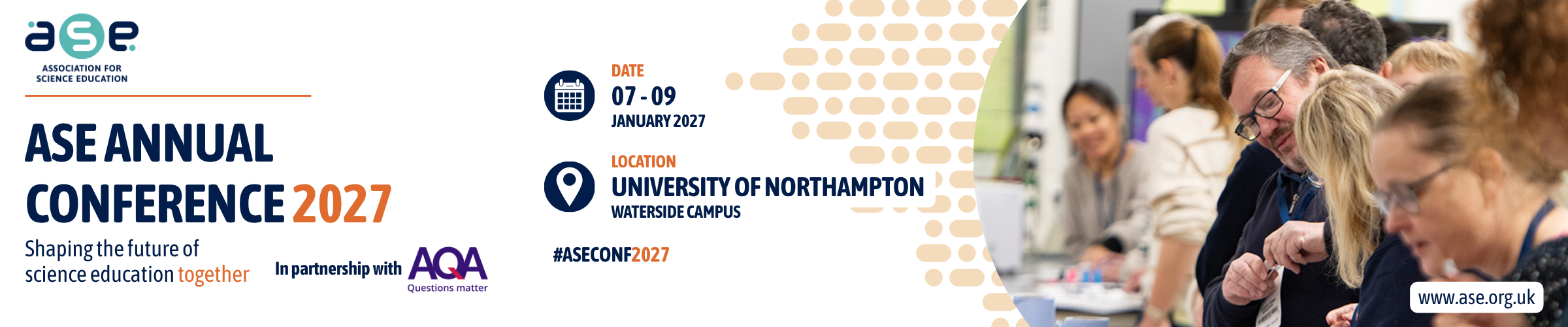
The ASE is delighted to be hosting its’ 2027 Annual Conference at the University of Northampton from 7th to 9th January.


Company: Recruitment Retention and Wellbeing clear filter
arrow_back View All Dates
Thursday, January 7
 

08:45 GMT

Why did they leave? Exploring the reasons physics teachers left teaching
Thursday January 7, 2027 08:45 - 09:40 GMT
There continues to be a physics teacher recruit and retention crisis across the nations of the UK.  
There is little point in governments investing heavily in teacher recruitment if qualified teachers then leave the profession in large numbers.

With this in mind, Mark Whalley and Stuart Farmer have conducted research in both England and Scotland into identifying the reasons why physics teachers have recently left the profession. In this session, these reasons will be explored and comparisons made between the situations in Scotland and England, which factors are in common and which are different in the two nations where there has been an increasing divergence in educational policy in the last two decades. How do factors such as accountability and performativity, administrative workload, pupil behaviour, relationships with colleagues, and career progression routes impact on teacher wellbeing and their decisions to stay or leave teaching?
Speakers
avatar for Stuart Farmer

Stuart Farmer

Learning and Skills Manager, IOP and Perimeter Institute
I was a teacher of physics in Scotland for over 30 years before becoming the Scottish Education Manager for IOP in February 2019. Throughout this time I have been active in curriculum and assessment development and providing professional learning for teachers. I am a former Chair... Read More →
avatar for Mark Whalley

Mark Whalley

Senior Lecturer in Education, University of Chester
I'm a senior lecturer in Educational Leadership at the University of Chester. My main teaching covers Professional Learning and Change Leadership but I also tutor across the MA Educational Leadership programme. My principal research interest is in teacher retention and by focusing... Read More →
Thursday January 7, 2027 08:45 - 09:40 GMT
LH321 (Learning Hub Level 3)

09:55 GMT

Pedagogical approaches for teaching emotive issues in primary science
Thursday January 7, 2027 09:55 - 10:50 GMT
Aims of this session:  
> To raise awareness of the link between the primary National Curriculum content and the lived experiences of children and families.
> To help delegates pre-empt potentially emotive issues within the science National Curriculum and consider sensitive pedagogical responses.

Emotive issues in science, really?  Science is often considered to be a fact-based subject; we don’t always anticipate that science lessons may evoke emotional responses from children (or their families).

During this session, we aim to consider the primary science curriculum through the eyes of a child who may find some topics challenging. These are not always the topics that we expect, and there are more than you might think. If you’re a child who does not live with biological relations, how do lessons on inherited traits in humans feel to you? If your parents struggle to afford good-quality food, what do activities highlighting a healthy diet mean to you?

We will consider how topics such as these can be addressed with sensitivity in the classroom without watering down or avoiding the scientific content.

Outcomes: Delegates will be introduced to a different mindset when teaching science.
Delegates should be able to identify aspects of the primary National Curriculum which may evoke an emotional response or cause unintended upset to the children they teach and their families.
Delegates should leave the session with some ideas about how they would/would not teach potentially emotive topics.

We are experienced teacher educators who have supported student teachers to get to grips with the science National Curriculum. We have also sat with students who have regretted the approaches they took in lessons when they taught the science curriculum in a factually correct way but did not fully consider the lived experiences of the children they teach. This prompted us to develop a taught session, called ‘Teaching science with sensitivity’, which we deliver to all our trainees. Feedback from students is always positive, and we would be keen to share our work with a wider audience. In doing so, we appreciate that many delegates have rich experience that they could contribute to discussion within the session.

Topics that we include are:

The human body, including physical differences, the importance of exercise, a healthy diet, hygiene/dental health and hygiene, drugs and alcohol. Potential concerns: Body differences, body image, addiction within the family, and the impact of socio-economic backgrounds.

Living, dead and things that have never been alive - Potential concern: death.
Food chains – Potential concern: awareness of the brutality of predation.
Fossils and evolution - Potential concern: conflict with science and families’ cultural/religious beliefs.
Living things and their habitats, life cycles and reproduction - Potential concern: sustainability/habitat destruction.
Inheritance and Selection – Potential concern: upset caused to children who do not live with their biological parents.
Speakers
avatar for Nicola Treby

Nicola Treby

Associate Professor and Head of Primary Core Subjects, University of Roehampton

VM

Vanessa Matthews

Senior Lecturer in Primary Science and Assistant Programme Leader BA year 2, University of Roehampton

Thursday January 7, 2027 09:55 - 10:50 GMT
LH125 (Learning Hub Level 1)

11:15 GMT

Building professional curiosity, joy and agency in trainee teachers
Thursday January 7, 2027 11:15 - 12:10 GMT
At the Nottingham Institute of Education, we have remained committed to ensuring that professional curiosity, agency and joy underpin our science provision across our primary initial teacher education (ITE) programmes. Maintaining this ambition against a national context of financial pressures in the university sector while meeting government reforms as articulated through the Initial Teacher Training Early Career Framework (ITTECF), the introduction of ITAP (Intensive Training and Practice) and the new OFTSED ITT Inspection Framework has not been easy. Our concern is that some of these challenges are contributing to a constrained provision of primary science in ITE.

We know that we are not alone and we would like to use this session as an opportunity to collectively celebrate and identify next steps in nurturing professional curiosity, agency and joy for our next generation of primary science teachers.
We invite you to join us in this interactive presentation where you will be able to share and reflect on how science is positioned in your own teacher educator settings.
(Outcomes) By the end of the session, you will:
• Gain a developed awareness of practice-based approaches (e.g. outdoor learning, informal contexts, micro-teaching, practitioner research projects) for embedding professional curiosity and developing critical research engagement in primary science ITE.
• Critically reflect on how ITE programmes currently develop research engagement and how this can establish professional agency.
• Consider wider possibilities, through the ASE and beyond, that will empower student teachers and ECTs in their professional development of their subject, curriculum and pedagogical knowledge in primary science.

Aims:
• Understand how science can be given a strong, coherent and joyful profile across a primary ITE curriculum
• Explore how purposeful and critical engagement with research can be scaffolded for student teachers and ECTs.
• Collaborate as a community of teacher educators to support the identification of practical strategies that can embed professional curiosity and joy in primary science ITE.

Background: At the Nottingham Institute of Education, we have remained committed to ensuring that professional curiosity, agency and joy underpin our science provision across our primary initial teacher education (ITE) programmes. Working as a team of primary science initial teacher educators in England, we have reflected on how to maintain this ambition against a national context of financial pressures in the university sector while meeting government reforms as articulated through the Initial Teacher Training Early Career Framework (ITTECF) and the introduction of ITAP (Intensive Training and Practice. Our concern is that some of these challenges are contributing to a diminished and constrained provision of primary science in ITE.

Our approach has evolved through our ITE undergraduate and postgraduate curriculum design, collaboration with expert practitioners, specialist science expertise within our university and local partnership schools. External examiner feedback and student outcomes have supported the development of this approach, highlighting its impact on confidence, agency and subject knowledge.

We will reflect on how we have deliberately designed, within our primary ITE curriculum, opportunities that encourage a critical engagement with research in primary science. This includes utilising external evidence-informed professional support such as the Primary Science Enhancement Award (PSEA), embedding science within ITAP so that foundational teaching foci, such as high-quality talk and questioning, can be developed through the lens of primary science and promoting practitioner enquiry in primary science within our final dissertation action research projects.

Speakers
AM

Alison Murphy

Senior Lecturer, Nottingham Trent University

avatar for Natasha Serret

Natasha Serret

Associate Professor of Science Education, Nottingham Trent University
I started my professional career as a classroom teacher and science lead in a London primary school. I was and remain passionate about classroom learning that promotes a scientific mindset alongside the development of an understanding of key scientific concepts.  This professional... Read More →

Thursday January 7, 2027 11:15 - 12:10 GMT
LH115 (Learning Hub Level 1)

15:40 GMT

Chair Chat
Thursday January 7, 2027 15:40 - 16:10 GMT
Our dedicated Chair Trio invite you to drop-in to the “Chair-Chat” sessions on one of the days of Annual Conference 2027. The Chair is a vital role to the ASE, and the elected Chair provides an authoritative voice for the thousands of members that the ASE supports, along with those working within the wider science education community. Those elected remain part of our Chair Trio for 3 years.

Got a question? Ever wondered about what goes on behind the scenes? Ever thought about getting involved in Committee activities? Are you wanting to know more about Professional Registration or writing an article in one of the ASE journals? First time attending our flagship Conference?

If this is your first ASE Conference, then please come along and say Hello.

We look forward to hearing your questions and will endeavour to answer them or point you in a selection of possible right directions!
Speakers
avatar for David Allen

David Allen

Associate Professor Learning and Teaching / Outgoing Chair of the ASE 25/26, University of Hertfordshire & Creative Primary Science Education Consultancy
I worked in primary schools for over twenty years as a classteacher, senior leader and Deputy Headteacher. I taught across Key stages 1, 2 and 3 in UK and in Spain. During this time I developed a passion for science, art and design, improvised drama, assessment for learning, creativity... Read More →
avatar for Claire Seeley (MA CSciTeach)

Claire Seeley (MA CSciTeach)

Primary Science Education Consultant / Co-Chair of the ASE
Claire Seeley has been a teacher for over thirty years in a wide variety of contexts including both inner city and rural schools England. Claire is also a Primary Science Consultant, providing both continuing professional development and initial teacher training.  She has a passion... Read More →
avatar for Natasha Serret

Natasha Serret

Associate Professor of Science Education, Nottingham Trent University
I started my professional career as a classroom teacher and science lead in a London primary school. I was and remain passionate about classroom learning that promotes a scientific mindset alongside the development of an understanding of key scientific concepts.  This professional... Read More →
EP

Emily Perry

Professor of Education, Manchester Metropolitan University
Thursday January 7, 2027 15:40 - 16:10 GMT
Learning Hub Level 2 landing space outside rooms LH227-230

16:10 GMT

International panel: How the global science teaching workforce is preparing students to be future-ready and to thrive
Thursday January 7, 2027 16:10 - 17:20 GMT
Our society is facing technological advancement, environmental challenges, and evolving labour market demands. As such, science education is increasingly expected to equip young people with the knowledge, skills, and dispositions needed to deal with these issues and thrive in an uncertain future. Science teachers are at the forefront of this effort, adapting curricula, pedagogies, and assessment practices to prepare students for a complex and interconnected world.
 
The panel discussion will explore how the global science teaching workforce is responding to these challenges and opportunities. Drawing on international perspectives, it will examine the ways teachers are fostering critical thinking, real world problem-solving, creativity, scientific literacy, collaboration, inquiry-based learning, sustainability, digital technologies, and adaptability essential for future readiness. This includes highlighting how science educators are empowering learners not only to succeed academically, but also to contribute meaningfully to their communities and address global challenges. The discussion will reflect on the pivotal role of the science teaching profession in shaping resilient, informed, and engaged citizens who are prepared to thrive in the future and help create it.
Thursday January 7, 2027 16:10 - 17:20 GMT
LH321 (Learning Hub Level 3)
 

Share Modal

Share this link via

Or copy link

Filter sessions
Apply filters to sessions.
Filtered by Date -