Loading…
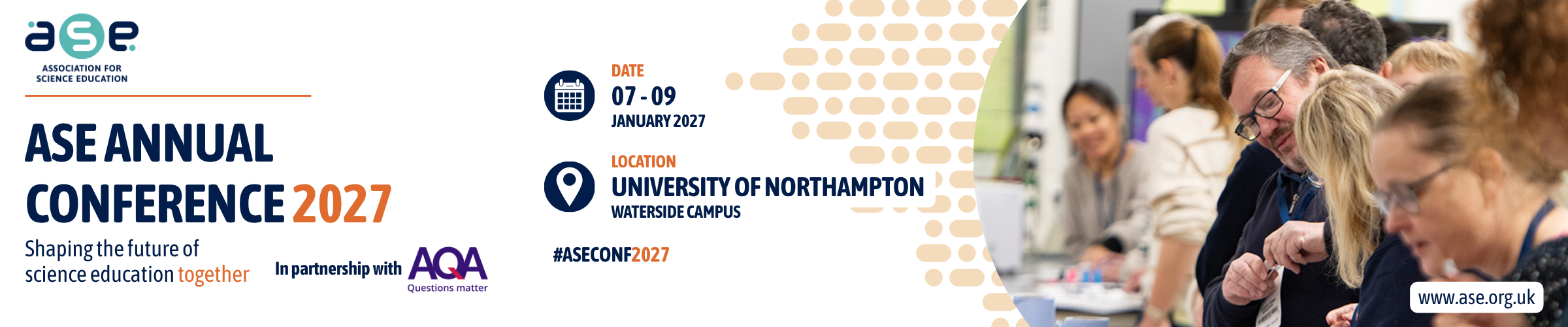
The ASE is delighted to be hosting its’ 2027 Annual Conference at the University of Northampton from 7th to 9th January.


Audience: FE/Skills clear filter
arrow_back View All Dates
Thursday, January 7
 

08:45 GMT

(Pearson): Practical science models that schools can actually deliver
Thursday January 7, 2027 08:45 - 09:40 GMT
This collaborative session invites teachers and leaders to reflect on practical science models that are realistic, workable and educationally valuable. It will explore how practical assessment and practical learning can be designed in ways that support classroom delivery, gather meaningful feedback and balance ambition with the operational realities schools face.

Participants will also explore what makes practical science both educationally valuable and operationally manageable; to surface the barriers schools face in delivering practical science well; and to discuss models that could improve consistency, feasibility and learner experience. Participants will leave with a set of practical design considerations, examples of alternative delivery models and prompts for reviewing practical science in their own context.
Speakers
avatar for Shauna O'Brien

Shauna O'Brien

Head of Science, Pearson

PP

Poppy Pan

Lead Specialist - Science, Pearson

Thursday January 7, 2027 08:45 - 09:40 GMT
LH125 (Learning Hub Level 1)

09:55 GMT

Keynote: Disciplinary oracy in the science classroom
Thursday January 7, 2027 09:55 - 10:50 GMT
Oracy is set to have a renewed emphasis in the revised National Curriculum, but what is the opportunity for oracy in the science classroom? In this keynote, Amy Gaunt will explore what it means to learn to and through talk in science, supporting students to develop their disciplinary knowledge and understanding while also learning to speak, listen and communicate like scientists.

Through discussion and practical activities, delegates will experience oracy in action and consider the opportunities for creating authentic and meaningful contexts for talk across their own science classrooms and departments.
Speakers
avatar for Amy Gaunt

Amy Gaunt

Amy Gaunt is Director of Education at Voice 21, the national oracy charity which exists to increase access to high-quality oracy education.

She is co-author of Create an Oracy Curriculum (2026) and Transform Teaching and Learning through Talk: the Oracy Imperative (2019... Read More →
Thursday January 7, 2027 09:55 - 10:50 GMT
LH013 & LH014 (Learning Hub Ground Floor)

10:50 GMT

Biology educators tea/coffee and muffins (sponsored by Miss Estruch Teach & Tell)
Thursday January 7, 2027 10:50 - 11:15 GMT
If your focus is teaching or supporting biology lessons, come along for a networking session with complimentary tea/coffee and a muffin, to discuss how Miss Estruch Teach & Tell can support your practice!
Sponsors
avatar for Miss Estruch Teach & Tell

Miss Estruch Teach & Tell

Miss Estruch Teach & Tell
Miss Estruch Teach & Tell is the proud sponsor of the Biology Education Research Programme (BERG) on Thursday of Conference, 

'Teach & Tell is run by Miss Estruch (Katie Estruch), a biology teacher since 2009 and former Head of Department, now helping teachers get their most valu... Read More →
Thursday January 7, 2027 10:50 - 11:15 GMT
Learning Hub Level 2 landing space outside rooms LH227-230

11:15 GMT

BERG: From sequence to species: Learning through DNA barcoding
Thursday January 7, 2027 11:15 - 12:10 GMT
This session will explore how the practical Barcoding For Beginners project is being used to investigate invertebrate biodiversity with learners in years 10-13. Hear about the impact of authentic scientific investigation and collaboration on educators and students and see the resources available to support this inquiry-based project using molecular biology techniques, bioinformatics and transferable skills.

Launched in September 2024, Barcoding For Beginners is a project by Wellcome Connecting Science, funded by a Royal Society SEED Partnership grant. It provided funded CPD for eligible educators, a series of resources, equipment and consumables to support a 10 hour DNA barcoding project in the classroom. This session will discuss the findings from this two year project and examine the impact on educators and learners of completing inquiry-based science, using molecular biology equipment, supported by scientists in the field.

This session will discuss and showcase:
• how DNA barcoding has been used in schools and FE colleges for practical, inquiry-based projects investigating invertebrate biodiversity in years 10 - 13
• how using practical project work can enhance understanding of molecular biology techniques in the curriculum
• the positive engagement of educators and technical staff with Barcoding for beginners CPD and resources
• the impact on practical molecular biology ability, transferable skills and career awareness in participating students
• one of the bioinformatics exercises to showcase how interrogating open access databases can be used in teaching

Attendees will:
• understand the structure and impact of the Barcoding for beginners programme and how it can be applied in school and colleges
• hear about the impact the practical investigations had on students engagement with molecular biology and bioinformatics and their development of practical skills.
• discuss how a DNA barcoding project fits with the curriculum and can be integrated into teaching
•t rial a bioinformatics element from the project to demonstrate how the project can enhance students’ domain-specific skills
Speakers
FG

Francesca Gale

Head of Science Engagement and Enrichment, Welcome Connecting Science
Sponsors
avatar for Miss Estruch Teach & Tell

Miss Estruch Teach & Tell

Miss Estruch Teach & Tell
Miss Estruch Teach & Tell is the proud sponsor of the Biology Education Research Programme (BERG) on Thursday of Conference, 

'Teach & Tell is run by Miss Estruch (Katie Estruch), a biology teacher since 2009 and former Head of Department, now helping teachers get their most valu... Read More →
Thursday January 7, 2027 11:15 - 12:10 GMT
LH231 (Learning Hub Level 2)

12:25 GMT

BERG: Collaborating on AI, assessment, and inclusion in HE biosciences
Thursday January 7, 2027 12:25 - 13:20 GMT
This interactive session will explore how collaborative, cross-institutional communities of practice can support higher education science educators in responding to emerging pedagogical challenges. The session will introduce the collaborative work of the BERG Higher Education Working Group through two current thematic areas: AI and assessment and decolonising the curriculum.

Through a series of short reflective case studies and emerging examples from participating HEIs, contributors will share approaches, challenges, and ongoing questions relating to inclusive curricula, assessment design, and the impact of generative AI on teaching and learning.

Participants will then be invited to discuss their own institutional experiences, challenges, and priorities within these areas. The session will encourage collaborative dialogue across disciplines and institutions, recognising that many of these challenges extend beyond bioscience education alone.

The session will conclude with a shared reflection on the role of collaborative networks and communities of practice in supporting responsive, inclusive, and evidence-informed approaches to science education in higher education.

Outcomes: - Participants will be able to:

Share current challenges and emerging practices relating to AI, assessment, and inclusive curricula within higher education science education.

Reflect on how different HEIs are responding to shared pedagogical and curricular challenges.

Discuss opportunities and barriers associated with collaborative approaches to educational change.

Consider how cross-institutional communities of practice can support ongoing professional dialogue and development.

Higher education science educators are navigating rapid pedagogical, curricular, and technological change. In response to shared challenges across the sector, members of the Biology Education Research Group (BERG) Higher Education Working Group, part of the Royal Society of Biology, established collaborative thematic groups focused on AI and assessment, and decolonising the curriculum. These groups bring together educators and academics from multiple HEIs to share practice, reflect on emerging challenges, and explore approaches to inclusive and responsive science education.
Speakers
CS

Caroline Smith

Assistant Head of School - Curriculum Innovation and Student Experience, University of Westminster

SR

Sarah Rayment

Nottingham Trent University, Senior Lecturer in Molecular Sciences
Dr Sarah Rayment is a senior lecturer in bioscience within SST. She is co-course leader for Bioscience courses with Integrated Foundation year and centre director for the bioscience scholarship research centre. She is passionate about skill development: whether through authentic student... Read More →
Sponsors
avatar for Miss Estruch Teach & Tell

Miss Estruch Teach & Tell

Miss Estruch Teach & Tell
Miss Estruch Teach & Tell is the proud sponsor of the Biology Education Research Programme (BERG) on Thursday of Conference, 

'Teach & Tell is run by Miss Estruch (Katie Estruch), a biology teacher since 2009 and former Head of Department, now helping teachers get their most valu... Read More →
Thursday January 7, 2027 12:25 - 13:20 GMT
LH231 (Learning Hub Level 2)

12:25 GMT

Honorary and Professional Members lunch (invitation only)
Thursday January 7, 2027 12:25 - 13:20 GMT
This professional registration lunch (by invitation only) is for those Honorary ASE members and member-science teachers and technicians who have gained professional registration or Chartership: CSciTeach, RSci or RSciTech, all of whom are invited to join Lynn Ladbrook, the ASE's CEO along with the Chair Trio for the Association.

New Honorary members will also be announced. Honorary Membership is the ASE's highest honour and is awarded to those individuals that have made outstanding contributions to the work of the ASE in at least two of the following areas:
National affairs of the Association
Regional affairs of the Association
Science education in general (at a national or international level)
Speakers
avatar for Lynn Ladbrook

Lynn Ladbrook

Chief Executive, Association for Science Education
EP

Emily Perry

Professor of Education, Manchester Metropolitan University
avatar for Claire Seeley (MA CSciTeach)

Claire Seeley (MA CSciTeach)

Primary Science Education Consultant / Co-Chair of the ASE
Claire Seeley has been a teacher for over thirty years in a wide variety of contexts including both inner city and rural schools England. Claire is also a Primary Science Consultant, providing both continuing professional development and initial teacher training.  She has a passion... Read More →
avatar for Natasha Serret

Natasha Serret

Associate Professor of Science Education, Nottingham Trent University
I started my professional career as a classroom teacher and science lead in a London primary school. I was and remain passionate about classroom learning that promotes a scientific mindset alongside the development of an understanding of key scientific concepts.  This professional... Read More →
avatar for Marianne Cutler

Marianne Cutler

Director of Curriculum Innovation, Association for Science Education
avatar for David Allen

David Allen

Associate Professor Learning and Teaching / Outgoing Chair of the ASE 25/26, University of Hertfordshire & Creative Primary Science Education Consultancy
I worked in primary schools for over twenty years as a classteacher, senior leader and Deputy Headteacher. I taught across Key stages 1, 2 and 3 in UK and in Spain. During this time I developed a passion for science, art and design, improvised drama, assessment for learning, creativity... Read More →
avatar for Rob Butler

Rob Butler

Registrar, Association for Science Education
I'm a Chartered Science teacher, the registrar and Project Officer for the ASE (running the Keeping Science Practical project).
I'm a senior professional development leader for the Science Learning Partnership network and I help the Science Council promote their professional registers. I'm an ex-special school senior leader, an ex-science teacher and an OUP author. I jointly run the ASE's Inclusive Science Educati... Read More →
Thursday January 7, 2027 12:25 - 13:20 GMT
Leathersellers Hide (Learning Hub Level 4)

13:35 GMT

(MiniOne Systems) Who's Baby Luna's Father? Using DNA Fingerprinting to Solve a Mystery
Thursday January 7, 2027 13:35 - 14:30 GMT
Embark on a hands-on adventure and join marine biologists in their quest to uncover the mystery of Luna's father! Meet Luna, an adorable whale calf,  and become part of a passionate team determined to solve this heart-warming puzzle using gel electrophoresis and DNA fingerprinting.
Speakers
EF

Erika Fong

Director, MiniOne Systems
Molecular Biology Anywhere and for Everyone! The game changing MiniOne Electrophoresis System was first of its kind designed specifically for teachers and students to have equal access to key biotech techniques with engaging activities. Whether used in the classroom lab or at home... Read More →
Sponsors
avatar for MiniOne Systems (Embitec)

MiniOne Systems (Embitec)

Browse our webpage at https://eu.theminione.com for links to:

> The MiniOne Electrophoresis System
> The New e-Pipette
> The MiniOne Incubator
> The Let it Glow Bacterial Transformation MiniLab
> Pipetting and Gel Loading Practice Kits
> MiniOne MiniLabs - complete lab kits for ha


... Read More →
Thursday January 7, 2027 13:35 - 14:30 GMT
CH314 (Creative Hub Level 3)

13:35 GMT

Harnessing game based learning in science
Thursday January 7, 2027 13:35 - 14:30 GMT
Game-Based Learning (GBL) offers powerful opportunities to enhance engagement, motivation, and conceptual understanding in science education. As science educators seek approaches that support curiosity, resilience, and active participation, well-designed learning games—both digital and non-digital—can create meaningful contexts in which students explore scientific ideas through investigation, collaboration, and problem-solving. This session explores how game-based approaches can be integrated thoughtfully into science teaching to support disciplinary knowledge, scientific practices, and inclusive classroom participation.

Rather than treating games as rewards or add-ons, the session focuses on using game-based strategies as structured learning experiences that align with curriculum goals and support progression in scientific understanding. Participants will explore how game mechanics such as challenge, narrative, feedback, role-play, and iteration can be used to strengthen students’ reasoning, modelling, and evidence-based thinking. Examples will include classroom-ready activities that support topics such as ecosystems, forces, energy, particle models, and scientific enquiry skills across primary and secondary settings.

A key emphasis of the session is the role of games in supporting inquiry-based science learning. Game environments naturally encourage experimentation, hypothesis testing, and revision of ideas—processes that mirror authentic scientific practice. Participants will consider how carefully designed gameplay can help learners explore complex systems, visualize abstract concepts, and develop persistence when working through challenging ideas. These approaches help students move beyond memorization towards deeper conceptual understanding.

The session will also highlight how game-based learning can support inclusion and participation. Games can provide alternative entry points into science for learners who may not respond as positively to traditional instructional formats. Collaborative gameplay can encourage discussion, peer explanation, and shared reasoning, helping to build confidence and scientific identity among a wider range of students. Examples will demonstrate how low-cost and accessible game strategies can be adapted for diverse classroom contexts without requiring specialist technology.
Assessment is another important focus. Participants will explore how teachers can use gameplay to gather evidence of student thinking through observation, dialogue, and reflective activities embedded within game experiences. Approaches will be shared for designing purposeful learning games that make students’ reasoning visible while maintaining high expectations for scientific accuracy and rigor. These strategies support formative assessment while promoting engagement and curiosity.

Importantly, the session will address how teachers can select or adapt games in ways that maintain strong pedagogical purpose. Participants will consider how to evaluate whether a game supports conceptual learning rather than distraction, and how gameplay can be integrated within sequences of lessons rather than used in isolation. Practical frameworks will help teachers identify opportunities where game-based approaches can enhance—not replace—effective science teaching.

This interactive session is suitable for educators across primary and secondary phases who are interested in expanding their teaching repertoire through evidence-informed and classroom-ready strategies. Through discussion, shared examples, and collaborative reflection, participants will leave with practical ideas they can adapt immediately to support engaging, rigorous, and inclusive science learning through game-based approaches.
Speakers
avatar for Ed Walsh

Ed Walsh

Science Education Consultant, Ed Walsh Consulting
An author and CPD presenter, I was a teacher for 20 years, 12 of them as team leader.  I then worked as a consultant, supporting teachers and science teams, training teachers and developing curriculum materials.  I am now a Series Editor for Collins, CPD Trainer for AQA and Development... Read More →
TS

Tammie Schrader

Science Education Consultant, Oakesdale School District/Hagan Foundation

Thursday January 7, 2027 13:35 - 14:30 GMT
LH344 (Learning Hub Level 3 lab-type space)

14:30 GMT

Inside nature: Transforming zoo post‑mortems into powerful biology Education
Thursday January 7, 2027 14:30 - 15:40 GMT

Ever wondered how to bring real-world science into your classroom in a meaningful and engaging way? This session introduces Inside Nature, a free resource developed by ZSL that transforms real animal post-mortems into curriculum-linked learning experiences.

You’ll gain insight into the full journey—from veterinary investigation to classroom resource—including the scientific, ethical, and creative decisions involved. Through examples and discussion, we’ll explore how authentic science can enhance engagement, deepen understanding, and make abstract concepts tangible for students.
Whether you’re looking to enrich your curriculum, improve practical engagement, or connect students with real scientific careers, this session will provide inspiration and ready-to-use ideas.

Outcomes: By the end of this session, participants will be able to:
Explain how authentic scientific practices can be adapted into curriculum-aligned resources
Identify effective strategies for using real-world science to enhance student engagement and understanding
Evaluate the use of multimedia approaches (e.g. dissection footage, animation) in supporting learning
Plan how to incorporate similar approaches or resources into their own teaching context

Background: At ZSL, every animal that dies in our care undergoes a post-mortem (necropsy) conducted by specialist veterinary pathologists. These examinations contribute to animal welfare, global research, and the advancement of veterinary knowledge.

Recognising that many secondary schools face barriers to accessing real-world science experiences, ZSL’s Conservation Education team developed Inside Nature. This project bridges classroom learning and authentic scientific practice by transforming real post-mortems into curriculum-linked resources. Drawing on collaboration between educators, scientists, and creative teams, the project translates complex, sensitive material into impactful, accessible teaching tools
Speakers
RM

Robyn Meehan

Senior Learning Officer, Zoological Society of London

Thursday January 7, 2027 14:30 - 15:40 GMT
LH323 (Learning Hub Level 3)
  11-19

14:45 GMT

Presidential Address: We need to talk about equity: Dilemmas, threats and possibilities for science education
Thursday January 7, 2027 14:45 - 15:40 GMT
2026 saw issues of equity, diversity and inclusion thrust violently into the academic and educational spotlight. EDI has been the subject of intense, polarised and painful debate across national and international media, with events that have shaken the academic world to devastating effect.
This presidential address explores the motive of what it means to talk/ speak about equity within science education. It engages with a range of discursive challenges relating to equity issues, spanning resistance to equity through the accusation that “you can’t say anything these days”, to the practical dilemmas that STEM educators may encounter, such as not knowing ‘what you can or can’t say’, through to issues of ‘voice’ and injustice and whose voices are valued, recognised or marginalised and excluded within STEM learning spaces.
The presentation concludes with some possibilities for supporting greater equity, justice and inclusion in and through science education and how educators might speak more justly and productively about equity issues.

Speakers
avatar for Professor Louise Archer OBE

Professor Louise Archer OBE

ASE President / Karl Mannheim Chair of Sociology of Education, UCL Institute of Education
I am currently the Karl Mannheim Professor of Sociology of Education at UCL IOE (2017-) and co-chair of the Sociology Activity Group (with Jessica Ringrose). Previously I was Professor of Sociology of Education at King's College London, where I was also the Director of the Centre... Read More →
Thursday January 7, 2027 14:45 - 15:40 GMT
LH013 & LH014 (Learning Hub Ground Floor)

15:40 GMT

Chair Chat
Thursday January 7, 2027 15:40 - 16:10 GMT
Our dedicated Chair Trio invite you to drop-in to the “Chair-Chat” sessions on one of the days of Annual Conference 2027. The Chair is a vital role to the ASE, and the elected Chair provides an authoritative voice for the thousands of members that the ASE supports, along with those working within the wider science education community. Those elected remain part of our Chair Trio for 3 years.

Got a question? Ever wondered about what goes on behind the scenes? Ever thought about getting involved in Committee activities? Are you wanting to know more about Professional Registration or writing an article in one of the ASE journals? First time attending our flagship Conference?

If this is your first ASE Conference, then please come along and say Hello.

We look forward to hearing your questions and will endeavour to answer them or point you in a selection of possible right directions!
Speakers
avatar for David Allen

David Allen

Associate Professor Learning and Teaching / Outgoing Chair of the ASE 25/26, University of Hertfordshire & Creative Primary Science Education Consultancy
I worked in primary schools for over twenty years as a classteacher, senior leader and Deputy Headteacher. I taught across Key stages 1, 2 and 3 in UK and in Spain. During this time I developed a passion for science, art and design, improvised drama, assessment for learning, creativity... Read More →
avatar for Claire Seeley (MA CSciTeach)

Claire Seeley (MA CSciTeach)

Primary Science Education Consultant / Co-Chair of the ASE
Claire Seeley has been a teacher for over thirty years in a wide variety of contexts including both inner city and rural schools England. Claire is also a Primary Science Consultant, providing both continuing professional development and initial teacher training.  She has a passion... Read More →
avatar for Natasha Serret

Natasha Serret

Associate Professor of Science Education, Nottingham Trent University
I started my professional career as a classroom teacher and science lead in a London primary school. I was and remain passionate about classroom learning that promotes a scientific mindset alongside the development of an understanding of key scientific concepts.  This professional... Read More →
EP

Emily Perry

Professor of Education, Manchester Metropolitan University
Thursday January 7, 2027 15:40 - 16:10 GMT
Learning Hub Level 2 landing space outside rooms LH227-230

15:40 GMT

Meet the ASE Teacher Developers Committee
Thursday January 7, 2027 15:40 - 16:10 GMT
ASE Teacher Developers' supports those whose roles include:

> The design, coordination and facilitation of professional development , mentoring and coaching, whether in school, schools groups or external
> Subject and departmental leadership

If this is you, come along to the "Meet the ASE Teacher Developers Committee" during Thursday afternoon tea break of Annual Conference 2027. We'll share upcoming activities led by the committee and talk about the ways you can get involved. We are keen to hear your views about how the ASE Teacher Developers group can support you and your colleagues.

We look forward to listening to your questions and will endeavour to answer them!
Speakers
KB

Katy Bloom

Associate Professor ITE & Science Lead, York St John University

Thursday January 7, 2027 15:40 - 16:10 GMT
LH322 (Learning Hub Level 3)

17:30 GMT

ASE Reception
Thursday January 7, 2027 17:30 - 19:30 GMT
The ASE Reception (formerly known as the Members Reception) is an open event for everyone, whether you are an ASE Member or not - it's an opportunity to say hello and network with others after an inspirational first day at Conference. Join us for a glass of bubbly to celebrate the ASE!

The ASE Books of the Year winners will also be announced, as well as the CASTME awardees. We look forward to welcoming everyone on Thursday evening of 2027.

Special Service Awards will also be announced.

Everyone is invited to have their first drink, compliments of the ASE. A PAYG will remain open for the evening until 21.30 for continued networking and socialising.

The Alexander Award: The Alexander prize is awarded annually, to a woman or group that includes women who has made a significant contribution to the scientific, technological, engineering or mathematical (STEM) education of girls or women, in situations of scarce resources.

It is granted in memory of Sir Norman Alexander, a physicist who held various roles in Nigeria, Ghana, Mauritius, Botswana, Lesotho and Swazliand. Sir Norman was married first to Elizabeth Alexander a pioneering scientist herself who carried out research in radar, geology, and tropical soils and then, after her death to Constance Geary, chief women education officer in Northern Nigeria. Mary Alexander, Sir Norman's daughter established the award in Sir Norman’s name, for women and girls in recognition of the pioneering working carried out by his wives and daughter.

CASTME Awards:  CASTME’s mission is to raise the general level of STEM education in commonwealth countries and beyond. They support and promote education at all levels, working in partnership with schools, colleges, civil society organisations and industry across the world. Their awards scheme recognises innovation, awareness raising, and sustainability across science education.


Speakers
avatar for David Allen

David Allen

Associate Professor Learning and Teaching / Outgoing Chair of the ASE 25/26, University of Hertfordshire & Creative Primary Science Education Consultancy
I worked in primary schools for over twenty years as a classteacher, senior leader and Deputy Headteacher. I taught across Key stages 1, 2 and 3 in UK and in Spain. During this time I developed a passion for science, art and design, improvised drama, assessment for learning, creativity... Read More →
avatar for Claire Seeley (MA CSciTeach)

Claire Seeley (MA CSciTeach)

Primary Science Education Consultant / Co-Chair of the ASE
Claire Seeley has been a teacher for over thirty years in a wide variety of contexts including both inner city and rural schools England. Claire is also a Primary Science Consultant, providing both continuing professional development and initial teacher training.  She has a passion... Read More →
avatar for Lynn Ladbrook

Lynn Ladbrook

Chief Executive, Association for Science Education
avatar for Natasha Serret

Natasha Serret

Associate Professor of Science Education, Nottingham Trent University
I started my professional career as a classroom teacher and science lead in a London primary school. I was and remain passionate about classroom learning that promotes a scientific mindset alongside the development of an understanding of key scientific concepts.  This professional... Read More →
EP

Emily Perry

Professor of Education, Manchester Metropolitan University
Thursday January 7, 2027 17:30 - 19:30 GMT
Leathersellers Hide (Learning Hub Level 4)
 

Share Modal

Share this link via

Or copy link

Filter sessions
Apply filters to sessions.
Filtered by Date -