Loading…
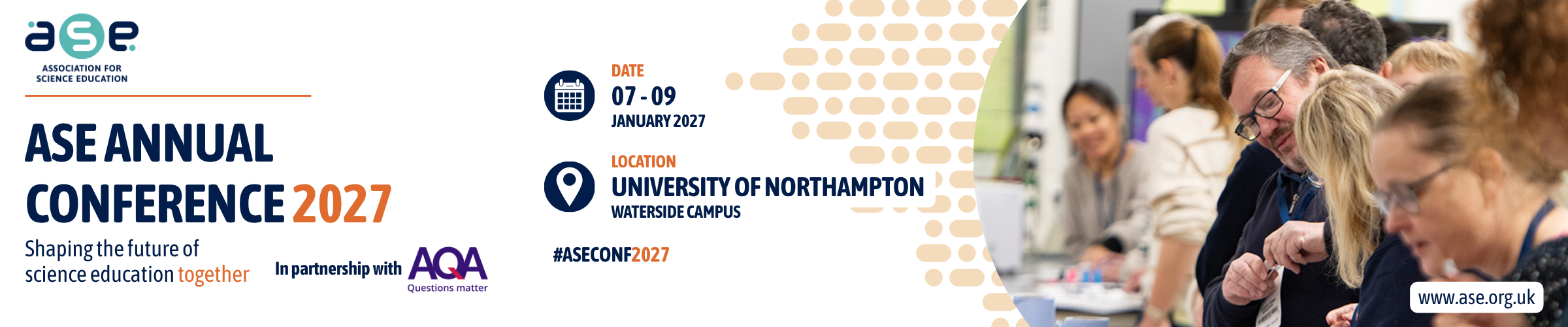
The ASE is delighted to be hosting its’ 2027 Annual Conference at the University of Northampton from 7th to 9th January.


Saturday January 9, 2027 11:15 - 12:10 GMT
This session explores how inquiry-based learning (IBL) in primary science can move beyond procedural or “pseudo” inquiry towards authentic inquiry where children genuinely hold epistemic authority within the classroom.

Drawing on an ongoing PhD study at the University of Cambridge Faculty of Education alongside practical classroom implementation using White Rose Science resources, the session will examine the relationship between teacher identity, working scientifically and pupil voice in primary science.

Recent national conversations have highlighted that while substantive knowledge is increasingly secure, disciplinary knowledge and authentic scientific inquiry remain underdeveloped. In many classrooms, children are still receiving science rather than actively doing science. This session argues that the challenge is not simply a lack of resources or curriculum structure, but a teacher identity issue.

The session will share findings from collaborative Lesson Study cycles conducted in a Year 4 classroom with a high proportion of EAL learners. The research focuses on how teachers interpret classroom moments such as silence, misconceptions, uncertainty and pupil struggle, and how those interpretations shape whether pupils are positioned as passive recipients of knowledge or active participants in scientific meaning-making.

Participants will explore the distinction between transmission teaching, pseudo-IBL and authentic IBL, considering how subtle teacher responses can either open or close epistemic space for children. Practical examples from science lessons will demonstrate how small shifts in teacher behaviour, such as allowing productive silence, redirecting questions back to pupils and encouraging peer-to-peer scientific discussion, can significantly increase student voice and disciplinary engagement while still working within existing curriculum structures.

Practical examples from a Year 4 science classroom will illustrate a clear inquiry-based lesson structure centred on recurring working scientifically skills. Lessons begin with recap activities and image stimuli that encourage children to notice, wonder and connect prior knowledge. Throughout the lesson, pupils repeatedly apply the same scientific skill in different contexts while teachers observe carefully for misconceptions, uncertainty and participation, using these observations to shape shared anchor charts and individual science journal entries. Exit passes are then used to assess developing understanding.

The session argues that this approach depends on teachers being confident in holding epistemic space for pupils, a confidence developed through collaborative Lesson Study and identity-focused professional reflection. Delegates will leave with practical, manageable strategies for collaborative planning, observation and reflection that can be implemented immediately in classrooms and schools.

Whilst this session is proposed by White Rose Education, this session is not promoting White Rose Science, and is focussing on the PhD research. This is not a funded initiative. The PhD researcher is a WRS customer and we are supporting him in his research.
Speakers
DK

Daniel Kechoud

Year 4 Teacher, Science Lead and PhD Candidate, Wolf Fields Primary School / University of Cambridge

avatar for Dan Breeze

Dan Breeze

Head of Primary Science, White Rose Education

Sponsors
avatar for White Rose Education

White Rose Education

White Rose Education is proud to sponsor the Primary Programme of the ASE 2027 Annual Conference

Created by teachers, mathematicians and scientists, White Rose Education is dedicated to helping every teacher become a world-class teacher.

White Rose Science takes the highly successful approach we pioneered with White Rose Maths and transfers it to the primary science curriculum. It uses a “small steps” approach to science teaching, and closely follows the national curriculum for science for years 1 - 6. It gives

... Read More →
Saturday January 9, 2027 11:15 - 12:10 GMT
LH013 & LH014 (Learning Hub Ground Floor)

Sign up or log in to save this to your schedule, view media, leave feedback and see who's attending!

Share Modal

Share this link via

Or copy link